


 Shkruar nga Pamfleti
US President Donald Trump appears to have won his trade showdown with Volodymyr Zelensky, as the Ukrainian president is set to back down and sign a deal that will give the US access to critical mineral deposits.
The agreement was seen as crucial to meeting Washington's demands for a peace settlement between Ukraine and Russia to end their three-year war.
Zelensky said in a speech that US and Ukrainian negotiating teams were working on a draft agreement, signaling an imminent deal.
"This is an agreement that can strengthen our relationship and the key is to work out the details to ensure its effectiveness," he said. He added that he "look forward to the outcome - a fair outcome."
This appears to be a shocking surrender from Zelensky, who just days ago reacted strongly against Trump, saying: "I cannot sell our country."
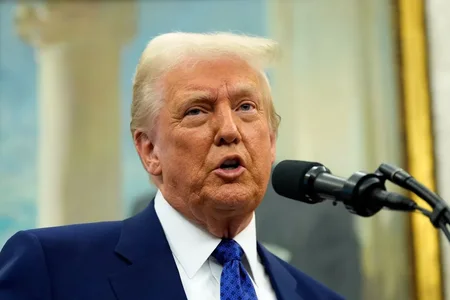
Trump told reporters in the Oval Office on Friday night that "we will sign a deal, hopefully in the next fairly short period of time."
A deal could be reached as early as Saturday, people familiar with the negotiations told the Wall Street Journal. The exact terms are not yet clear, but Trump has sought $500 billion in minerals in exchange for continued military support.
This comes after Zelensky angered Trump so much during negotiations that the president threatened to completely withdraw US funding from Ukraine, Axios reported.
On February 15, Zelensky publicly rejected the agreement, calling it "not in the interests of a sovereign Ukraine."
Zelensky became even more volatile just three days later, reacting sharply to talks he was not involved in between the US and Russia in Saudi Arabia, which led Trump to claim his approval ratings were at 4%.
The clashes reached a climax when Trump appeared on social media to call Zelensky a "dictator."
Zelensky rejected proposals for what the Trump team called an "economic partnership" and "a historic opportunity for the United States of America to co-invest with Ukraine, to invest in its economy, to invest in its natural resources."
Ukraine claims to have the largest reserves of titanium in Europe - used to produce alloys for aircraft and naval vessels - and lithium, a commodity that is gaining increasing value amid global demand for batteries - particularly in electric vehicles.
The war-torn country also has deposits of rare earths that are essential for high-tech industries, including defense and clean energy.
These minerals are particularly valuable to the US amid rising tensions with China, which controls large parts of the global supply.
Zelensky was angry with the initial proposal, claiming it was too vague, and demanded a 50% share of Ukraine's mineral deposits.
He said Trump was seeking $500 billion worth of minerals, which far exceeded America's total contribution to the war effort in Ukraine of $100 billion.
Now, the deal appears to have been reached with the help of retired Maj. Gen. Keith Kellogg, Trump's envoy to Ukraine, whom the president criticized for being too pro-Zelensky on Friday, according to Politico.
Kellogg and Zelensky met in Kyiv on Thursday, where the president said the envoy's work "restores hope."
"I have given instructions to work quickly and very logically," Zelensky said.
Kellogg played a "major role" in reaching the deal, through his praise of the Ukrainian president and spending three days with him in Kiev, according to people close to the Ukrainian government.
Trump has said the Russia-Ukraine war would never have started if he were president and claimed he could have ended the conflict abruptly - without ever revealing his plans to do so.
The president was clear that Ukraine must compensate the US for the assistance it has provided in support of the war effort so far.
Trump suggested that Kiev could begin to compensate the US for the aid it has sent over the past three years with "about $500 billion" in critical minerals.
The prospect of exploiting Ukraine's natural resources was apparently part of the Trump administration's plan from the beginning.
Zelensky said Kiev could sign an agreement with the US, the EU and other unnamed allies that would allow joint investments and the use of Ukraine's natural resources.
Ukraine has trillions of dollars worth of natural resources, including many rare earth minerals that are vital for building modern technology - although many of them are located in industrial centers in the east, currently occupied by Russia.
Mining analysts and economists say that Ukraine currently has no commercially operating rare earth mines.
Senior government sources told the Financial Times that the agreement provided few details about what this "long-term security shield" would look like.



Lini një Përgjigje