


 Shkruar nga Pamfleti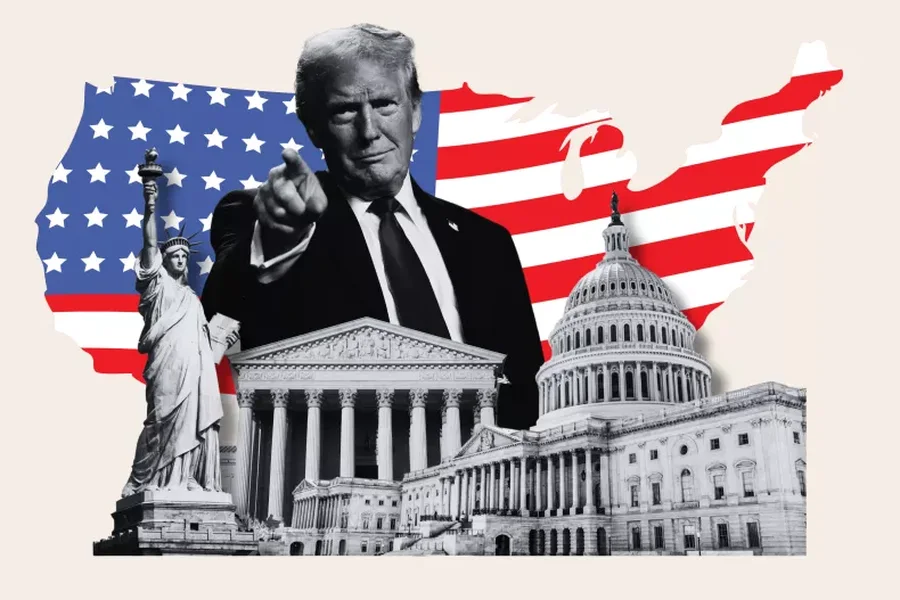
No major Canadian party or politician has come out in favor of US membership. A Leger poll conducted between December 6 and 9 found that only 13 per cent of Canadians would support such a move, while 82 per cent were actively opposed.
In recent weeks, President-elect Donald Trump has suggested that the United States expand its territorial holdings by encouraging Canada to join the Union as the 51st country, buying Greenland from Denmark and regaining control of the Panama Canal.
Speaking to Newsweek, one US expert said Trump's policies were a "throwback to the 19th century", which saw the US expand westward across North America and even invade Cuba and the Philippines.
A second academic specializing in US imperialism said Trump was seeking an "older form of power projection" that "resembles the bloody days of Teddy Roosevelt".
After his victory over Vice President Kamala Harris in November, Trump announced that he plans to impose a new 25% tariff on all goods entering the US from Canada and Mexico until both countries "stop" drug and illegal immigrant trafficking in place.
The move prompted Canadian Prime Minister Justin Trudeau to descend on Trump's Mar-a-Lago resort in Florida to discuss the issue, after which the president-elect mockingly called the Canadian leader "Governor Trudeau" on Truth Social.
When reached for comment, Trump transition spokeswoman Anna Kelly said "world leaders are gathering around the table because President Trump is already delivering on his promise to make America strong again. When he officially takes office, America will respected again and the whole world will be safer."
On December 18, Trump explicitly called for Canada to join the American Union.
In a post on Social Truth, he said: "No one can answer why we subsidize Canada to the tune of over $100,000,000 a year? It makes no sense! Many Canadians want Canada to become the 51st country. They will save massively on Tax and Defense, I think it's a great idea."
No major Canadian party or politician has come out in favor of US membership. A Leger poll conducted between December 6 and 9 found that only 13 per cent of Canadians would support such a move, while 82 per cent were actively opposed.
Trump also repeated his first-term suggestion that the US should buy Greenland, an autonomous Danish territory spanning more than 835,000 square miles with a population of just under 60,000.
In a post on Truth Social on December 22, Trump wrote: "for the purposes of National Security and Liberty throughout the world, the United States of America considers ownership and control of Greenland to be an absolute necessity."
Danish authorities have previously stated that they have no interest in selling Greenland. In 2019, Trump canceled a planned visit to the Scandinavian nation after Danish Prime Minister Mette Frederiksen called his earlier suggestion that the US should buy Greenland "absurd".
The United States seriously considered making an offer for Greenland and Iceland during the presidency of Andrew Johnson in 1867-68. In 1946, President Harry Truman offered Denmark $100 million in gold bullion for the territory. Neither attempt was successful.
On December 21, Trump also suggested that he might seek to return the Panama Canal to US sovereignty. The canal was financed and built by the US, but was handed over to Panama in 1999 pursuant to an agreement signed by President Jimmy Carter in 1978.
In a Truth Social post, Trump said: "The tariffs being charged by Panama are ridiculous, especially knowing the tremendous generosity that has been given to Panama by the US.
"If the principles, moral and legal, of this grand gesture of giving are not followed, then we will demand that the Panama Canal be returned to us in full and without question."
Speaking to Newsweek, Professor Sean Adams, an American history expert at the University of Florida, compared Trump's proposals to 19th-century American imperialism.
"The plan to buy Greenland offers a throwback to the 19th century, when many American politicians — especially Democrats — were quite aggressive about territorial expansion," Adams said.
Adams compared Trump's ambitions to those of President Andrew Jackson, who oversaw the purchase of Alaska. However, he argued that the incoming president is less concerned with expanding Republican government.
"President Trump hung a portrait of Andrew Jackson in the Oval Office and the recent turn toward territorial expansion is very reminiscent of Jacksonian attitudes toward aggressive expansion of the United States' borders," Adams said.
Throughout its history, the US has expanded significantly by acquiring territory from other countries, including the 1803 Louisiana Purchase from France, the 1819 Florida Purchase from Spain, the 1854 Gadsden Purchase from Mexico, and the 1867 purchase of Alaska from Russia.




Lini një Përgjigje