


 Shkruar nga Pamfleti
In a position of weakness, the EU has missed the train of developments. It remains dependent on the defense sector and has lost its negotiating advantage.
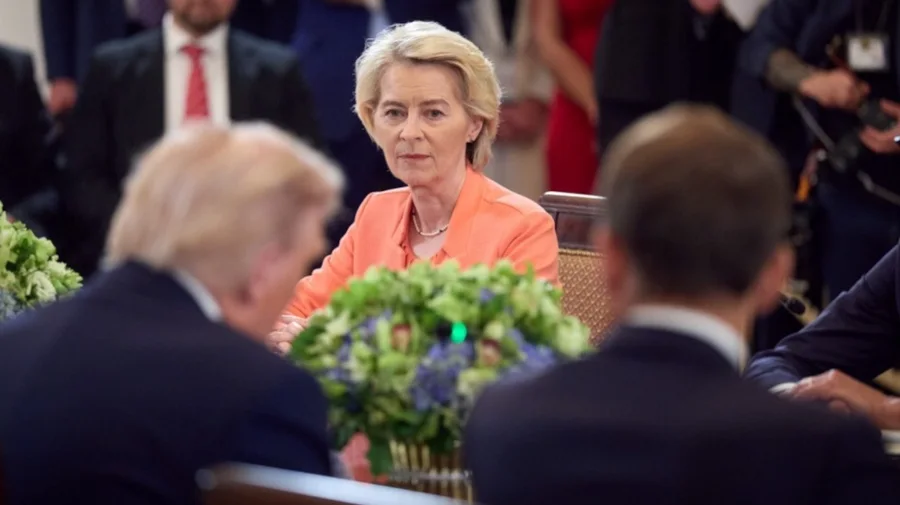
After signing a trade deal that many in Europe have described as "humiliating", the EU appears to be experiencing its own version of the "unequal conditions" imposed by colonial powers on China after the First Opium War.
As Politico reports in its analysis, Commission President Ursula von der Leyen traveled to Donald Trump's golf resort in Scotland in July to avoid a trade war.
Instead, it agreed to 15% tariffs on most European exports, a move interpreted in Europe as a clear political defeat. However, just days after the agreement was signed, Trump threatened new sanctions, this time on European regulations targeting US technology giants, warning that the US could cut off exports of critical microchips. "If the EU doesn't comply, it will pay the price," was the US president's message.
The move dashed Brussels' hopes of asserting its "sovereignty" in the digital sphere. Analysts liken the situation to the 19th century, when China was forced to open its ports under threat from British warships.
Back then, Beijing paid for its technological inertia and refusal to modernize. Today, Europe is paying for its dependence on the US for defense and technology.
As Sabine Weygand, head of the European Commission’s Directorate-General for Trade, put it, “we are paying the price for ignoring the alarm clock of the first Trump administration and going back to sleep.” Trade Commissioner Maroš Šefković acknowledged that the deal reflected Europe’s strategic weakness: “It’s not just about trade; it’s about security, about Ukraine, about geopolitical instability.”
"The Turnberry System"
US Trade Representative Jamie Greer has called the agreement the "Turnberry system", drawing parallels to the 1944 Bretton Woods conference that shaped the post-war economic order.
In practice, however, it is a four-page document, full of ambiguities that leave Trump room to escalate his demands from quotas on steel and aluminum to the $600 billion in investments that Brussels has pledged "in principle" to bring to the US.
"If they don't, then they'll pay 35% tariffs," Trump said bluntly.
Europe's weakness
The picture that emerges is that the EU was unable to negotiate from a position of strength. “The agreement is a direct result of Europe’s weakness in the security sector,” said analyst Torsten Benner, noting that for decades member states had shied away from investing in defense and technological innovation.
The head of the Commission's Trade Directorate, Sabine Weyland, admitted that the EU "went back to sleep" after Trump's first term, ignoring warning signs.
But beyond the immediate trade implications, the bigger issue is strategic: Europe remains dependent on the American military umbrella and technological superiority.
Mario Draghi warned that if the EU does not invest in defense, technology, energy self-sufficiency and the common market, it "risks losing geopolitical relevance."


Lini një Përgjigje