


 Shkruar nga Pamfleti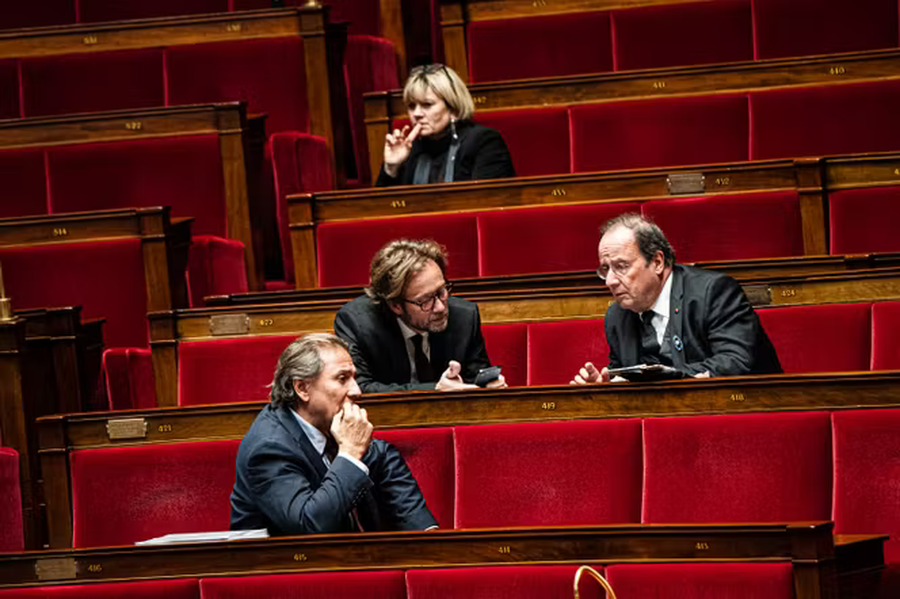
Former French president tests ground amid divisions on the left and skepticism within the Socialist Party
François Hollande is facing a difficult path if he decides to run in the 2027 presidential election. A statement made by the First Secretary of the Socialist Party (PS), Olivier Faure, on January 24 in Tours, brought the former president's name back to the center of the debate.
Faure, accompanied by the leader of the Ecologists Marine Tondelier and former representatives of “La France Insoumise” such as Clémentine Autain, Alexis Corbière and François Ruffin, was announcing the date of the left-wing primaries. He declared that, if everyone agreed on François Hollande, then he could be the candidate. The reaction of those present immediately showed reservations and hesitation.
According to an analysis published by Le Monde, this scene reflects the ambivalence surrounding Hollande's figure. Part of the left accuses him of weakening the progressive camp during his presidential term. However, his return to the National Assembly in 2024 as a deputy for Corrèze has changed public perception.
The possibility of his candidacy, previously considered unlikely, is gaining ground as the left remains divided between an uncertain primary and doubts about other figures such as MEP Raphaël Glucksmann.
Some of Olivier Faure's associates are using the possibility of Hollande's return as a means of pressure in internal debates, while former First Secretary of the PS, Jean-Christophe Cambadélis, keeps the idea of his candidacy open.
Even in President Emmanuel Macron's camp, some left-wing figures do not rule out backing Hollande in the first round if no centrist candidate manages to consolidate. They see him as a possible "republican arch" candidate to thwart the far right.
Hollande himself says that any personal initiative must come after a collective movement. According to his circle, he has begun working on programmatic elements and is expected to release a series of thematic podcasts on issues such as housing, violence against children and social isolation.
In parallel, he holds informal meetings with social democratic figures, including Raphaël Glucksmann, Boris Vallaud and Bernard Cazeneuve.
Ecologist Yannick Jadot has also been involved in these discussions.
This group shares the belief that a limited left-wing primary is unlikely to succeed and aims to build an alternative that also attracts the center-right electorate.
According to Le Monde, it is expected that after the local elections a joint initiative will be undertaken to structure this "political arc".
However, obstacles remain numerous. Strained relations with the Greens, especially after the death of activist Rémi Fraisse in 2014 during clashes with the police, continue to weigh. François Ruffin has stated that a Hollande victory does not correspond to the aspirations of the left-wing electorate.
Within the PS itself, the situation is equally complicated. Current leaders such as Boris Vallaud and Olivier Faure have worked to rebuild the party after poor results in the 2017 and 2022 presidential elections. A return of Hollande could be seen as a setback to this process. According to inside sources cited by Le Monde, some consider him incapable of winning an internal vote.
Hollande has intensified contacts with former colleagues and new party figures. He was elected as an MP under the banner of the New Popular Front and supported no-confidence motions presented by the socialist group, including the vote that brought down Michel Barnier's government in December 2024.
At present, few analysts believe in a full political comeback. Hollande himself knows that he can only emerge as a “circumstantial candidate” if the primaries fail and if other alternatives lose support. For now, he continues to strengthen his presence in the debate and maintain political space, while the French left remains in search of a unifying figure. /Adapted from Le Monde /


Lini një Përgjigje