


 Shkruar nga Kim Ghattas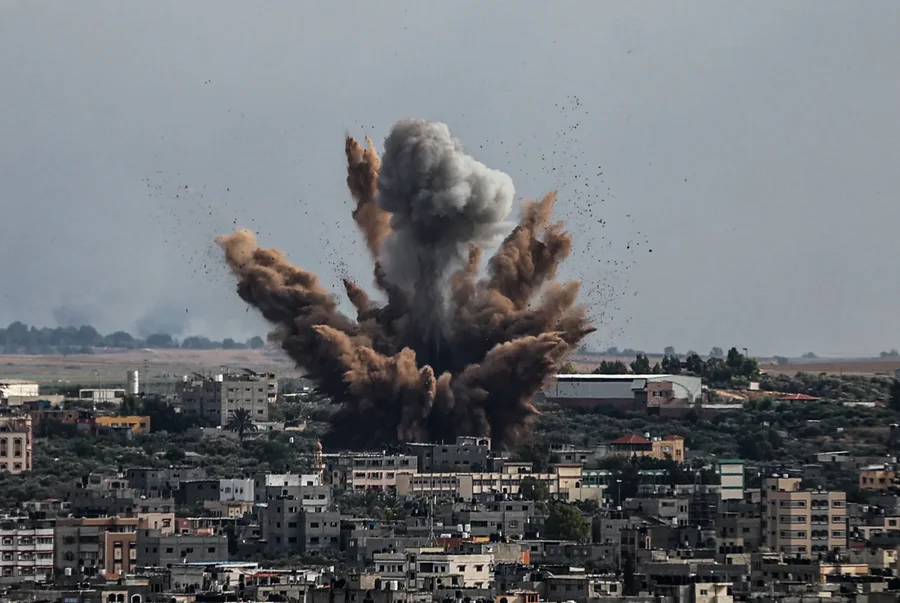
People were beginning to realize that focusing only on this issue, at the expense of everything else, was leaving the entire region behind.
News on the Middle East is currently dominated by all things Palestinians and Israelis. From Israeli Prime Minister Benjamin Netanyahu's controversial speech to the US Congress, to the decision of the International Court of Justice, that the continued occupation of the Palestinian territories by Israel constitutes an open violation of international law, this is almost the only topic discussed (with some casual interest in a potential Saudi-American defense pact as well).
In principle, it is only right that the devastating 9-month war in Gaza, which followed the horrific attack by Hamas on October 7, 2023, should receive so much attention. But it is also a useful cover for authoritarian leaders across the Middle East, who are using this period to further weaken freedoms and human rights in the Arab world.
In May of this year, Kuwait's ruler dissolved his country's opposition-dominated parliament for four years, a rare occurrence in the Middle East. The news caused quite a stir in the media. That same month, Tunisian police attacked and arrested lawyers and raided the offices of the bar association, part of a continuing crackdown on dissent.
This event also received little international attention. Meanwhile this month, the United Arab Emirates held a major trial of some 80 dissidents and political activists, handing down 43 life sentences for suspected terrorist offences. Most of the details of this process were kept secret by the authorities.
Meanwhile in Saudi Arabia, Abdulaziz Almuzaini, a well-known director of animated films, who has a 5-year cooperation contract with the well-known platform Netflix, revealed that he was sentenced to 13 years in prison, although he is still free at home.
It seems that one of his animations was misinterpreted as support for the Islamic State, so he was accused of supporting extremist ideology. Meanwhile this week, Egypt arrested cartoonist Ashraf Omar, who had criticized the country's ongoing power outages.
He was blindfolded and taken from the house in the early hours of the morning. The list is very long, and I haven't even mentioned Syria and Sudan here yet. You might say this is just another day in the Middle East. Or that the internal politics and repression in the entire region have nothing to do with Gaza or the Palestinian issue.
And yet, they have everything to do with it. For decades, Arab regimes suppressed dissent, suspended reforms, indoctrinated children and expanded their defense budgets at the expense of social progress. And for all this, they said they did it in the name of Palestine.
The most popular Arabic word for shuffling ranks in wartime translates roughly as follows: No sound should be heard above that of battle! And the battle is against Israel. First popularized by Egypt's leader Gamal Abdel Nasser, this slogan was used to silence critics following his defeat in the 1967 6-Day War against Israel.
Decades later, the Arab uprisings of 2011 bucked this trend. Millions of people took to the streets demanding freedom, justice and better living standards. That move was not a denial of the importance of the Palestinian cause to the Arabs.
People were beginning to realize that focusing only on this issue, at the expense of everything else, was leaving the entire region behind. The counter-revolution dashed all hopes of protesters from Egypt to Syria. Now, the war in Gaza has turned the spotlight back on Palestine, a sharp wound and a highly emotive issue, affecting people from Cairo to New York to Kuala Lumpur.
An issue that is still a cause of conflict between Arab governments and their citizens. Public expressions of support for Gaza are banned in the Gulf countries as rulers struggle to balance the need for regime stability with the need to strengthen their ties with Israel.
Jordan has been trying to curb pro-Palestinian protests that are filled with anger and threaten to turn anti-government. The President of Egypt only allowed the pro-Gaza protests for a while, and then stopped them when he heard some crowds chanting: "Bread, Freedom, Social Justice!".
The blow to solidarity with the people of Palestine has of course spread within Israel itself, where the government has targeted both Israeli Jews and Palestinian citizens of Israel. This conflict is also being used in one of the worst cases of a sickening tactic.
According to her, a person responds to an argument or attack by changing the subject to focus on someone else's bad behavior, implying that all criticism is invalid because no one is actually completely innocent.
Some argue that it is unacceptable to discuss Syrian President Bashar Al-Assad's ongoing war against his own people because of his traditional anti-Israel stance: "Have you seen what Israel is doing?"
Others argue the opposite: “Is Israel killing Palestinians? But what can we say about the hundreds of thousands killed by Bashar?" The systemic problems in the Middle East will not be magically resolved if and when a Palestinian state is created.
But there will also be no lasting progress in the region without addressing and ending the longest occupation in modern times. Injustice and impunity feed on each other in an endless ring that stretches from Damascus to Gaza, and from Beirut to Ramallah. / Adapted "Pamphlet" from "Financial Times"







Lini një Përgjigje