


 Shkruar nga Gavin Mortimer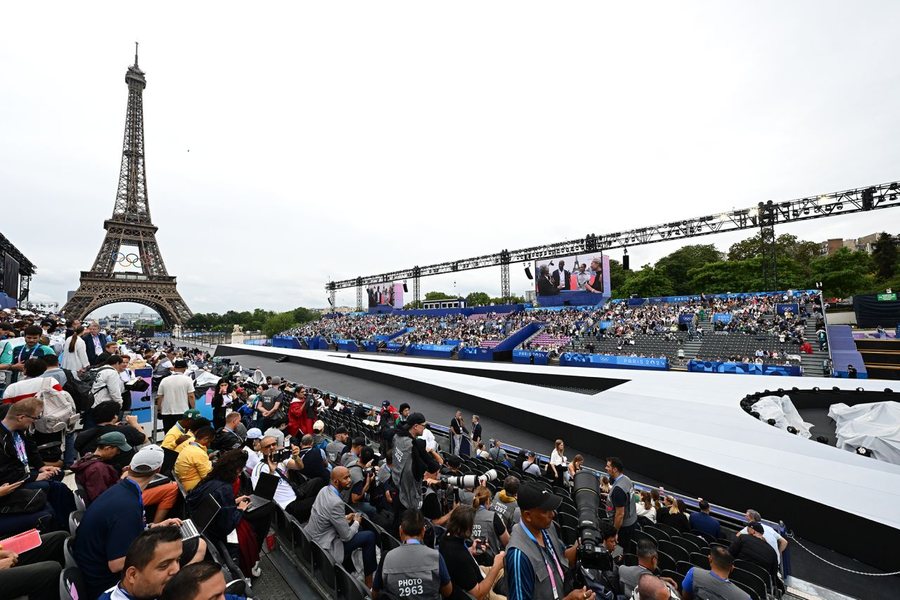
Macron wanted people around the world to see France at its best. Meanwhile, instead of this image, they will see a country plunged into chaos.
The Paris Olympics couldn't have started any worse than that. Hundreds of thousands of passengers were left stranded after high-speed rail lines were hit by a series of suspicious fires.
The railway company SNCF says that it is a "massive attack, aimed at paralyzing the network". The security services declared on Friday that the extreme left may be behind these attacks. But whoever is to blame, one thing is clear: French President Emmanuel Macron is furious with anger.
Because the eyes of the world are on Paris, as the opening ceremony of the games took place yesterday evening. Macron wanted people around the world to see France at its best. Meanwhile, instead of this image, they will see a country plunged into chaos.
Thomas Jolly was responsible for the opening ceremony of the Paris Olympics.
His very name promised an amazing show that would surprise and excite many. He stated in advance that the ceremony would be a "celebration of cultural, linguistic, religious and sexual diversity in France".
One cannot but argue that France is a diverse society, but is there much to celebrate? Once upon a time. The last major global event hosted by France was the 1998 FIFA World Cup, where for the first time in their history, it was the French who ultimately won the tournament.
The triumphants were a very diverse team. They were called "black-blanc-beur" (beur is a slang term for someone born in France of North African descent, such as Zinedine Zidane, star of the 1998 triumph). More than 1 million French people took part in huge celebrations on the Champs-Elysées after beating Brazil 3-0 in the final.
It was the highest level of what the French commonly call vivre-ensemble, or "living together"; a favorite phrase of politicians at the time, but rarely heard today.
In fact, this slogan began to fade a decade ago.
In June 2016, France hosted the European football championship, and to inspire a parallel with this event, sports sociologist William Gasparini reflected on the great victory of 1998. According to him, it was a time when the West was brimming with confidence. in himself and convinced of the "end of history", as he had been told.
" Unemployment was falling, the economy was moving at a very good pace and France was winning, " explained Gasparini. The euphoria evaporated at the start of the new millennium. Gasparini cited the September 11, 2001, terrorist attack on the US as an important factor in the fading of the "vivre-ensemble" vision, as some French people began to view their fellow Muslims with suspicion.
In his 2004 book, The Battle for Muslim Minds, France's leading expert on Islamism, Gilles Kepel, compares Great Britain's hospitality in granting asylum to figures from the Islamic world, with the very different behavior of France.
" What French officials fear so much is that the social suffering felt by Muslims on the outskirts of big cities...will manifest itself in a fiery form as religious extremism, eventually leading to acts of violence and terrorism ," he writes. among others Kepel.
This fear was confirmed, not because France began to grant asylum to radical believers, but because of the emergence of the Internet. Kepel emphasizes the emergence of YouTube on the scene in 2005 as a fundamental moment in the re-Islamization of some young European Muslims.
Extremists used this platform to convert many people to their stream, as well as to propagate their ideas. And the results have been dramatic. An extensive survey conducted in 2020 reported that three-quarters of French Muslims under the age of 25 preferred Islamic law (Sharia) to the law of the French Republic.
Meanwhile, for Muslims over 35, this figure dropped to a quarter. Asked in 2016 if France could ever return to the "living together" approach that dominated in 1998, Gasparini replied: " I don't think we can go back to that fantastic time... Today we live in a France that suspects many things ".
A month later, a radical Islamist crushed to death with a 19-ton truck 86 people in the city of Nice who had gathered on the main boulevard to celebrate Bastille Day, the main national holiday. It was the last of the large-scale massacres to take place in France.
But since then there have been many other attacks by Islamic radicals, including the killing of two teachers. Far from being a country of "vivre-ensemble", France has become a nation where its citizens live "face to face". These are the words used by the former Foreign Minister, Gérard Collomb, when he resigned in 2018.
The very strong statement was intended as a warning to French President Emmanuel Macron. However, it went unnoticed. What is worse, through his indifference and incompetence, President Macron has caused anger among another segment of the population, which is affected by a "social evil" similar to that experienced by many French Muslims in suburbs of cities.
These are the 'proletarians' in the provinces, or as the media called the Yellow Vests, who showed their discontent in the streets with the big protests of 2018, and then at the ballot box last month. In this year's European Parliament elections, Marine Le Pen's National Rally won 93 percent of the country's municipalities, and 96 out of 101 departments.
Only the biggest cities resisted. The radical left of La France Insoumise (LFI) did very well, campaigning solely on the plight of the Palestinians in Gaza. This approach was aimed at getting the votes of progressives but also of Muslims, 62 percent of whom voted for LFI in the European elections.
The National Rally also dominated the first round of voting in the parliamentary elections, and would have won the majority of seats in the parliament in the second round, but had not a "sanitary cordon" been hastily created between the centrists of President Macron and the bourgeois left .
According to the historian of French institutions, Philippe Fabry, this cordon sanitaire is no longer "ideological, but sociological", a revival of the class contempt that characterized the last years
of the reign of King Louis XVI: "The nobility of the Republic is refusing to allow people to interfere in social life and in the corridors of power".
This is how he described Macron's strategy during an interview given to "Le Figaro" this week. But nothing perhaps shows the collapse of France's multi-cultural myth more than two editorials published during the last parliamentary elections.
One was signed by 80 prominent Muslims, and called on people not to vote for National Rally because of the party's overt "racism" against minorities and immigrants. While the other editorial was supported by 100 prominent people, most of them from the Jewish community of France.
He called on people not to vote for the left-wing New People's Front, because according to them this party is a "threat" to the Jews. This is the bitter reality of today's France: that of a country with deep and dangerous divisions. Of course, he did not appear at the opening ceremony of the Olympic Games. /Adapted "Pamphlet" from "The Spectator"



Lini një Përgjigje