


 Shkruar nga Pamfleti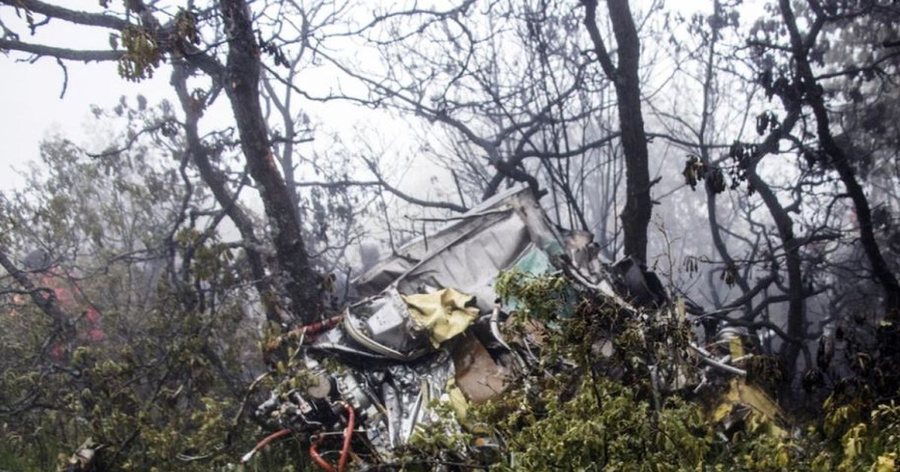
The investigation into the death of Iranian President Ebrahim Raishi in a helicopter crash on Sunday is taking a new turn.
According to data cited by military and aviation analysts, the helicopter in which 63-year-old Raisi died after a mechanical failure (according to the first data reported by the Iranian news agency IRNA) was not a 1960s model, but a 1994 Bell 212 nine-seat, United States plant.
As reported by The Stratcom Bureau of Pakistan, the helicopter had the identification number 6-9207 and the manufacturer's serial number 35071. The twin-engine helicopter belonged to the IRIAF (Islamic Republic of Iran Air Force) and was recently transferred to transfer service. VIP. This, of course, raises more questions to add to those wondering why Iran's president, foreign minister and other officials were traveling – in very bad weather and over dangerous terrain – in such an old helicopter.
Given that the United States and Western countries in general imposed heavy sanctions, including banning the sale of aircraft, after the revolution and overthrow of the Shah in 1979, it is surprising how a 1994 helicopter was found in Iran Air Force. According to unconfirmed information from the aviation market, Iran has 10 Bell 212 and 412 helicopters (of which three are of the latest version) produced in the mid-to-late 1990s and purchased by circumventing sanctions. There are two scenarios for the fatal helicopter. The first is that it belonged to Saudi Arabia's state oil company Saudi Aramco, which, as part of its fleet renewal, sold it to an American aircraft dealer in 2011, who in turn sold it through a third party in Iran. The second seeks the fleet of 10 helicopters purchased in the 90s, always bypassing sanctions through third parties and companies, directly from Iran.
This particular helicopter was said to be equipped with a nose-mounted weather radar, a full IFR night package (meaning it wasn't just flying what the pilots could see), and bad weather avionics. It was a twin engine, as the "descendant" of the legendary "Huey" that was widely used by the Americans in the Vietnam War and continues to fly today in various air forces around the world. Of course, the question is whether and how efficiently all these systems worked? This is because, on the one hand, Bell Textron has stopped the maintenance cycle of the helicopter (that is, it does not do maintenance, since it considers that they have completed the service cycle), while on the other hand, it is very difficult to impossible for the Iranians to find spare parts, because of sanctions.
Most likely – something that would also explain the question of why officials were flying a 30-year-old helicopter – is that even in this helicopter, the Iranians are following the "recipe" they apply to the rest of their American aircraft: cannibalization. (ie exporting spare parts from some non-working helicopters and becoming "donors" for working ones). However, Iran has mostly US aircraft from the 60s and 70s.
The Shah of Iran, Mohammad Reza Pahlavi was a fan of flying and wanted to turn his country's air force into one of the strongest in the world. He succeeded in part by creating the strongest air force in the Middle East, with massive orders of mostly American aircraft (among them the legendary F-14 Tomcat, which the Americans withdrew from active service and destroyed all parts so that parts of exchange from reaching the Iranians) and helicopters, all produced until the late 1970s.
Since 1979 when the Iranian Revolution overthrew the Shah and he went into exile, the Americans have expressly prohibited any spare parts or technology/know-how from reaching Iran. It is characteristic that in the specific case of the downing of the helicopter, the Iranian government asked the American government to provide assistance, according to a representative of the White House, which the Americans refused "mainly for logistical reasons."







Lini një Përgjigje