


 Shkruar nga Pamfleti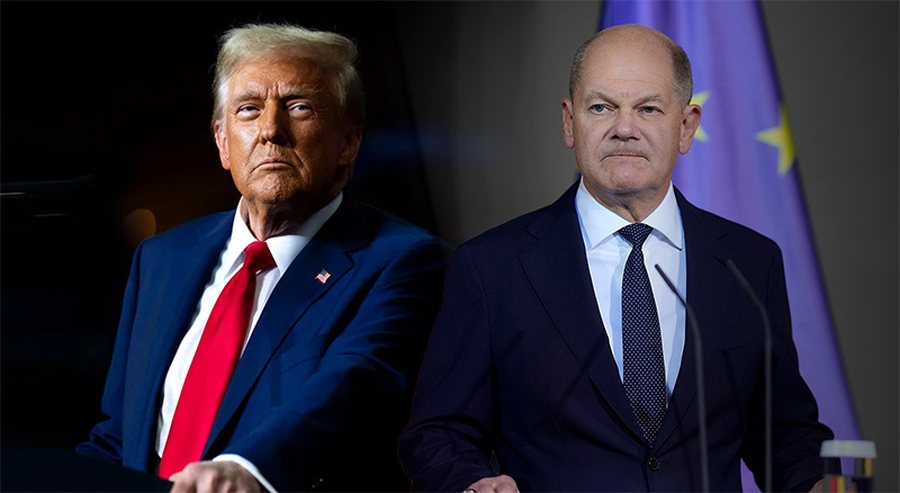
The German crisis comes at a time when France, its main partner in European leadership, is hampered by its own political turmoil.
Wednesday November 6 was a seismic day in western politics. On one side of the Atlantic, it was confirmed in the early hours of the morning that right-wing nationalist Donald Trump had been elected president of the USA; on the other hand, the government running Europe's largest economy – the German coalition of social democrats, market liberals and greens – collapsed.
The collapse of the Berlin alliance will leave a political vacuum in Germany for months, just when the EU needs decisive leadership. Instead, the country faces months of electoral reckoning, followed by protracted coalition negotiations, with investment and public spending on hold.
Germany is now in its second year of recession. Its economic model is broken due to the end of cheap Russian gas and declining exports to China, which is increasingly an industrial competitor. Its powerful auto industry is shedding jobs and closing factories as orders fall. The government even revived border controls inside Europe's Schengen area in a panic reaction after a migrant stabbed three people to death.
Populist, Eurosceptic, anti-immigration parties on the far right and left – against support for Ukraine – are gaining ground, making it increasingly difficult to form stable national and regional governments. Among them, the far-right Alternative for Deutschland (AfD) and a new insurgent left movement led by ex-communist Sahra Wagenknecht (BSW) are polling with around 25% of the national vote. Germany is succumbing to the “Dutch disease” – the collapse of major parties and the fragmentation of the political spectrum that is weakening many European democracies.
Sociologically, there are echoes of what fueled Trump's comeback. Working-class voters, particularly young whites, are emerging as extremists because of falling living standards, stagnant wages, insecure jobs and resentment against refugees.
The coalition fell apart allegedly over economic policy. Finance Minister Christian Lindner, leader of the liberal, pro-business Free Democrats (FDP), rejected calls from the Social Democrats (SPD) and the Greens to loosen Germany's rigid constitutional "debt curb" and allow more spending on support for Ukraine and the revival of the economy. Lindner called for tax cuts and sharp reductions in welfare spending (even though public debt is lower than in any other G7 economy). This prompted SPD Chancellor Olaf Scholz to fire him rather than wait for the FDP to leave.
In reality, Lindner wanted out because his party is struggling for survival, falling well below the 5% threshold needed to hold seats in the Bundestag and has fallen out of many regional parliaments.
Scholz is now limping along with a minority Green SPD government and plans to seek a confidence vote on January 15, which he is certain to lose - setting the stage for snap elections in March. The opposition Christian Democrats (CDU/CSU) are demanding that he call an immediate confidence vote to bring the election forward, but they do not have enough votes to elect an alternative chancellor.
The German crisis comes at a time when France, its main partner in European leadership, is hampered by its own political turmoil. President Emmanuel Macron is increasingly a "lame duck" after the dissolution of parliament in June left him co-existing with a centre-right minority government whose survival is at the mercy of the far-right National Rally of Marine Le Pen.
This is all bad news for anyone expecting decisive European leadership after Trump takes office next year, and a windfall for opponents of closer European integration, led by illiberal Hungarian Prime Minister Viktor Orbán.
Opinion polls taken before the collapse of the coalition put Friedrich Merz's CDU/CSU at around 33%, with the far-right AfD in second place at around 18%, the SPD at 15%, the Greens at 10% , BSW with 8% and FDP between 3 and 4%. Since no major party is willing to consider a coalition with the AfD, the only credible governing combination would be a "Grand Coalition" of CDU/CSU and SPD for the fourth time since 2005, but even that alliance can barely have a parliamentary majority and need a third partner. Even if the FDP manages to overcome the 5% barrier, the CDU/CSU and the FDP would not have enough seats to form a centre-right coalition.
Merz strongly supports increased military assistance to Ukraine and has criticized the "traffic light" government for holding back supplies of Leopard 2 tanks and more recently Taurus long-range missiles. However, it is not clear that he would be willing to suspend the debt curb and increase government borrowing to pay more aid to Kiev, or to invest more in Germany's crumbling public infrastructure or in the transition of green. He has also drawn conservatives to the right on issues such as migration and energy policy since the days of centrist Chancellor Angela Merkel.
The collapse of the traffic light coalition is a disappointment to those who believed a progressive alliance was possible between pro-market forces, supporters of a bold green energy transition and social justice advocates. The external shocks of the Covid-19 pandemic, the Russian invasion of Ukraine, and a drop in Chinese demand for German imports helped derail the German dream.
But German fiscal fetishism also played a central role in dooming Scholz's government to failure. The center left went on for too long with the Conservatives and the FDP clinging to the cult of balanced budgets and debt containment. As a result, public borrowing remained taboo and investment in the country's crumbling infrastructure has been woefully inadequate.
It is not clear whether a new conservative-led coalition would be willing or able to break out of this stifling fiscal austerity.
If not, the German economy will die in good health and Europe will go down with it./ The Guardian


Lini një Përgjigje