


 Shkruar nga Pamfleti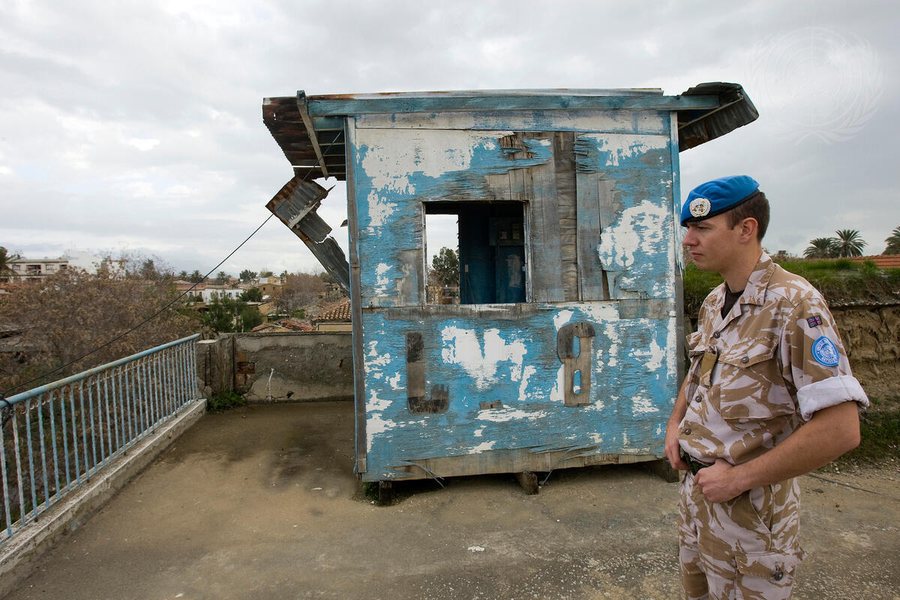
From federal dream to two-state wall: Erdogan closes the era of Cyprus negotiations
When Recep Tayyip Erdogan declares that the “most realistic solution” for Cyprus is the two-state model, he is not just repeating Ankara’s political line.
He is closing, at least on the diplomatic front, a chapter opened since the 1960s, initially with the idea of a common republic and then with the concept of a federation under the supervision of the United Nations.
Alongside the new Turkish Cypriot president, Tufan Erhurman, Erdogan emphasizes that negotiation efforts from 1968 to the present have not produced results, adding that there is no longer any point in sitting at the table “just to maintain the facade.” The message to the international community is clear: Turkey no longer sees reunification as feasible, but seeks recognition of two separate political structures.
A conflict frozen for half a century
To understand the power of this position, one must go back to 1974: the coup d’état supported by Greek elements aiming at the annexation of the island by Athens; the Turkish military intervention; the de facto division of the territory. Since 1963, the joint Greek-Turkish Cypriot administration had collapsed, and sporadic violence had deepened the divisions between the two communities.
In 1983, Turkish Cypriots declared the Turkish Republic of Northern Cyprus, recognized only by Turkey. Meanwhile, the rest of the world continues to consider only the Republic of Cyprus, now a member of the EU, legitimate. The green line, under UN control, has become a symbol of a frozen but never resolved conflict.
End of the federal model?
For decades, the UN has pushed the idea of a federal Cyprus with two politically equal communities within a single state. The key point was the Annan Plan – a republic with two autonomous entities, a single international personality and a common government.
The result of the 2004 referendum was decisive:
-Turkish Cypriots approved it,
-the Greek Cypriots overthrew him.
However, a few weeks later, the European Union accepted Cyprus as a member state, formally including the North, although without real control over it. This was read by Ankara and the Turkish Cypriots as proof that the Greek side could block any compromise, retaining EU support without paying political costs.
Sovereignty, equality and the fear of the minority
Erdogan is reprising this narrative today: he accuses Nicosia of rejecting the sovereign equality of Turkish Cypriots and treating them as a second-class minority within a state dominated by Greek Cypriots.
Erhurman goes further, describing the “Turkish Cypriot people” as one of the two founders of the state, with sovereign rights across the entire island, not just the north. This approach overturns the international narrative, which sees the North as a secessionist region that needs to be reintegrated.
At the core of the conflict lies mutual fear:
-Greek Cypriots see full equality as a loss of majority privileges,
-Turkish Cypriots see the lack of equality as surrender in the face of a state they consider hostile.
Gas, sea and a new map of power
The Cyprus issue is no longer just ethnic or historical. Gas discoveries in the waters around the island and conflicts over maritime borders have turned the Eastern Mediterranean into a zone of rivalry between Turkey, Greece, Cyprus, Israel, Egypt, and behind the scenes the EU and the US.
For Turkey, the two-state model legitimizes a new sphere of influence in the north of the island and in the surrounding seas. For Nicosia, the federal model maintains formal control over the entire exclusive economic zone and gives it the advantage of negotiating from a position of strength.
As long as neither side agrees to give up these strategic advantages, international diplomacy remains paralyzed.
A conflict that determines the future of the region
Erdogan's latest statements come at a time of heightened tension in the Eastern Mediterranean: new bases, military alliances, naval and air exercises. Cyprus is thus becoming an arena where European, Turkish, Arab and Atlantic interests meet.
The debate over the federal or two-state model is no longer simply a constitutional issue: it is the question of who will sit at the table for gas, maritime and security agreements, in an area stretching from Suez to the Balkans. /Adapted from “Pamphlet” by “Inside Over”






Lini një Përgjigje