


 Shkruar nga Pamfleti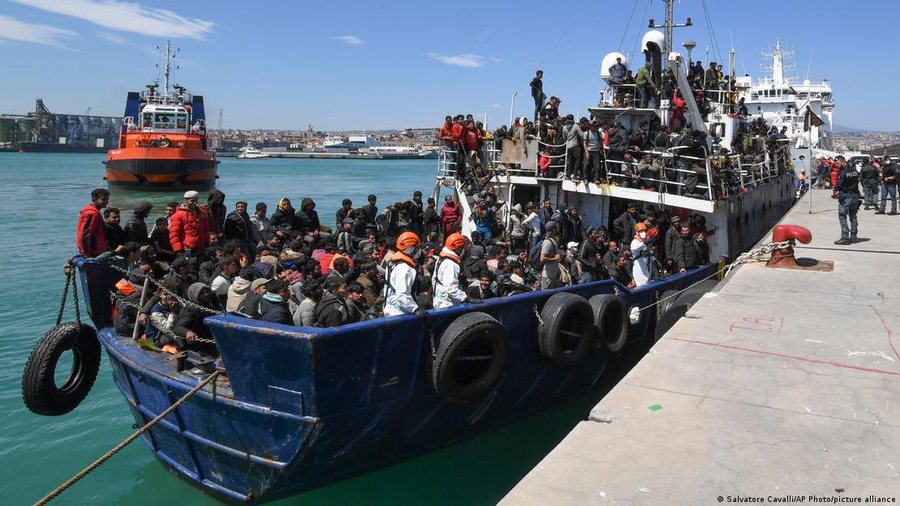
The European Union's interior ministers will discuss the key points of the common asylum policy in Luxembourg on Thursday.
They want to agree new accelerated procedures at Europe's external borders and a fairer distribution of refugees among member states.
EU Home Affairs Commissioner Ylva Johansson was optimistic that a "breakthrough" could be made after years of disagreement. Even the German Minister of the Interior, Nancy Faeser (SPD), has signaled the approval of the planned border procedures. But within Germany there is harsh criticism from the ranks of the two coalition parties, the Greens and the SPD, as well as from non-governmental organizations and scientists. They call on the German government not to agree to the EU proposal.
The Dublin system remains in force
The Migration Council, an organization mostly made up of academics, said in Berlin on Wednesday that no reform would be better than one that would increase problems in the EU's asylum policy. The president of the council, Vassilis Tsianos, called on the Federal Minister of the Interior, Nancy Faeser (SPD), to vote against the reform plans in Luxembourg. Tsianos said the plans do not lead to a common asylum system, but deepen Europe's division on asylum and migration policy. The Council criticized the fact that the new plans do not reform the Dublin system, which puts member states under great pressure at the EU's external borders. According to the Dublin system, the country on whose soil the refugee first set foot is responsible for refugees.
Border procedures are not real asylum procedures, but only a "preliminary check based on approximate criteria". Reasons for flight and need for protection cannot be properly documented. This leads to detention near the border, said Bernd Kasparek of the Berlin Institute for Empirical Research on Migration and Integration. The planned EU reform aims to "systematically undermine asylum seekers' access to asylum law", criticized Marei Pelzer, a specialist in asylum and migration law from the organization Pro Asyl. Refugees at the border will not have legal representation, this means that there will not be a fair asylum procedure.
The representative of the Evangelical Church Council in Germany (EKD), Bishop Christian Stäblein, called on EU interior ministers on Wednesday to show "courage for a humane policy with refugees". Stäblein called for the reform to improve refugee protection and the effectiveness of the asylum system. "I categorically reject mandatory border procedures and the relocation of refugee protection to countries outside the EU by expanding the list of safe third countries," the bishop of the Evangelical Church Berlin-Brandenburg-Schlesische Oberlausitz (EKBO) told the German news agency, epd.
Criticism also from the ranks of the coalition parties
But criticism also comes from the parties of the governing coalition: Many politicians of the Green party find it difficult to accept that people seeking protection can be kept in facilities at the external borders of the EU for weeks, while the demands of are being reviewed. In their election manifesto, the Greens clearly rejected this in 2021. Around 730 members of the Green party are behind a letter to leading politicians in their party criticizing the course of "scare and isolation". 22 out of 206 SPD caucus MPs in the Bundestag also signed a statement clearly opposing the reform. It says: "We view the comprehensive introduction of border procedures as critical, as they promote conditions close to imprisonment."
German government pro-plans
Germany supports the EU Commission's plans, which include fast procedures for processing asylum requests at the EU's external borders and easier deportations to third countries. But the federal government is pushing for binding agreements on the distribution of refugees or at least compensation payments from countries that do not want to accept asylum seekers. Also, the Greens want families to be excluded from this accelerated procedure. Marei Pelzer, from Pro Asyl, is skeptical that Germany will succeed with this request.
Germany supports the EU Commission's plans, which include fast procedures for processing asylum claims at the EU's external borders and easier deportations to third countries. Chancellor Olaf Scholz and Minister of the Interior, Nancy Faeser Photo: Ben Kriemann/dpa/picture alliance
Chancellor Olaf Scholz had said on Tuesday, June 6, in Berlin, that Germany has already made the decision. Since the huge movement of refugees in 2015 and 2016, there has been constant wrangling in the EU over whether those seeking protection should be spread across all member states. This is also foreseen in the current proposal of the EU Commission.
SPD Interior Minister Nancy Faeser, for her part, has been calling a "historic moment" for the EU's refugee policy for several weeks. At least since the influx of millions of refugees from 2015, the EU's common asylum policy has been considered a failure – despite numerous attempts at reform.
If 15 of the 27 EU member states vote in favor of the reform in Luxembourg and if together they represent at least 65 percent of the total EU population, then negotiations with the EU Parliament can begin./dw







Lini një Përgjigje