


 Shkruar nga Pamfleti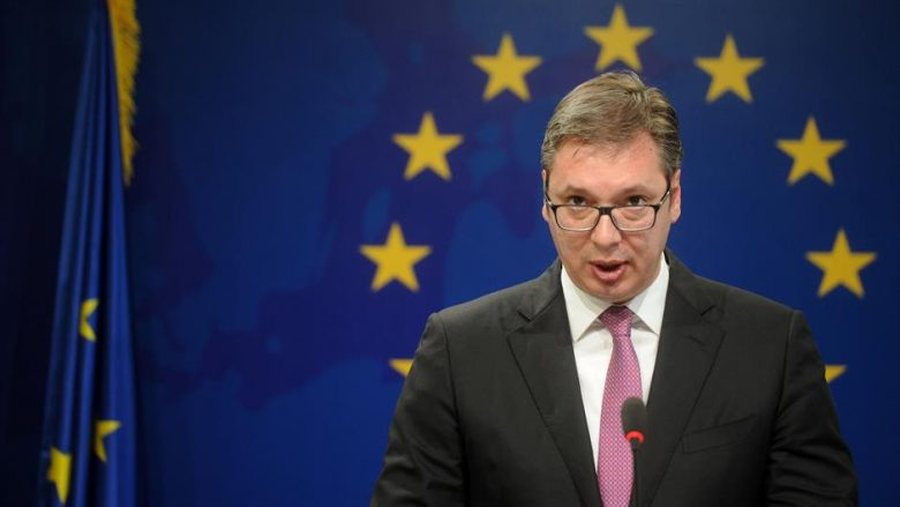
The EU does not observe from the point of view of emotions, ie. whether someone "likes" or "dislikes" the government, in this case the president of Serbia, only cares if the institutions work, if there is rule of law, if it is possible for citizens to be informed objectively about what is happening and if the authorities respect the human rights standards to which Serbia is committed.
The European Union has reacted after fraud and irregularities in the December 2023 elections in Serbia. It was clearly defined against the regime of Aleksandar Vucic, "throwing out" numerous reports that supported the claims of the opposition and civil society about the undemocratic nature of the government.
Also, finally, in more detail, she referred to the terrorist attack in Banjska in the north of Kosovo, condemned the attacks on journalists, the inconsistency of the foreign policy with the European one, in the context of the refusal to open new chapters in the membership process.
However, at the time when the biggest rebellion against the regime started, and after the collapse of the tent in Novi Sad, the death of 15 people and the refusal of the authorities to take responsibility in the right way, according to the criteria of a large part of the public and when more than 50 faculties are blocked, when the opposition blocks the institutions almost every day, the dominant narrative in relation to the EU is that it turns a blind eye to all the disasters that befell the local society.
Regarding the reaction of the EU leaders to the recent socio-political crisis in Serbia, Dana's interlocutors agree that everything is being closely monitored, but also that it would not be realistic to expect the EU to have any reaction in this moment because it would lead to a prologue for the rebellious part of the people.
" Of course, the European Union monitors very carefully everything that happens in a country, and this is not just a phrase. However, the EU does not observe from the point of view of emotions, ie. whether someone "likes" or "dislikes" the government, in this case the president of Serbia, only cares if the institutions work, if there is rule of law, if it is possible for citizens to be informed objectively about what is happening and if the authorities respect the human rights standards to which Serbia is committed ", Goran Miletič, director of Civil Rights Defenders for Europe, told Danas.
In the case of the protest, he adds, the Europeans are concerned that all these that were mentioned are not true, nor is there transparency and responsibility for the fall of the tent in Novi Sad, nor can all citizens have objective information about that event. According to him, the most unacceptable fact is that there have been abuses of authority by the police, unexamined accusations of torture and many cases of arrests that were not necessary.
In general, the actions of the authorities in relation to the protests and the topic of the protests will certainly be in the focus of the European Commission and the European Parliament. Also, the re-promotion of the foreign mercenary narrative, the proposal of a foreign agent registry law despite the fact that it will not be passed, and the tabloid campaign against almost any public figure who criticizes the actions of the authorities in any way is seen as particularly negative.
According to Goran Miletic, many of those who deal with Serbia in Brussels believe that all this is completely counterproductive, especially now that the opening of group 3 is being discussed and that the chances for this are now quite small.
Sofija Todorovic, EWB journalist, tells Danas that European institutions are certainly following closely what is happening in Serbia in recent days.
"We can expect concrete reactions from the EU only if the regime decides to act more repressively towards the students and those citizens who protest. What will be important for the European Union is how the judicial authorities will handle what happened in Novi Sad, especially because of the corrupt nature of the government's affairs ", she says.
A part of the member countries of the European Union are aware that Serbia is in a political crisis and they see the recent events as a deepening of that crisis, which began long before the controversial December elections.
However, to expect that the position of the President of Serbia among the EU leaders will be threatened due to the current student blockades and protests is not realistic./ Adapted "Pamphlet" from "Danas"


Lini një Përgjigje