


 Shkruar nga Pamfleti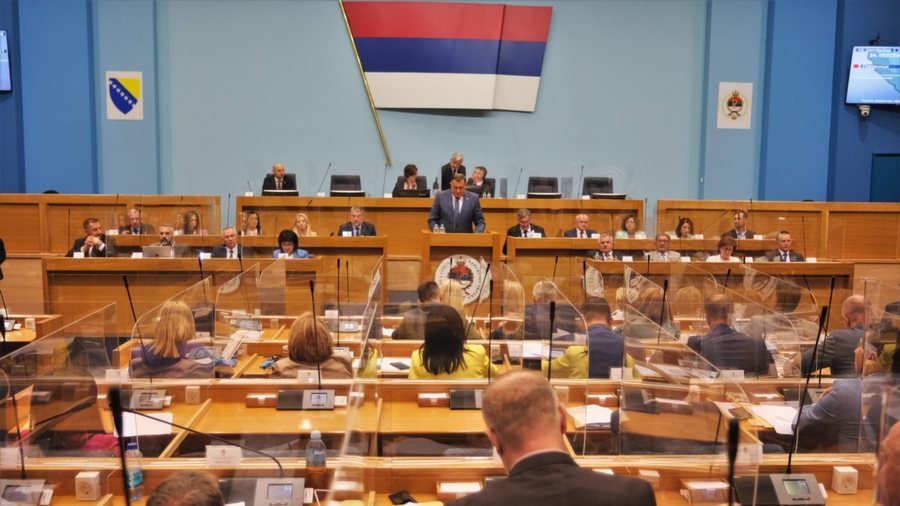
The National Assembly of Republika Srpska has approved changes to a law that states that the decisions of the High Representative in Bosnia and Herzegovina will no longer be recognized.
During an extraordinary session on June 21, MPs approved changes to the Act on the publication of laws and other regulators. The adoption of these changes was treated as a matter of urgency. Fifty-four of the 61 deputies present voted for the changes, while seven abstained.
According to the current law, legal acts in Republika Srpska come into force when they are published in the official gazette, which publishes legislation that is approved by the highest authorities, including the high international representative. The approved changes have removed the high representative from the list of authorities that approve legislation which is then published in the official gazette.
This decision is being seen as part of the efforts of some officials for the secession of Republika Srpska. Also, this decision is contrary to the 1995 Dayton Agreement that ended the Bosnian war. According to this agreement, an international envoy has been installed to oversee the implementation of peace.
Serbs in the Republika Srpska entity do not recognize Christian Schmidt, who was appointed high representative in 2021, as the United Nations Security Council did not support his appointment. China and Russia have disagreed with his appointment, as he has not been confirmed by the Council, but other states have said this is not necessary.
The High Representative has the power to dismiss officials and draft laws as he is the final interpreter of the Constitution, although his decisions can be reviewed by Bosnia's Constitutional Court.
"Today, Bosnia and Herzegovina does not have a high representative. [Schmidt] is not a high representative and this is the message of Republika Srpska", Radovan Viskovic, Prime Minister of Republika Srpska, said in Parliament.
Earlier in the week, Schmidt warned that Serbs would face - unspecified - consequences if they violate the peace agreement or refuse to accept his decisions.
Signatories to the Dayton Agreement, including Republika Srpska, "have an obligation to cooperate fully with the high representative," Schmidt's office said.
The decision of Republika Srpska has been supported by the Russian Embassy, which has said that Schmidt is not a legitimate representative.
The President of Republika Srpska, Milorad Dodik, has close ties with Russia and on May 23 he visited the Kremlin and met with Russian President Vladimir Putin.



Lini një Përgjigje