


 Shkruar nga Pamfleti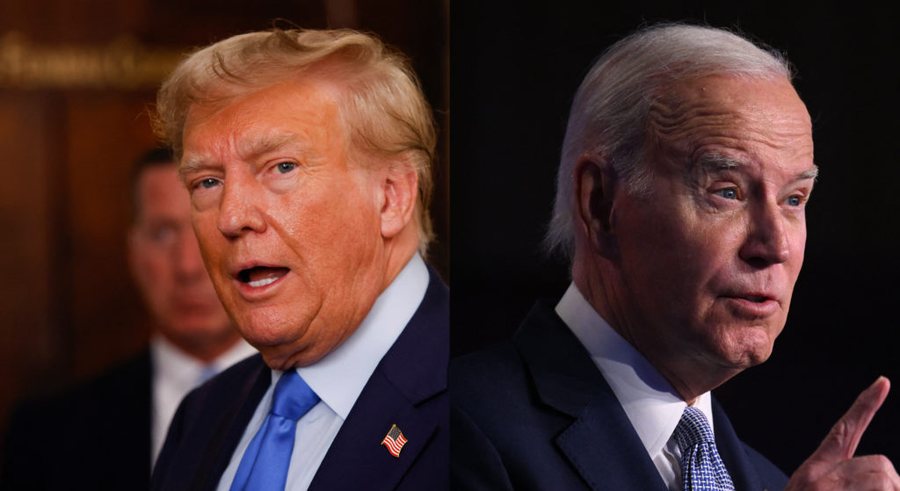
Former President Donald Trump on Thursday repeated earlier comments that he would not defend NATO member countries that have not met defense spending targets. The clash between former President Trump and President Biden over NATO is another sign of the divisions between their supporters over America's role in the world.
Two years after Russia launched a full-scale attack on Ukraine, former President and presumptive Republican presidential nominee Donald Trump shocked NATO allies with a statement.
"One of the presidents of a big country asked me 'will you protect us if we don't pay and are attacked by Russia?' You haven't paid? He told me yes. I told him that then I will not protect you. In fact, I would encourage them (Russia) to do whatever they want with you ," former President Trump said.
"Can you imagine such a comment from a former President of the United States?" , Biden said in his response.
President Biden, who has made strengthening the coalition against adversaries a centerpiece of foreign policy, sharply criticized his predecessor's approach.
"No president in our history has bowed to a Russian dictator. Let me say it with the best possible clarity: I will never do that. This approach is foolish, shameful, dangerous and un-American ," he said.
President Biden has said that he will respect the "sacred commitment" of Article 5 of the NATO charter, which provides for the defense of a member country of the alliance in the event of an attack by another non-allied country. This is contrary to the position of Mr. Trump, who continues with his isolationist "America First" approach. Former President Trump's comments have caused anxiety among allies.
"This year, 18 allied countries are expected to spend 2 percent of their Gross Domestic Product on defense. This is another record figure and a sixfold increase compared to 2014, when only three allied countries met this objective" , said NATO Secretary General Jens Stoltenberg.
Senior Trump campaign adviser Jason Miller said Trump "has made allies increase their spending on NATO by asking them to pay."
Another Trump ally, retired General Keith Kellogg, has suggested the creation of a phased system, according to which countries that do not spend 2 percent of their Gross Domestic Product on defense would not benefit from the protection provided by Article i 5.
Others say the signals from former President Trump and his allies have gone beyond the containment approach, running counter to the "principle of the policy of deterrence" of an attack by an enemy country.
"Trump is trying to score points through such attitudes, from the strong. American resolve on the international stage has been too strong for America's friends. But, this is a kind of strength in contrast, which would be better not to appear at all" , says Kristine Berzina from the German Marshall Fund.
Foreign policy has traditionally not been a key issue in US elections. However, given Trump's criticism of NATO, the broader question of America's role in the world could become another topic that could cause division among American voters.
"This is a very politicized issue that is being used by Mr. Trump to motivate his base of supporters. But there is a fundamental understanding among Americans that this alliance is important" , says Clifford Young from the organization "Ipsos Public Affairs".
According to an October poll by the Chicago Council on Global Affairs, only 50 percent of Republicans believe the United States benefits from transatlantic alliances, compared to 80 percent of Democrats and 63 percent of independent voters. VOA


Lini një Përgjigje