


 Shkruar nga Pamfleti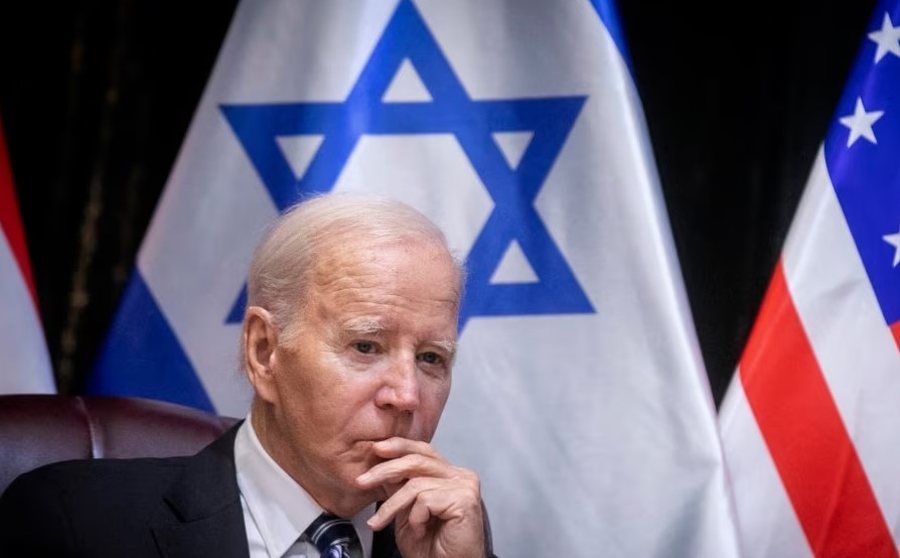
According to experts in Israel, today's visit of President Biden to Tel Aviv aims to prevent the conflict between Israel and Hamas from expanding into a regional conflict. In an interview for the Voice of America, political analyst Dahlia Scheindlin, from Tel Aviv, says that while President Biden's visit is extremely important for the morale of Israelis, the great danger of regional escalation continues to reign in the Middle East. In an interview, Israeli expert Scheindlin, a columnist in the Israeli daily Haaretz, says that the war between Israel and Hamas requires a comprehensive political solution and not continuous conflict management.
-How is President Biden's visit to Israel being interpreted and what is it expected to achieve?
Dahlia Scheindlin: There is no doubt that the Israelis see it as a great gesture of solidarity. It is very important for the morale of the Israelis, who are going through the biggest shock in the history of the state, are feeling overwhelmed and in a state of war, so the visit of President Biden is a great morale boost and makes Prime Minister Netanyahu look as an important statesman. This is a prime minister who is highly criticized in Israel. Throughout the year, he has been criticized for the policies followed, which the Israeli public strongly opposes. Therefore, the Israeli public sees it as solidarity, but also as a support that the American president gives to the (Israeli) prime minister. While not entirely unprecedented, it is nonetheless unusual for a US president to undertake such a visit to an active war zone on such short notice. So it makes a lot of sense.
The visit aims to clarify the next steps and coordination with the United States. The United States has already sent significant weapons, sent aircraft carriers to the region, to try to prevent a regional escalation. But I think there is a big risk of a regional escalation. There are divided opinions on whether such a demonstration of weaponry by the United States in the region will prevent or encourage escalation. We cannot know this at present. I know the United States is more committed to de-escalation, but I think the Israelis are not currently committed to de-escalation. So it remains to be seen if the United States can do so given what happened last night with the massive explosion at the Gaza hospital that left hundreds dead. Both sides blame each other for the responsibility. And as a result, Palestinian leader Mahmoud Abbas canceled the meeting with President Biden, and that makes it difficult for many Arab states to work with President Biden on this (goal).
- Do you think that the cancellation of the meeting between Palestinian President Abbas and President Biden represents a step backwards?
Dahlia Scheindlin: The step behind would mean that there was the possibility of progress. The situation here is so gloomy that even if the meeting had been held, it would be difficult for any dramatic change to occur, which would lead to the reduction of tensions or the cessation of fighting. President Abbas is a very problematic figure at the moment. One media outlet referred to him as someone who represents the Palestinians. It's not true. He is not chosen. He has not been elected since 2006. Palestinian society is very angry with him. Therefore, whatever agreement he could reach with the President of the United States would have no impact on the Palestinians. Of course, Israel has been delegitimizing him for years in the eyes of the Israeli public. Under these conditions, it would hardly be possible to make any progress towards improving the situation.
- This is the fifth escalation between Israel and Gaza that you have witnessed. You are an opponent of the occupation policy and a critic of Prime Minister Netanyahu. Are we likely to see the end of this tragedy?
Dahlia Scheindlin: Even if this tragedy ends tomorrow, it's too late. In other words, the number of Israeli civilians who were massacred, Palestinians killed, there are so many civilians killed and destruction of civilian infrastructure, while the southern part of Israel has been completely evacuated as well as half of Gaza, over 700,000 people have been evacuated , or who have tried to leave in terrible conditions. The damage is so great and I have to make it clear that it is not simply about limiting a bad policy in the future. Now it's about recovering from the extent of the damage that has been done. As for the political aspect, the occupation will not end. It won't end soon. He was returning to permanent politics before this attack. Israel has pursued a policy of permanent occupation of the Palestinian territories, Gaza and the West Bank, since 1967 in various forms. Israel's government wants to convince the world that it left Gaza in 2005, after withdrawing from the settlements and withdrawing the army from inside Gaza. But in fact, in many forms, Israel exerted extensive control over life in Gaza by controlling land, sea and air crossings. But Israel controls the movement of people, who need special permits. How many people can come to Israel to work? Most of the time, only a few of them, with a few exceptions in the last two years. Israel controls all imports and exports, which has kept Gaza in a state of disrepair, unable to develop its own capacities or develop. And there were reasons for this policy. There is no doubt that Hamas rules as an authoritarian, theocratic, undemocratic and abusive organization, because firing rockets into civilian populated areas for all these years is a war crime. And now there is little doubt that Hamas is an organization that supports terror in the worst sense of the word. Therefore, without wishing to minimize the complexity of Israel's policies, they have had a devastating impact on civilians throughout this time. That is why some of us, who think that the only way to make progress, is to find a comprehensive political solution, believe that the idea of managing the conflict without a political solution does not work. And now we are all seeing the result.
-Are we likely to see a political solution in the coming weeks?
Dahlia Scheindlin: No, we are unlikely to see a political solution in the coming weeks or years. We can hope to have at least an extension of the present fighting, to end this state of war....
One of the biggest concerns is that the government of Israel has no idea what its intention is in the coming days. Many Israelis, despite the fact that some of them are suffering, are shocked by the terrible attack 11 days ago, are wondering if the government really expects through this war, in the future, to reoccupy Gaza and 2 million Palestinians there, who have a hostile relationship with Israel. No one wants that, no matter how radical they may be. The other possibility is that the Palestinian Authority, which governs the West Bank, albeit to a limited extent, since Israel exercises significant control in that part, would also govern Gaza, but this does not seem a realistic possibility, due to the forces that exist within Gaza and militant groups there. It will be impossible to destroy all the militant groups and they hate the Fatah party and the Palestinian Authority. So, this is not a real possibility. If the Americans want to achieve anything of weight, they must not be content with managing the current war. America should work very closely with the Israelis and all other partners in the region, to think about what should be done next. We cannot manage this conflict without a political solution. So far I have not heard from politicians any significant ideas about Gaza in particular, but I think the solution must involve some kind of international engagement and cannot be seen in isolation from the rest of the Palestinian community in the region, in the West Bank and East Jerusalem . It should be seen comprehensively. / VOA





Lini një Përgjigje