


 Shkruar nga Pamfleti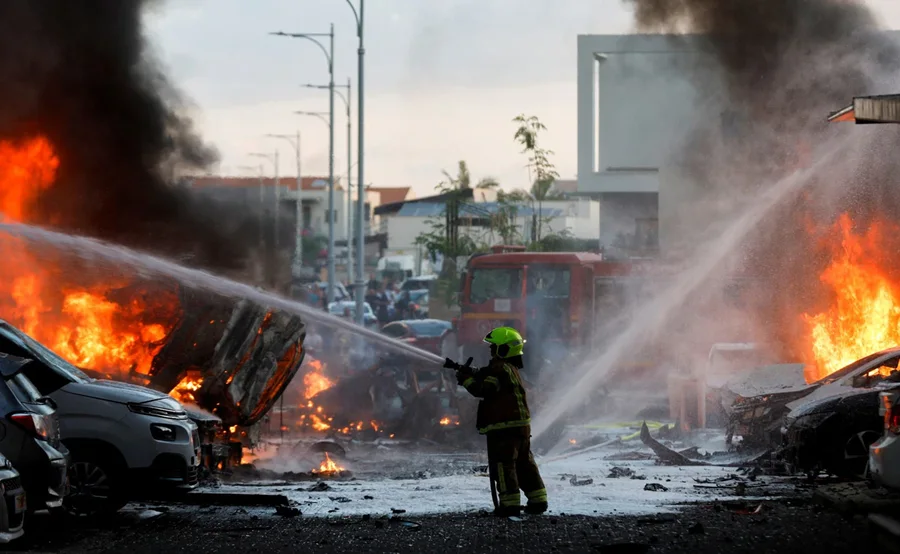
Shortly after the Hamas terrorist attack on October 7, a powerful wave of solidarity united Israeli society. But the Hamas hostage issue has reopened old divisions.
On many of the tall buildings of Tel Aviv you see the Israeli flag and two Hebrew words: "Beyachad Nenatze'ach" - "Together we will win".
But a closer look reveals a different picture on the streets of Israel's economic and cultural metropolis: On one side posters from relatives of Hamas hostages, who are demanding a deal that will bring their loved ones home – even if it meant the end of the war against Hamas. On the other side you see pictures of fallen soldiers with the call to continue the fight until "complete victory".
This contrast is symbolic of the division within Israeli society. It is about the question that shakes the country to its foundations: Is the return of the hostages worth ending the war?
A society in a state of shock
Fissures in Israeli society were visible in the months leading up to the terrorist attack on October 7, 2023. There had been months of protests against justice reforms that Prime Minister Benjamin Netanyahu's religious-right government wanted to implement.
Then came Hamas fighters from the border with the Gaza Strip, and killed about 1,200 people, almost all civilians, and kidnapped more than 250 hostages. The Islamist Hamas, which has ruled the Gaza Strip since 2007, is categorized as a terrorist organization by Germany, the US and other countries as well as the EU.
After the terrorist attack, Israeli society was initially in complete shock. Many felt that their government was unable to handle the crisis, and quite a few civilians wanted to take matters into their own hands. They created civilian emergency centers that organized everything. From donating money for soldiers' combat equipment, to arranging hotels and housing for thousands forced to leave their homes, to brokering farm workers to replace migrant workers fleeing the war. In a way, civil society and private initiatives seem to have taken over the role of government. And sometimes it got the impression that they were the only ones keeping the place running.
Bitter division in Israel
A year later, there is not much of that spirit of unity left in society. Old divisions have opened again: the demand for the release of the hostages has now become synonymous with the rejection of the government's war policy. Insults to hostages' family members are now common - both on social networks and on the streets. There were also physical attacks. The word many people choose is "Smolanim", which means something like "leftist" which has long been considered an insult in many parts of Israeli society.
According to many supporters of Israel's right-wing government, the campaign for the release of the hostages is in the hands of those parts of Israeli society who want to overthrow the current government. They lash out at people like Gil Dickmann. The relative of the hostage Carmel Gat, who was killed in August 2024, is a well-known figure in the campaign of the families of the hostages. Dickmann says that on social networks, because of his attitudes, he has even become responsible for the murder of his cousin.
Many opponents of the hostage families argue that campaigning for the release of their relatives strengthens Hamas' negotiating position with Israel. But Dickmann, on the other hand, believes that such arguments serve only one man: Prime Minister Benjamin Netanyahu.
What can be agreed upon?
Shmuel Rosner is an opinion researcher and journalist at the Israel Public Broadcasting Corporation. In his podcast, Rosner talks about the so-called "bargaining sphere", where he refers to the common denominator of fundamental issues on which Israel's various political directions can still agree with each other.
These common elements have changed since October 7, says Rosner. "On the one hand, there are issues that are not being discussed now, such as the presence of the Israeli army in the West Bank and the Gaza Strip." While the decades-long occupation of the West Bank, which is considered illegal under international law, is now seen as necessary by a larger proportion of Israelis than before the October 7, 2023, attacks by Hamas.
On the other hand, Rosner points out, the war allowed radical groups in Israeli society to legitimize previously taboo ideas. As an example, the concept of so-called "transfer" - which means the forced expulsion of Palestinians from the entire area from Jordan to the Mediterranean. "Such ideas used to be on the outskirts of Israeli society, but now it is seen as legitimate to talk about them," says Rosner. The result is the return of conflicts that many Israelis thought had been overcome. "This makes it more difficult to reach a common denominator."
Many Israelis do not feel safe
A year after the worst terrorist attack in Israel's history and then the war against Hamas in the Gaza Strip, many hostages are still being held by Hamas, tens of thousands have yet to return to their homes in the north of the country, and now a war with With Hezbollah in Lebanon seemingly inevitable, the question arises: do Israelis feel safer seeing how their government is handling this situation?
A September 2024 study by the Israel Institute for National Security Studies (INSS) comes to the opposite conclusion. According to the survey, 31 percent of Israelis have a "low" or "very low" sense of security, while only 21 percent said their sense of security is "high" or "very high."
The number of Israelis leaving the country had been increasing since before October 7. Now official statistics from the Israel Central Bureau of Statistics (ICBS) show that more Israelis left the country in 2023 than in 2022. According to preliminary figures for 2024, this number has continued to grow.
In this heated situation of debates and political messages, on the streets of Tel Aviv you also see smaller and less visible stickers with faces, names and stories. They are the faces of those killed on October 7 or during the war in Gaza. Their stories may be the last thing left for Israeli society to unite./DW


Lini një Përgjigje