


 Shkruar nga Pamfleti
The Russian president's dreams of restoring imperial power threaten NATO and the EU, not just Ukraine; Europe must stand by Kiev, increase pressure on Moscow, and deter a new Russian offensive.

No authoritarian regime lasts forever, and one day Vladimir Putin will no longer be at the helm of Russia. However, despite signs of a weakening Russian economy, discontent in society, and a wavering trust within the ruling elite, it is still too early to predict his political end.
The analysis emphasizes that no one can predict when and how the Putin era will end. For this reason, European democracies should focus not on waiting for his downfall, but on building a long-term strategy that prevents the Kremlin from achieving its goals.
According to the author, Putin's main goal remains the subjugation of Ukraine, the restoration of Russian influence in the post-Soviet space, the weakening of NATO, and the undermining of the unity of the European Union. The failure to achieve these objectives would constitute the greatest failure of his political project.
In this context, support for Ukraine is considered the most important element. The war has entered a phase where neither side seems capable of achieving a decisive victory on the battlefield. New technologies, especially drones, have transformed the nature of the conflict, while both sides are trying to hit the opponent's energy infrastructure, economy and morale.
However, the analysis warns that even if the fighting stops, the challenges for Ukraine will not end. A ceasefire or freeze in the conflict could bring new political and social tensions within the country. The risk that Ukraine will remain economically weakened, depopulated, and politically divided would constitute an indirect success for the Kremlin, even if Russia fails to control the country directly.
Therefore, the author argues, the real victory over Putin will not be measured only by the preservation of Ukrainian territory, but by Ukraine's ability to transform into a stable, democratic state integrated into the European Union.
Another important element is the increasing economic pressure on Russia. Despite extensive international sanctions, the Russian economy continues to benefit from energy exports. The analysis argues that Europe should strengthen measures against Russian oil exports and further restrict the networks that help Moscow evade sanctions.
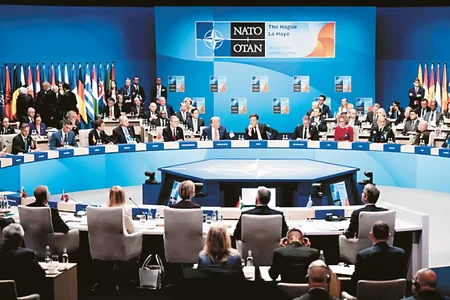
Equally worrying is the possibility of a new military escalation. The author estimates that the most dangerous period for European security may be precisely the transition phase, when Europe is trying to build more independent defense capabilities and when American commitment to NATO remains uncertain.
In these circumstances, Putin may be tempted to test the alliance's cohesion with limited actions on NATO's eastern flank, aiming to test whether allies are willing to react in a united manner.
The analysis also focuses on the hybrid warfare that Russia is waging against European countries through disinformation, cyberattacks, sabotage, and political influence operations. According to the author, Europe cannot limit itself to defense alone, but must develop capabilities to thwart and disrupt these operations.
Another important aspect is the relationship with Russian society itself. Although dialogue with the Kremlin remains necessary, the analysis argues that the West should also communicate with other segments of Russia: economic elites, professionals, civil society, and the community of Russians living abroad.
The message should be that there is a possibility of a different relationship between Russia and the West if the country chooses a different political path.
The author also warns that one of the biggest challenges for Europe comes not only from Moscow, but also from within the continent itself. The rise of populist, nationalist and Eurosceptic forces in some European countries could create new opportunities for Russia to disrupt Western unity.
Ultimately, the analysis concludes that the most powerful weapon of democracies is not just military or economic strength, but the ability to maintain their stability, prosperity, and cohesion. As during the Cold War, success will depend not only on policies toward Russia, but also on the ability of democratic societies to remain strong, secure, and attractive.
Change in Russia could come quickly or it could take years. Until then, the analysis concludes, the biggest challenge for the West is strategic patience and maintaining unity in the face of an adversary that relies on the division and fatigue of its rivals./ The Guardian


Lini një Përgjigje