


 Shkruar nga Pamfleti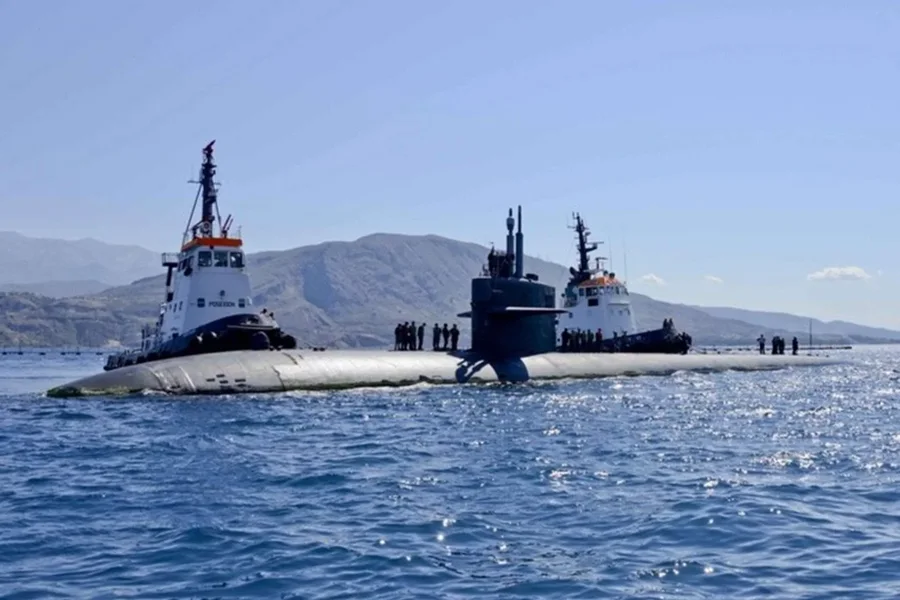
A US Navy nuclear-powered submarine has made a historic stop in Icelandic port, the first time such a ship has docked off the Icelandic coast.
According to the US Navy, the arrival of the Los Angeles-class USS Newport News in Grundartangi underscores the US's growing commitment to Arctic security and NATO's collective defense posture, especially as Russia and China expand their activities in the region.
This historic visit comes as NATO recently increased aerial surveillance with an RQ-4D Phoenix drone mission covering the GIUK gap from Finland, further highlighting a shift in focus towards the Upper North.
The arrival of the USS Newport News in Iceland is more than a symbolic gesture; it underscores a renewed vigilance in the Arctic amid evolving global security dynamics.
USS Newport News (SSN 750) represents one of the U.S. Navy’s most capable fast attack submarines, combining nuclear propulsion with a multi-role design. Equipped with Tomahawk cruise missiles, MK-48 torpedoes, and advanced sonar and surveillance systems, she excels in anti-submarine and anti-surface warfare, intelligence gathering, and strike missions. Her deployment to Iceland demonstrates the Navy’s ability to project power and maintain a forward presence even in the challenging waters of the Arctic, where submarine operations are becoming increasingly strategic.
Since commissioning, USS Newport News has maintained an extensive operational record in the Atlantic and Arctic regions, earning three Arctic Service Ribbons for missions above the Arctic Circle. Iceland’s decision to open its ports to nuclear-powered, but not nuclear-armed, submarines builds on previous historic stops such as the brief resupply visit of USS San Juan in 2023, demonstrating growing trust and interoperability with NATO allies.
Compared to older diesel-electric submarines or smaller regional fleets, a nuclear-powered attack submarine like the USS Newport News offers unmatched durability, stealth, and range.
Unlike its decommissioned predecessors, it can remain underwater for long periods without surfacing for refueling, enabling continuous interception and surveillance along the vital North Atlantic shipping lanes.
Strategically, this visit carries broad geopolitical implications. It reinforces the US Navy's commitment to securing the GIUK gap, a critical key point for monitoring Russian submarine movements between the North Atlantic and the Arctic.
Combined with new NATO RQ-4D drone missions from Finland, this marks a clear signal that the Alliance is strengthening situational awareness and response capabilities across the Arctic and North Atlantic. Iceland’s unique position at the heart of this maritime crossroads places it once again at the center of strategic planning for Arctic and transatlantic defense.








Lini një Përgjigje