


 Shkruar nga Pamfleti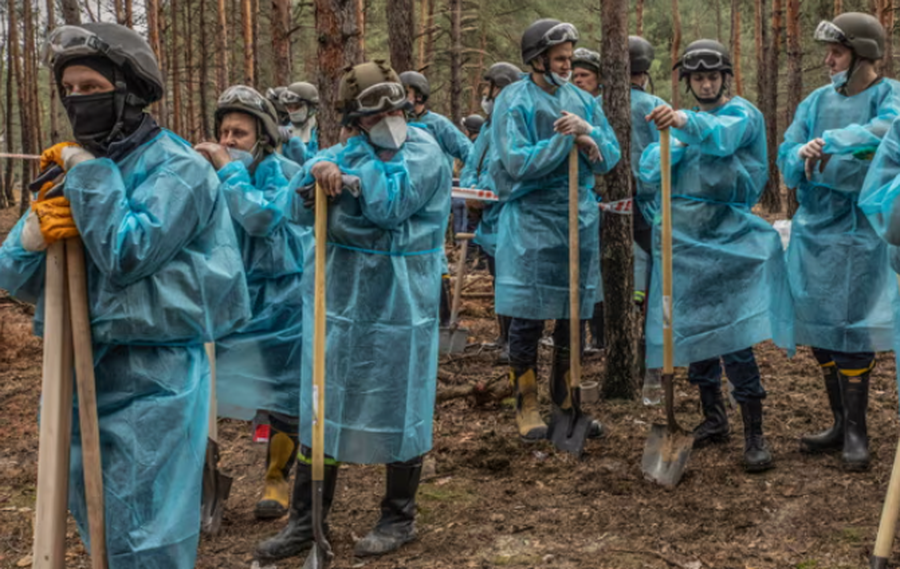
Murder, sexual violence and forced labor are some of the accusations against Russia included in the International Criminal Court's report...
The European Court of Human Rights has found that Russia has committed flagrant and unprecedented human rights abuses since it invaded Ukraine in 2014, including murder, sexual violence and forced labor.
The court's Grand Chamber ruled unanimously that between May 11, 2014, and September 16, 2022, when Russia ceased to be a party to the European Convention on Human Rights, it had committed "clearly unlawful conduct on a massive scale."
Pro-Russian armed groups entered the Donetsk and Luhansk regions of eastern Ukraine in 2014, and Russia began its full-scale invasion of Ukraine on February 24, 2022.
In its ruling, published on Wednesday, the court said there was evidence of widespread and systematic use of sexual violence, accompanied by acts of torture, such as beatings, strangulation or electric shocks.
Civilians and prisoners of war were subjected to mock executions, cutting off body parts and electric shocks, including to intimate areas, the court said.
Finding repeated violations of the convention, many of which had occurred over a period of more than eight years, the court said that “these actions aim to undermine the very fabric of democracy on which the Council of Europe and its member states are founded, by destroying individual freedoms, suppressing political freedoms and blatantly disregarding the rule of law.”
The violations identified by the court included:
Indiscriminate military attacks.
Summary executions of Ukrainian civilians and military personnel.
Torture, including the use of rape as a weapon of war.
Illegal and arbitrary detention of civilians.
Unjustified displacement and transfer of civilians.
Threatening, harassing, and persecuting all religious groups except followers of the Ukrainian Orthodox Church, which is historically linked to Moscow.
Threats and violence against journalists and new laws that prohibit and penalize the dissemination of information in support of Ukraine.
Forcible dispersal by the Russian army of peaceful protests in occupied cities and villages.
Destruction, looting and expropriation of property.
Suppression of the Ukrainian language in schools and indoctrination of Ukrainian schoolchildren.
The transfer to Russia, and in many cases, the adoption there of Ukrainian children.
The court said that “the prevalence of sexual violence and rape by Russian soldiers in the occupied territory is particularly abhorrent. The evidence demonstrates the extreme violence of the circumstances in which women were raped or sexually assaulted and the intent to terrorize and humiliate them… In addition to the impact on the direct victims, the rape of women and girls in the context of an armed conflict has also been described as a means for aggressors to symbolically and physically humiliate defeated men.”
“Rape or the threat of rape is also used to displace communities from their lands or to increase terror during attacks. Evidence also attests to the horrific sexual violence that is often inflicted on male detainees. Sexual abuse, torture and mutilation of male detainees are often carried out to attack and destroy their sense of masculinity or manhood.”
The judges said that sexual violence and rape were used in Ukraine after the February 2022 invasion “as part of a military strategy to dehumanize, humiliate and break the morale of the Ukrainian population, as individuals and as a community, and to assert dominance over sovereign Ukrainian territory.”
The court will decide whether to order compensation at a later date. However, Russia has previously informed the court of its intention not to enforce the court's rulings or pay compensation.
A total of 26 states parties to the convention intervened as third parties in the case and expressed their support for holding Russia accountable for human rights violations stemming from the occupation of Ukraine.
The court also ruled that the downing of flight MH17 using a missile supplied and transported to eastern Ukraine by the Russian Federation, resulting in the deaths of all 298 civilians on board, was in breach of the convention. / Adapted Pamphlet from The Guardian/





Lini një Përgjigje