


 Shkruar nga Pamfleti
Negotiators agree that Ukraine's accession to the EU is essential for its future. Ukraine wants rapid membership in the European Union as a guarantee of its security. In fact, Kiev has made the issue a priority in negotiations for a peace agreement with Russia.
According to officials in Brussels and Kiev, quoted by Politico magazine, Ukraine sees a time "window" for its membership from the end of elections in Hungary this April until the presidential election in France in April 2027.
Volodymyr Zelensky has already said that Ukraine wants rapid membership, but Kiev's path is fraught with obstacles. European Union membership usually takes years, and Ukraine's application for membership presents economic and governmental hurdles. Several solutions are under discussion, including a plan that would gradually bring EU benefits to Ukraine and limit Kiev's veto power to only essential decisions.
In essence, it would be a fast-track accession, but with stars. Such a gradual form of membership with fast-track procedures could set a legal and institutional precedent and completely change the meaning of a state's EU membership. This is why some European leaders have opposed Ukraine's demand to set a clear timetable for its membership.
How a country becomes a member of the European Union
The union has 27 members and has not added any more since Croatia joined in 2013. There are nine countries on the waiting list, while Ukraine began the process in 2022. There is a reason for the long waiting list. Membership in the European Union comes with big benefits. It allows easier access to a large market, facilitates the free movement of labor, and comes with subsidies in important sectors.
Membership also requires work from candidate countries, which must demonstrate low levels of corruption, a strong rule of law, and democratic functioning rules.
Success in these chapters takes time, and it takes an average of 9 years for a country to join. Final checks usually take a year or more. Although some drafts of a proposed peace plan mention Ukraine's membership in the European Union in 2027, a date that President Volodymyr Zelensky continues to propose, it would be almost impossible to complete the classic process so quickly.
Marta Cos, the EU Commissioner for Enlargement, admitted on the sidelines of the Munich Security Conference that it would not be possible to join Ukraine so quickly using the existing process. However, she said the process must change and that Europe is "discussing" how to do this.
"Ukraine's membership in the European Union is not enlargement. It is the unification of Europe," said Marta Kos.
Why Ukraine is an advantage
European officials want to bring Ukraine into the EU quickly, in part because it could encourage Kiev to accept other parts of the peace deal. Europe is also trying to show that it has an important role to play in securing peace and that it should not be left out of negotiations between the United States and Russia.
Russia has stated that it does not oppose Ukraine's accession to the EU, while peace plans prepared by the Trump administration refer to the possibility of Ukraine's membership in the Union.
Ukraine's rapid accession to the European Union, or at least setting a clear date for accession, could also help unlock private investment for the country's post-war reconstruction, according to Ukrainian and European officials.
Commission President Ursula von der Leyen has said that the path to membership is in itself “a fundamental security guarantee.” However, this week she rejected Mr. Zelensky’s request to immediately set a specific date for membership.
"From our point of view, the dates themselves are not feasible," the Commission president said at a press conference in Kiev, Ukraine, on Tuesday.
Why Ukraine is a particularly difficult case
Ukraine's accession to the European bloc will not be easy. The country has a large population (about the size of Poland) and is facing economic difficulties after years of war. There are concerns that if it joins the European Union, there will be a massive influx of workers to other EU countries and that the country will need significant EU funding for its economic development.
Ukraine is also a major power in the agricultural sector. This could pose a threat to member states with large agricultural bases, such as France, as their producers would have to compete with Ukrainian grains and other products.
"The full integration of Ukraine will be a big challenge, both for Ukraine and for the EU, because it is a large and not particularly wealthy country," Polish Foreign Minister Radoslaw Sikorski said in Brussels on Monday.
Respect for the rule of law is also a central element of European Union membership, and Ukraine is grappling with the fallout from a corruption scandal in the energy sector. According to a New York Times investigation, the Ukrainian government has dismantled oversight mechanisms in recent years.
Finally, approval of new members requires unanimity among the other countries in the bloc, and Ukraine's candidacy has already struggled to gain full support. So far, Hungary has blocked efforts to move Kiev to the next stages.
What could European officials do?
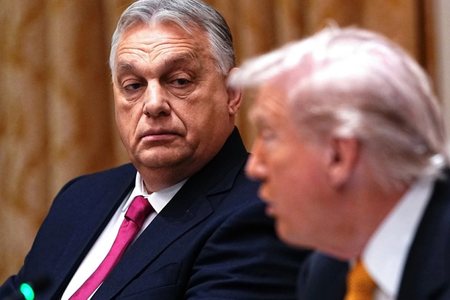
One view is that Hungarian Prime Minister Viktor Orban is unlikely to block Ukraine's accession if President Trump pushes the issue forward. Viktor Orban could also lose power in Hungarian elections next April. However, the opposition party has also said it opposes a quick accession of Ukraine to the Union, so this may not immediately clear the way for Kiev.
If Hungary remains opposed, European officials may try to find a solution for Ukraine's accession to the Union without unanimous consent.
"To achieve this, major reforms will be needed," said Mujtaba Rahman, managing director for Europe at the research organization Eurasia Group.
European officials are also considering a “soft” form of membership. Several scenarios are under discussion. Under such a scenario, Ukraine would gradually gain access to the European market and could gain access to subsidies only over time and after reforms. By gradually implementing the benefits, it would be possible to soften the impact on farmers and the EU budget. If Ukraine did not meet the rules on the rule of law or other European standards, its membership would not proceed.
The idea would be to avoid a situation in which Ukraine would be an EU member and absorb European funds without the necessary safeguards against corruption. European officials have also suggested that Ukraine could join without full voting rights.
What could be the consequences?
If Ukraine is allowed to join through an accelerated procedure or with limited rights, there is a risk of creating a two-speed system within the European Union, in which some countries would be treated as new candidate members.
This could set a precedent and jeopardize or change the goals for countries like Albania, Moldova, and Montenegro, which are steadily working towards membership in the Union.
There are already some areas where member states are not all equal. Cyprus does not have full access to the benefits of free movement within the EU, while Denmark, Hungary and Poland do not use the euro. /Adapted Pamphlet /



Lini një Përgjigje