


 Shkruar nga Jay Mens
Today the regime in Tehran talks about mojazat (punishment) or khun-khahi (lust for blood).
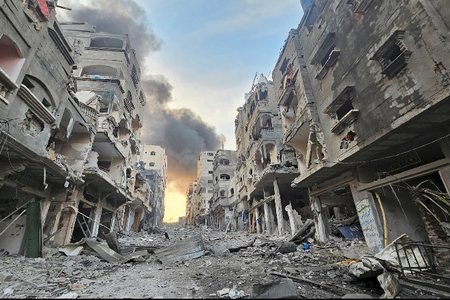
It has never been a war just for Gaza. Since October last year, the Middle East has been embroiled in a regional war. which, over the next few weeks, is likely to erupt into an open and full-scale war.
After Israel's airstrike in Beirut, and last week's assassination of Hamas leader Ismail Haniyeh in Tehran, Iran is promising a different approach to this. After the 2020 assassination of the head of the elite Quds Force of the Revolutionary Guards, Qassem Soleimani, and the Israeli attack on Iran's consulate in Damascus, Iranians promised enteqam, revenge.
Today the regime in Tehran talks about mojazat (punishment) or khun-khahi (lust for blood).
Israel has three unpaid blood debts, accumulated over the past few weeks, from the entire so-called "Axis of Resistance". It bombed Hodeidah, the port controlled by Houthi militias in Yemen, in broad daylight. Killed a senior Hezbollah commander - also wanted by the United States for bombing US Marines in Beirut in 1983 - amid Hezbollah's stronghold in the Lebanese capital.
He humiliated the Iranian regime by killing the political head of Hamas within this country, just a few hours after meeting the Supreme Leader. The response will be coordinated, so that all three affected parties receive reimbursement, either together or one after the other.
Perhaps the Axis could delay a serious attack until August 13, which coincides with the ninth of Avi: a date in the Jewish calendar that for millennia has been synonymous with tragedy. It is the date on which the Romans expelled the Jews from Israel in 70 AD; the date when the Jews were expelled from England in 1290, and when the Warsaw ghetto was liquidated in 1942.
Israel's enemies know all about this day. Even last year, Iranian forces made a short documentary about this day. While in 1994, Hezbollah chose this very date to blow up a Jewish community center in Argentina's capital, Buenos Aires, killing 85 people.
But more than time, what will happen matters. How the Axis chooses to retaliate will also answer the most important question of all: Has Israel been bluffing when it talks about facing the consequences of its attacks on Axis targets?
The Axis may assume that Israel has bitten off more than it can chew. He could drag Israel into a devastating second war in Lebanon, which would be far more punishing on the Israeli home front than Gaza. Other factions of the axis, can significantly damage Israel's air defenses.
Before long, morale within Israel would weaken. While the White House would soon come under great pressure to push for a cease-fire. Iran may even use the chaos to finally build its own nuclear bombs.
The other option for the axis is to hope that America will step in to support Israel. Since October of last year, deployments of US military assets in the Middle East have done less to deter Iran than to deter Israel.
US pressure likely prevented Israeli Prime Minister Benjamin Netanyahu from starting a war with Lebanon in October, preventing a significant Israeli response to Iran's latest missile attack in April this year.
The Axis may choose to launch an attack where the stakes are either too high or too low to justify a full-scale regional war, betting that Washington will again keep Israel's response in check. But what if Israel's show of military force isn't a bluff at all?
For months, Middle East analysts have grown accustomed to a war within limited parameters. A ceasefire has been seen as out of reach since November 2023. It appeared imminent as Israel grew weary under escalating internal unrest and US pressure.
Many people assumed that Israel was not ready for war. Its reserves were exhausted, it faced a serious shortage of ammunition, and it appeared that it had lost American support. But now these assumptions must now be questioned. Israel may have decided to play everything for everything.
Contrary to popular belief, Netanyahu is not currently in the hands of extremists. He has more political freedom than a year ago. The Knesset is on summer break, which means that a motion of no confidence in him cannot be raised until the end of October.
Until then, he is in complete control of everything. His real deadline is November 5, when America goes to the polls. So August is the ideal time for Netanyahu to try anything. A way out of the conflict may appear in September.
Ideally, October will be fairly quiet, just in time for the Jewish high holidays, the return of the Knesset and the US presidential election. Now the question is whether Israel will enter a second war - against Lebanon - or a third war with Iran.
Israel crossed all of Hezbollah's red lines when it struck Beirut and killed a senior commander of this militia. Now Hezbollah has no choice but to attack at least one major Israeli city. Israel will retaliate again, and so on. It's hard to see how things could end any other way.
In his speech on Thursday last week, Hezbollah leader Hassan Nasrallah said the killing of Haniyeh was an "attack on Iran's sovereignty, national security, prestige and honor".
However, Iran's options are even more complicated. The Islamic Republic faces many problems: high inflation, high unemployment, disaffected minorities, widespread corruption, and as is now clear to all, a compromised inner circle. The one area in which he excels is his imperial project.
If it fails with it, the regime may indeed be in danger. Iran has a long-term plan to drive the United States out of the Middle East, and to make Israel an unlivable country. So far, the plan has worked. Tehran has been the biggest beneficiary of the chaos in the region.
Now he has to make a choice: if he doesn't go far enough, he risks being damaged by internal strife. If it goes too far, it could turn Joe Biden into Jimmy Carter, returning Donald Trump to office, or prompting Netanyahu to fulfill what he seems to consider his destiny: the complete destruction of Iran's nuclear program.
Last week, it was against this volatile backdrop that senior British officials met with their Israeli counterparts. The irony is that the meeting came just a week after the British government withdrew its opposition to a possible International Criminal Court arrest warrant for the Israeli leadership on war crimes charges.
As the stakes in the Middle East crisis mount, the UK needs to ask itself some serious questions about its interests in the region, and how best to reflect those interests in policy terms. October 7, 2023, destroyed the balance of power in the region. For months, it has tilted in Iran's favor, but now it's back on the table. Iran and Hezbollah will launch massive barrages of rockets at Israel in the coming weeks. However, the moment of truth for the region will be seen only after the consequences of this attack. /Adapted "Pamphlet" from "The Spectator"
*Note: Jay Mens, lecturer in history and politics at Harvard University, USA.






Lini një Përgjigje