


 Shkruar nga Pamfleti
Record rainfall of up to 94 cm, state of emergency in several states and massive power outages
A powerful snowstorm hit the East Coast of the United States on Monday (February 23), from Maryland to Maine, causing widespread transportation paralysis, school and business closures, and power outages for hundreds of thousands of residents.
The storm lashed the northeastern region with heavy rain and strong winds, forcing millions of people to stay indoors. Authorities warned of dangerous driving conditions and declared a state of emergency in some areas.
Meteorologists said it was the strongest storm to hit the region in a decade. In many areas, the snow piled up to 60 centimeters, breaking local records for accumulation. The rains disrupted public and air transport and led to the postponement of a meeting of the United Nations Security Council.
The National Weather Service reported that parts of Rhode Island and Massachusetts received nearly 37 inches of snow. New York City's Central Park received more than 19 inches of snow. Authorities warned that driving conditions in New York were "nearly impossible."
More than 600,000 homes and businesses across the East Coast were without power, with New Jersey and Massachusetts among the hardest-hit states. In Massachusetts, about 300,000 customers faced power outages, including 85% of customers in Barnstable County, which includes the Cape Cod area, according to data from the website poweroutage.us.
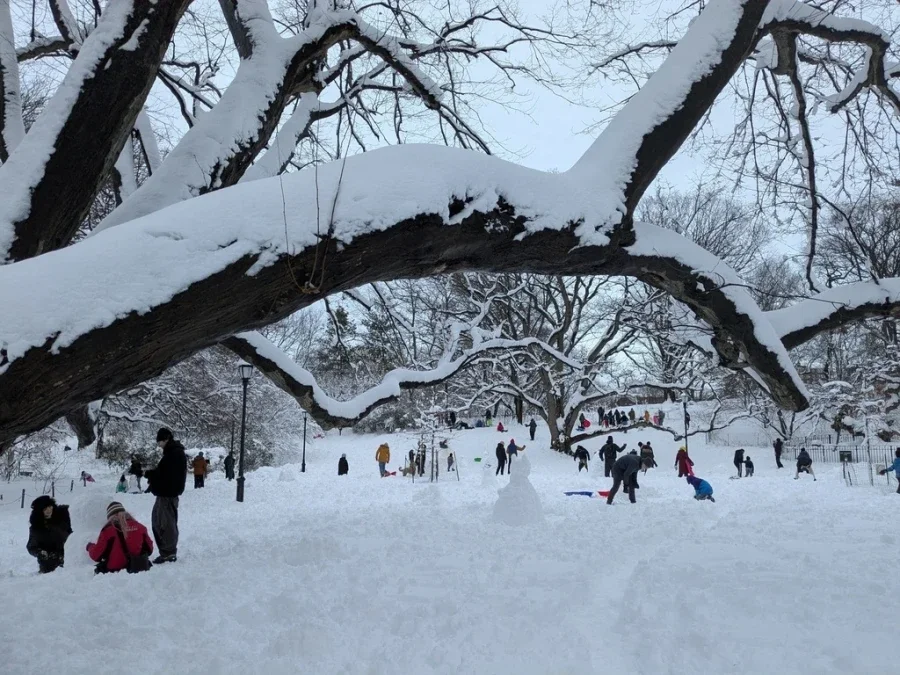
Rhode Island, the smallest state in the US, appears to have faced the heaviest snowfall during the storm. According to local media, this is the heaviest storm to ever hit the state.
Providence, the capital of Rhode Island, recorded 91.4 centimeters of snow, breaking the previous record of 72 centimeters set in February 1978.
Authorities in Rhode Island and Connecticut imposed a ban on non-essential travel. Later in the day, Massachusetts Governor Maura Healey also declared a curfew. In an online post, she announced that the ban would apply to all non-essential travel in southeastern Massachusetts and that the speed limit on the Pike Highway would be reduced to 15 mph. She noted that travel conditions were extremely dangerous and warned that if there were any blockages, emergency services could find it difficult to intervene.
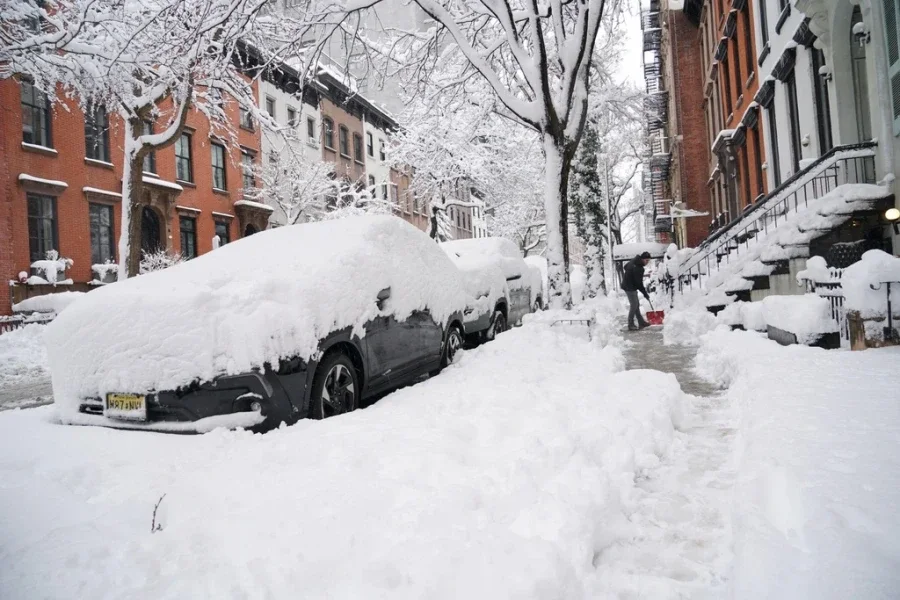
In New York City, a traffic ban temporarily brought the metropolis of over 8 million people to a complete standstill before the measure was lifted at noon. All streets, highways and bridges were closed during the height of the storm.
In Connecticut and New Jersey, authorities expressed concern that falling trees and branches could worsen road conditions and cause more power outages. In Providence, a city spokesman told The Providence Journal that more than 300 vehicles were towed because they were parked in areas where snowplows were operating.
The aviation sector was also hit hard. According to the monitoring site FlightAware, 5,706 flights within, to or from the United States were canceled. The data shows that 98% of flights from LaGuardia Airport and 91% from JFK Airport in New York were canceled. Logan International Airport in Boston canceled 92% of departing flights, while Newark Liberty Airport in New Jersey canceled 92% and Philadelphia International Airport canceled 80%.
Authorities warned that over 2,000 more flight cancellations are expected on Tuesday, with Boston and New York airports among the most affected.
The National Weather Service described the storm as a classic “bomb cyclone” off the northeast coast. The term is used to describe a storm that intensifies very quickly when atmospheric pressure drops significantly within 24 hours, usually during the fall and winter, as a result of cold Arctic air colliding with warmer air masses.
While the storm is moving north and weakening in some areas, the National Weather Service announced that it is monitoring another system that could bring new snowfall to the region later in the week.








Lini një Përgjigje