


 Shkruar nga Antonio Polito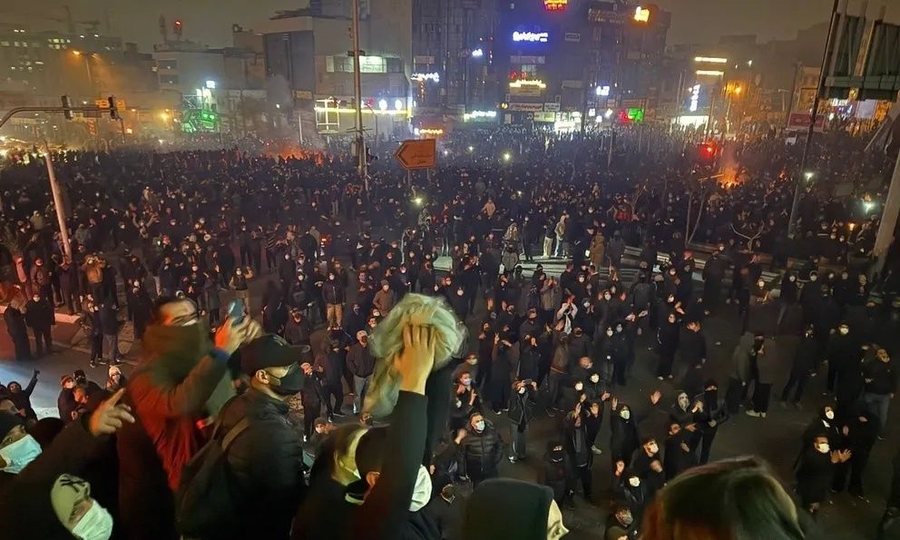
The ayatollahs' regime has long failed. It was the first in the Islamic world, in modern times, to rise up against the West and the "American Satan"...
Just as we have mourned the death of the West, the crisis of its values, and the end of its history, here are millions of Iranians who would give their lives, in fact, are giving their lives, to share with us our achievements: freedom, prosperity, tolerance. The right of women to let their hair down and light a cigarette in public; the right of young men to kiss in the street and listen to whatever music they like; the right of fathers not to starve because the government spends its resources on missiles, to fuel a global revolution, and then is no longer able to defend even its own skies.
History has begun to move again. In Tehran, Isfahan, Mashhad, Shiraz, Qom, the grim auxiliaries, dressed in the gray of theocracy, are firing on the crowds, chasing protesters into hospitals, and trying to put out the fire with the usual methods, targeting and terrorizing their own people.
But the ayatollahs' regime has long since failed. It was the first in the Islamic world, in modern times, to rise up against the West and the "American Satan": when, in 1979, almost half a century ago, the Iranian people overthrew the Shah, it seemed to the progressive forces of Europe like a new "October Revolution." Today, on the streets of Iran, there are those who, on the contrary, cheer for the monarchy and the return of Pahlavi's son, who lives in exile in the United States.
In 1982, the "party of God," Hezbollah, founded on the Shiite faith and financed by Iran, was the first Islamic army to deal a devastating blow to Israel during the Lebanon war, through the "invention" of suicide attacks. Today, its charismatic leader has been killed and the entire leadership of the group has been eliminated by the Israelis in Beirut.
Six months ago, first the Jerusalem air force and then Trump's deadly B-2 bombers, with their devastating bunker-busting bombs, struck targets where Iran was enriching the uranium needed for its challenge, the fetish of a dream of nuclear deterrence.
But while on our streets people cursed the military show of force by the United States and Israel in those days, it is likely that many Iranians, on the contrary, found reason for hope in the regime's obstacles and the weakness they revealed. The humiliations suffered by their country may have been previously unknown to this new uprising, born of economic crisis and poverty, but, as always, fueled by a thirst for freedom. This time, a mobilization not only of young people and women, but of the entire people, supported also by ethnic and religious minorities.
Trump's stated support, accompanied by the usual threats of military action, even "surgical" intervention in Caracas, which gives these threats new credibility, must have played an important role in encouraging the protesters.
But even if the regime has failed, the Iranian state's repressive apparatus, fueled by the genuine religious fanaticism of its militias, has not failed. Therefore, it is by no means certain that everything will not end again as it has so many other times: with murder, hanging, raids, repression and an iron fist. "Enemy of God" - this is a charge that in Iran can cost a human being his life.
Thus, the West faces a dilemma: what to do when its own government massacres and persecutes its own people? It is also the question behind which the sad silence of our streets is hidden and seeks justification. We are so eager to fight against imperialism that we ignore the right of peoples to freedom, except when it is the Americans who violate it.
In a city like Rome, where the nation's strongest union has just organized a demonstration in defense not of the "Madurist" regime, which is still in power, but of Maduro himself, so far not a single high school has been occupied in support of the brave Iranian youth. It is clear that, if the murder is not considered a "violation of sovereignty", then, ultimately, it does not concern us.
But it is not just a matter of indifference. There is something more. And this lies in the fact that a significant part of our public opinion, those who usually mobilize, are so angry with the West in which they live, with its values, traditions and history, that they react only when it offends the dignity of others. But when a people like the Iranians ask us for help to share with us the same ideals that our streets often despise, then they are left alone.
Nobel Peace Prize winner Shirin Ebadi, along with other Iranian dissidents, asked Trump for "international help to prevent a catastrophe: you promised three times that you would intervene to help the Iranian people, now is the time to act."
We all hope that this aid will not lead to new wars, in a world already shaken by violence. But if we are unable to make our voice heard by the ayatollahs, to mobilize that “superpower” of Western public opinion that played a key role in ending the massacre in Gaza and that is silent today, and to use the full force of our diplomacy and economy, then we will remain responsible for having left the word to the weapons./ Adapted from “Pamphlet” by “Corriere Della Sera”





Lini një Përgjigje