


 Shkruar nga Pamfleti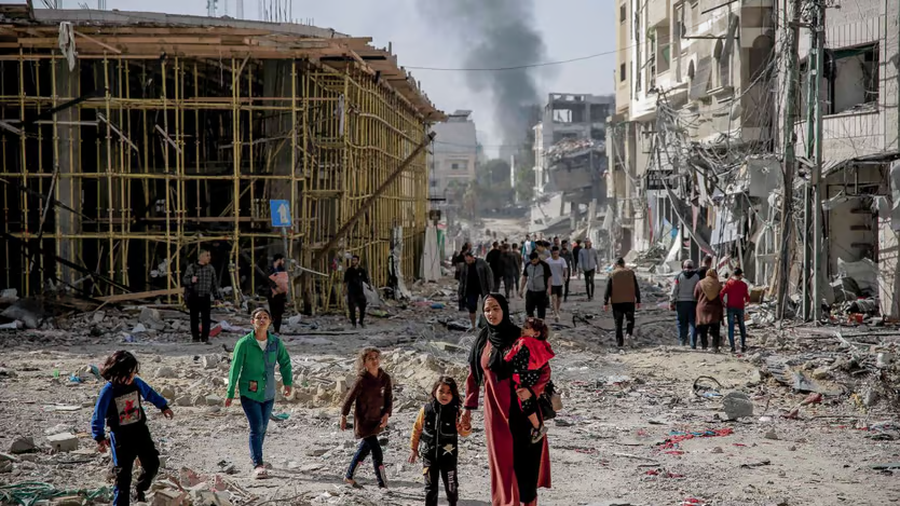
What will happen after the ceasefire between Israel and Gaza has ended?!
It was a rare moment of peace after weeks of agony. Dozens of Israelis, held captive for seven weeks, have been reunited with their families in recent days. A brief lull in the Gaza war has allowed Palestinians to emerge from their shelters and search for food and fuel, search for lost relatives and see what remains of their homes.
However, these moments had their downside: most of the hostages have not been released, and most of the Palestinians who returned home found only ruins. This means that their 'freedom' will be short-lived. The truce may be extended for a few more days, but it will end one day, and the fighting that follows may be worse than before.
Israel's cabinet approved the hostage deal on November 22 after hours of debate and weeks of indirect negotiations with Hamas. The first day went according to plan. Both sides stopped fighting on the morning of November 24. That afternoon Hamas released 13 Israeli hostages, ranging in age from a two-year-old girl to an 85-year-old woman, and 11 other foreigners from Thailand and the Philippines. Israel released 39 Palestinian prisoners from its prisons, including women and children.
If the first day was calm, however, the second was anything but calm. Hamas delayed the release of the hostages for hours, claiming Israel had failed to honor the pact. Israel had intended to allow 200 trucks of humanitarian aid a day into Gaza every day during the ceasefire. Only 137 managed to get in on the first day. But after the mediation of Qatar, which helped broker the deal, the exchange continued.
The truce may be extended. After the four-day deal ends, every ten hostages released by Hamas will buy another 24 hours of peace. Egyptian officials say they have received "positive signals" about extending the peace, although neither Israel nor Hamas have confirmed anything.
Hamas has obvious interests in prolonging the peace. A longer ceasefire would give the group's military commanders time to regroup and prepare, both to attack Israeli troops stationed in northern Gaza and to defend the South, where the Israeli military has no made yet another great incursion. It would also lead to more pressure on Israel not to resume fighting. The families of the hostages would like the deal to be extended. This would also be done by the president of America, Joe Biden, who says that his goal is "to keep this pause beyond tomorrow".
At some point, however, Hamas will run out of hostages it is willing to release in this round of negotiations. It will probably hold both Israeli soldiers and men captive in the unlikely hope of reaching a larger deal that includes a permanent ceasefire and the release of many Palestinian prisoners.
When the cease-fire inevitably comes to an end, Israel will resume the war against Hamas. Speaking from Gaza on November 26, Netanyahu, Israel's prime minister, said: "We have three goals for this war: eliminating Hamas, returning all our hostages, and ensuring that Gaza no longer becomes a threat to the State of Israel. We will continue until the end, until victory. Nothing will stop us."
In the next round of fighting, Israeli troops will continue to clear the rubble of northern Gaza to enter the tunnels. They are also in a dilemma as to how they will act in the South. The Israelis cannot easily send armored units to "occupy" the area, as they did in the north, because it is filled with displaced civilians from the north.
Instead, they may try to push it in little by little, perhaps starting with the central city of Khan Younis. But even this is fraught with danger. Civilians will have to choose between gathering on a deserted strip of beach and hiding in their homes or makeshift shelters; both can have dire results. Fighting in populated areas will also be more dangerous for Israeli troops.
It is difficult to assess Hamas' strength - most of its fighters are thought to be holed up in tunnels - but Israeli officers say nearly half of its units have suffered serious casualties. On November 26, Hamas confirmed that Ahmed al-Ghandour, the head of its northern brigade, had been killed earlier in the war. A member of the military council and head of one of its five regional commands, he is one of the highest-ranking militants known to have died since October 7. However, Hamas is hardly close to surrendering and will undoubtedly fight harder in the south, making it the last stand.
All of this makes America nervous. Mr. Biden has yet to call for a ceasefire, but his team is concerned about Israel's plan for a major offensive in the south. "I have encouraged the prime minister to focus on trying to reduce the number of casualties while trying to eliminate Hamas, which is a legitimate target," he said on the first day of the ceasefire.
America would like Israel to stop its action in the south, especially since Netanyahu has no plan for what happens in Gaza after the war. It could encourage Israel to continue its offensive in the north and keep the south closed, for now, with an enhanced flow of humanitarian aid through Egypt. Antony Blinken, the Secretary of State, may visit the region again this week. So will Emmanuel Macron, the French president, who has called for a lasting ceasefire.
If America pressures Israel to hold back, it could spare Gaza's 2.2 million residents another round of fighting and displacement. But it will also leave them in an even smaller desperate enclave than the one they lived in before, under a partially disbanded Hamas regime. / Adapted "Pamphlet" from "The Economist"







Lini një Përgjigje