


 Shkruar nga Mujtaba Rahman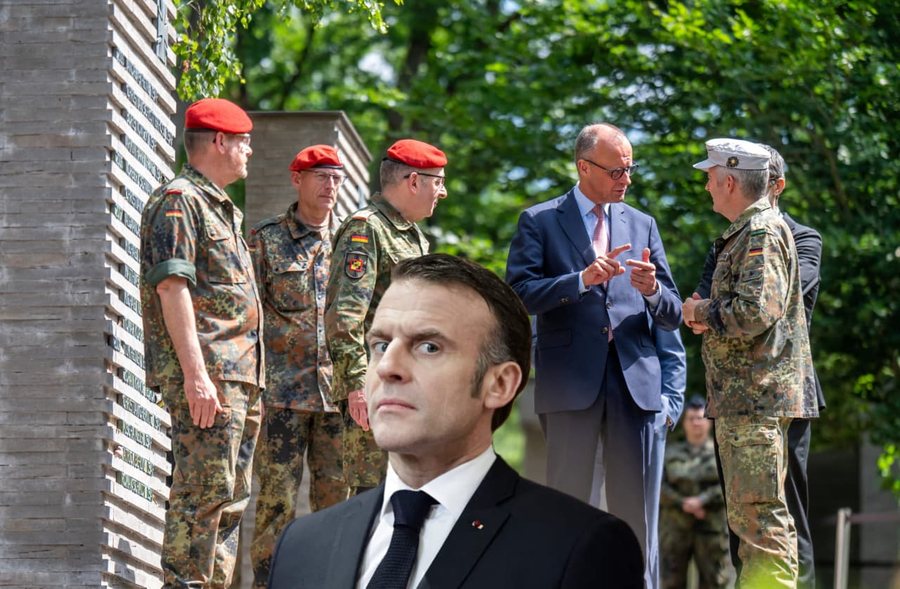
France will view the next decade with anxiety, as Germany will maintain its status as Europe's industrial powerhouse, as well as become, by sheer size alone, the dominant military power within the EU.
An old French nightmare, that of Germany’s growing military power, is resurfacing in a new form. Indeed, 19th- and 20th-century anxieties about an invasion along the Rhine River have long since faded away in the Franco-German partnership within European and Atlantic alliances. Moreover, Berlin’s current plans to double defense spending are welcomed in France as a bulwark against Russian aggression and US disengagement.
However, according to anonymous government officials, French President Emmanuel Macron is said to be "obsessed" with the great fiscal freedom that Germany has to rearm over the next five years, especially compared to impoverished France.
He fears an invasion, not of French territory, but of his country's dominant position as the EU's most effective military-diplomatic power. He is also concerned about whether Germany's billions will be used to build or to cloud his vision of a strategically autonomous European defense industry.
In theory, both countries are bound by NATO members’ new pledge to spend 3.5 percent of GDP on defense by 2035. But while Germany has a credible plan to reach that target by 2029, short of large grants from an EU defense fund that may never exist, France has no obvious way to meet its NATO commitment and reduce its budget deficit to 3 percent of GDP in four years.
Given the gap between their GDPs and populations, this year’s defense budgets of Germany and France are roughly comparable, 86 billion euros in Germany and 62 billion euros in France. However, by 2029, Germany expects to spend 150 billion euros a year; while France, even with its expanded defense plans, will spend 80 billion euros at best.
However, several senior French officials who spoke on condition of anonymity dismissed fears that Germany's new military power, and to some extent Poland's, would erode Paris's influence in Brussels. They argued that France's "special" status within the EU also stems from its global military reach, its permanent membership of the UN Security Council and its nuclear deterrent.
French military chiefs, who asked to remain anonymous, also dismissed the Bundeswehr's ability to become an effective force after eight decades of historical aversion to all things military. They said the costs of making up for it were welcome and important, but it would be many years before the German army and air force could match those of France.
The most immediate problem, however, is the direction of the movement. Will building up the German army help create a more strategically autonomous European defense industry, create jobs in Europe, and strengthen European economic power? Or will it pour money into off-the-shelf American military equipment and favor industrial alliances with American defense giants?
At times, German Chancellor Friedrich Merz echoes Macron on this issue, saying that his country’s increased defense spending should have a European “framework” and promote “European strategic sovereignty.” At other times, he has spoken of a “coalition contract” within NATO and the importance of the transatlantic partnership.
However, the sheer scale of Berlin’s spending in the coming years will inevitably make its defense industry a major player in European military innovation and procurement. And in the past, much of Germany’s industry preferred to seek partnerships with the US or turn to new German companies rather than collaborate with established players in France or other EU countries. Sticking to this old pattern, Paris was disappointed by Rheinmetall’s recent decision to enter into a deal with the US company Anduril to produce drones and missiles. But while it may be too late to wean Germany off American fighter jets, the truth is that there can never be a strong European military-industrial base unless EU countries come together to develop the weapons of the future.
It is therefore vital that Berlin and Paris immediately create a blueprint for the coming boom years and redouble their political commitment to Franco-German cooperation in defense innovation, training and procurement. The window of opportunity is narrow, and then, there will only be room to implement the decisions already taken.
The majority view in Paris is that German rearmament will raise these “industrial balance” issues long before it raises “political balance” issues within the EU. But Merz also understands that unless it is embedded in a European consensus, Germany’s military power could become a political problem, and not just for the French.
However, France will view the next decade with anxiety, as Germany will maintain its status as Europe's industrial powerhouse, as well as become, by sheer size alone, the dominant military power within the EU.
The inconvenient truth for France is that when it comes to creating a European defense industry, and even the potential rapid growth of France's military capacity, strategic autonomy is now in Germany's hands. / Adapted from "Pamphlet" by "Politico"


Nga statistikat e popullates ne USA Gjermanet jane ne vend te pare me 40% me 43milione. Pra kur merreni me Gjermanet mendoni Ameriken. Vetem ngritja e Gjermaneve atje ku e meritojne si komb do ndreqe Europen e boten per se mbari.