


 Shkruar nga Pamfleti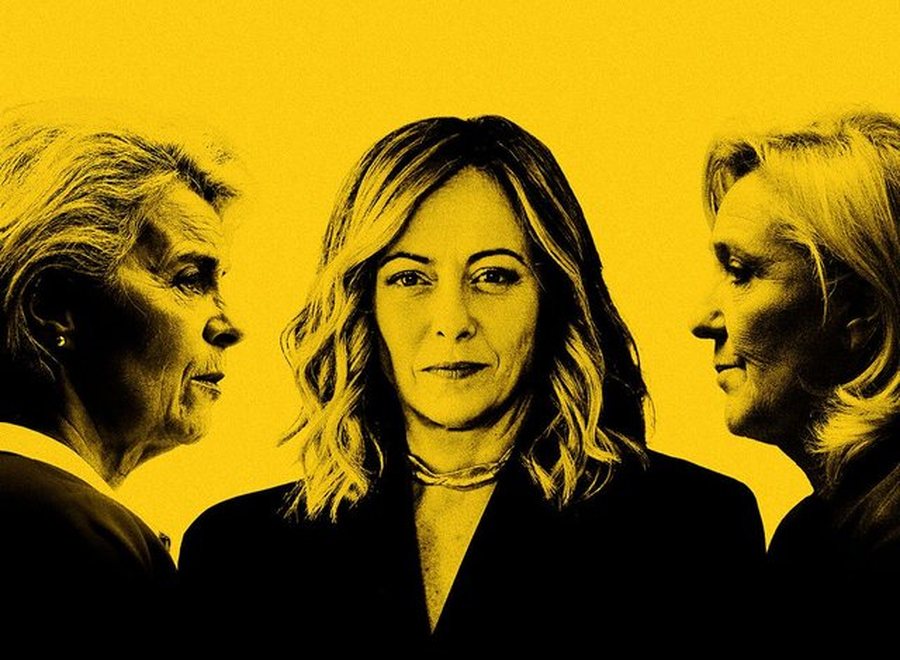
At a crucial moment, they are the key to the dilemma of how to deal with populism.
In a dangerous world, 'old' Europe finds itself in an alarming position. In Ukraine, the bloodiest war since 1945 continues, while Russia poses a threat to cyberspace. If Donald Trump returns to the White House, he could cause problems in NATO, the foundation of European security. The continent's economy is vulnerable to shocks caused by industrial policy and protectionism in other countries. Eurosceptic populists are moving up in the polls.
To face these risks, Europe needs, at least, a coherent leadership in the European Union. It should also keep extremists out of power. Whether it will succeed depends in part on the election of three women: Ursula von der Leyen, the president of the European Commission, Giorgia Meloni, the prime minister of Italy, and Marine Le Pen, France's leading populist.
Ursula von der Leyen has led the EU's executive arm since 2019 and is running for a second term. She deserves a second term. It has done a good job: marshaling the EU's strong collective response to Vladimir Putin's aggression and helping to deepen European integration at a crucial time, for example by pushing through a ground-breaking debt-issuance program common.
A cold-blooded German conservative, she has also put the European Commission at the center of decision-making when Franco-German relations have been strained. Given the threats, the need for strong and unified leadership has never been greater.
To win a second term, she first needs the support of the EU's 27 national leaders. Then, it must get a majority in the European Parliament, which will hold elections on June 6-9, with over 350 million citizens eligible to vote. In theory, it will enjoy the support of conservative, liberal and socialist groups.
But because politics has become so fragmented, these three groups are collectively predicted to win only a small majority of seats. Mrs. von der Leyen barely passed her first vote, in 2019. This time, victory is not assured.
This brings us to Ms. Meloni, Prime Minister of Italy from 2022 and leader of the right-wing Brotherhood of Italy (Fratelli d'Italia) party, which has returned, from an insurgent force, to running the country. It is expected to do well in the EU elections.
With her support, Ms von der Leyen may have a better chance of winning a parliamentary majority for a second term in the EU's top job. She has been on a date with Giorgia Meloni.
"I worked very well with Giorgia Meloni," she said on May 23.
Those words, and the idea of any sort of pact involving Mellon's party, have angered liberals and EU figures, including some in Germany's ruling Social Democratic Party and Emmanuel Macron's party in France. To them, Ms. Meloni is on the same level as Viktor Orbán, Hungary's strongman, and other unpleasant types. It lends credence to racist conspiracy theories. She has compared the EU with the Soviet Union. In short, Meloni is exactly the type of right-wing figure who should be excluded from decision-making.
Ms. Meloni, sure has a lot of politics and unpleasant qualities. However, to rule out working with him as a matter of principle would be a short-sighted decision. She has made a common cause, with Mrs. von der Leyen, on issues such as illegal immigration; the two women have made joint visits to North African countries, reaching agreements with autocrats to stem the flow.
She has been a strong supporter of Ukraine, unlike some of her peers on the populist right. Her party makes cultural wars at home, but for security and economy, she has run Italy as a pragmatist. It should not be shut out of the political stream.
Moreover, reaching a deal with him could have an additional advantage: dividing the populist right between its more moderate and extreme elements.
This is where Ms Le Pen comes in. Her party, National Rally, is expected to do well in the European elections as well. Ms. Le Pen has tried to rebrand herself as a leading figure, but don't be fooled. It has a long history of xenophobia and servility towards Russia. She wants to create a mega-group of nationalists, which can lead Europe to the right. To do this, she wants to team up with Mrs. Meloni.
After the outcome of the European elections, the 'bargaining' could drag on for months and will test Mrs von der Leyen's mettle. One way could provide stable leadership at the EU level and show how moderates can intelligently confront the populist right. The question is no longer whether the populists can be contained. It is how to respond to their growth.
Triple problem
The alternative route could be disastrous. European politics has become so fragmented that perhaps no parliamentary majority will be found for Mrs. von der Leyen or any other candidate for the presidency of the commission. This would trigger a constitutional crisis at a very bad time, as Ukraine is at war, as well as the possible presidency of Trump.
Furthermore, if Ms. Meloni sees nothing to gain from working with the center, she may be tempted to work with Ms. Le Pen. If they make the wrong choice, Europe's centrists could destabilize the EU and help create what they have long feared: a united, pan-continental far-right movement. To avoid this, it is worth 'dealing' with Mrs. Meloni./Monitor- The Economist




Lini një Përgjigje