


 Shkruar nga Goffredo Buccini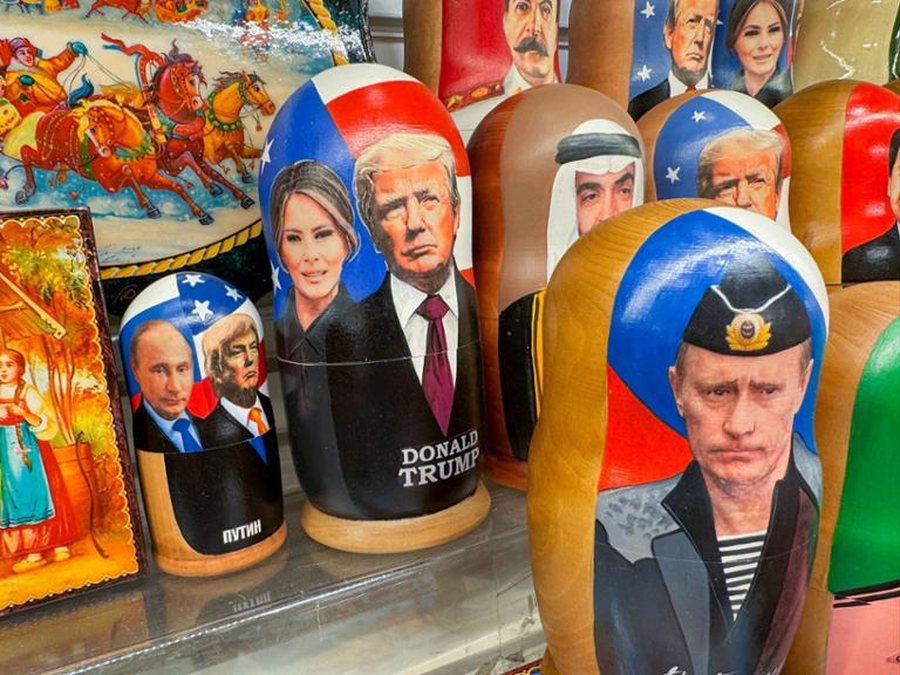
This is the picture. Everything, absolutely, pragmatic and everything to Putin's advantage...
In January 2016, ten months before winning the White House, Donald Trump showed full awareness of his growing popularity: "I could stand in the middle of Fifth Avenue and shoot someone, and I wouldn't lose a single voter."
In fact, he was not wrong. In the past nine years, Americans have forgiven him almost everything: convictions, abuses of power, verbal excesses, messy policies, even a failed uprising. But the question he must now ask is: can he, especially in the year leading up to the midterm elections, hand Europe over to Putin without losing a single voter?
Because that is what the highly controversial 28-point plan for Ukraine is really about, a plan that its special envoy for the war, real estate developer Witkoff, has apparently appropriated from the Kremlin's wishes: the de facto surrender of Kiev, under the published terms and conditions, would essentially expose Europe to the Russian dictator's wishes, with consequences and chain reactions that a leader like the US president, whose approval ratings are already falling due to inflation generated by tariffs and the Epstein affair, which has never really subsided, would be wise to consider in advance.
Remaining at the level of realpolitik, that is, leaving aside the inherent immorality of treating a free population as a chess piece in a game of chance in order to negotiate agreements with the aggressor without the attacked having any say except in the final “yes” or “no,” several critical issues are immediately apparent.
First: Russia's recognition of forcibly occupied territories (and not even fully occupied ones, since Moscow has controlled approximately 77% of Donbas in almost four years) would introduce a destructive principle into relations between states: since World War II, any war of conquest to change borders has always been considered illegal. It is true that international legality is a very vague concept, as demonstrated by the long paralysis of the United Nations on the world's most sensitive issues.
However, once again, we are not talking about principles, but about substance: the idea that a stronger state can take whatever it wants, at the expense of its weaker neighbors, would have a practically immediate effect on Taiwan. With what authority would Americans have to object if Beijing decided to impose its hand on the untamed island, after having given the green light to the Russians in Ukraine? Could Trump really afford such a backlash without paying the price this time too?
Second: As Timothy Snyder, a historian who chose to leave Yale to gain more freedom to criticize Trumpism, aptly explains, “in effective negotiations, concessions are not made in advance”: in this case, there is no hint of negotiation, but simply appeasing the school bully.
Faced with this scenario, Europeans and Asians may conclude that they must soon equip themselves with nuclear weapons (at least tactical ones) to avoid the fate of Ukraine, given that the Russians have relied on nuclear deterrence from the beginning to quietly believe that they cannot be punished, even when Joe Biden, not their friend, was in the White House. A visible effect of Trump’s unreliability as an ally is, as Federico Rampini explained, the rearmament of Japan and Germany, respectively, in the face of threats from China and Russia in their sensitive regions. In Le Grand Continent, analyst Stéphane Audrand goes straight to the heart of our weaknesses: with a shaky pillar of the Alliance like Trump and institutions designed for a time of peace and trade, Europe seems powerless when faced with the Kremlin.
"To dispel fear, we must learn to manage it. Once the impact of this fear is acknowledged, we must confront it and ensure that the dialogue with Russia returns to the path of rational calculation and prevention; not by sowing terror itself, but by being firm and credible," explains Audrand.
The anti-drone wall envisaged by the EU is not enough, because it is based on the implicit and false idea that Russia cannot be hit and that for this reason we must build shields, unable to draw our swords. The "sword" we are talking about is, of course, nuclear proliferation. The more nuclear bombs, the greater the risk that someone will use them: is this really the result of Trump's famous "transactional" doctrine?
Third. Europe, cut off from the negotiating table, will suffer the side effect of a very present danger for those European countries burdened internally by territories that Putin may wish to "protect", such as Moldova (facing Transnistria) and Lithuania (with the Kaliningrad enclave). This is without taking into account the certain increase in hybrid warfare actions, already carried out by Moscow with its famous "under the threshold" aggressiveness: that is, with risky, daring operations, but not enough to provoke a justified reaction from NATO, such as the 25 drone attacks on Europe in just a few weeks.
This is the picture. Everything, absolutely, pragmatic and everything to Putin's advantage. It is possible that sooner or later the Americans will ask themselves why they have been so accommodating towards a historical adversary of the United States./ Adapted from "Pamphlet" by "Corriere della Sera"


Lini një Përgjigje