


 Shkruar nga Diplomatico | Pamfleti.net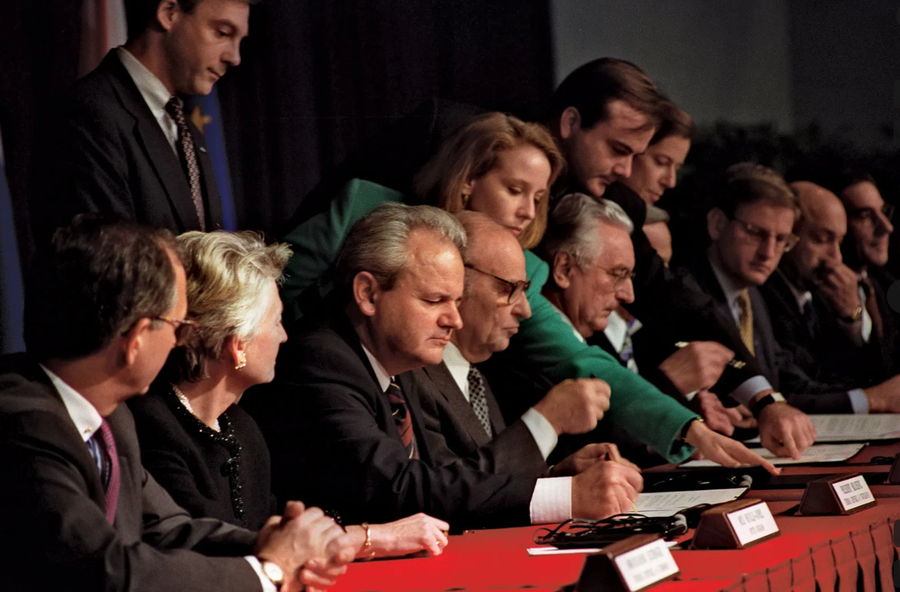
The Dayton Accords were signed by the presidents of Bosnia, Croatia, and Serbia to end the war in Bosnia and Herzegovina. This agreement established a General Framework Agreement for Peace, whereby Bosnia remained a single state with two main parts: the Bosniak-Croat federation and the Republika Srpska, with Sarajevo as its undivided capital.
The negotiations took place at Wright-Patterson Air Force Base near Dayton, Ohio, and were led by Richard Holbrooke, the chief American negotiator, and US Secretary of State Warren Christopher.
The war in the former Yugoslavia erupted in the early 1990s, following the breakup of the federation that included Bosnia, Croatia, Serbia and other states. After Croatia and Bosnia declared independence, ethnic Serbs opposed the breakup through armed struggle, while Croats and Bosniaks also fought over territory.
Serbian separatists were backed by Yugoslav President Slobodan Milosevic, who aimed to bring territories under Belgrade's control. They used brutal tactics to expel other ethnic communities, including murder, rape and Nazi-style concentration camps.
In Croatia, the war ended in January 1992 with a fragile ceasefire between the Croatian government and the Serbs. Meanwhile, in 1994, the Bosnian-Croat federation was created after an agreement in Washington, but fighting with the Serbs continued.
NATO intervened in February 1994, shooting down Serbian planes that violated the no-fly zone and carrying out airstrikes in early 1995. In the summer of 1995, Bosnian and Croatian forces recaptured large areas of territory from the Serbs through “Operation Storm,” the largest offensive in Europe since World War II.
The US, under the authority of President Bill Clinton, trained the Croatian army, changing the balance on the ground and leading to a radical psychological and military shift. At that stage, Washington and its allies offered a framework for peace, while NATO carried out airstrikes to force the Serbs to accept negotiations.
In late August 1995, airstrikes increased due to a new Serbian attack on Sarajevo. In September, the first talks were organized in Geneva, Switzerland, and on September 14, an agreement was reached between Serbian leaders to end the more than three-year siege of the Bosnian capital.
The conference to end the war began on November 1, 1995 at Wright-Patterson Air Force Base. Presidents Alija Izetbegovic, Slobodan Milosevic, and Franjo Tudjman, along with representatives of world powers, met and then signed the General Framework Agreement.
The document confirmed the sovereignty and integrity of the participating states, the peaceful resolution of disputes, and respect for human and refugee rights.
The agreement, re-signed on December 14, 1995 in Paris by world leaders such as Bill Clinton, Jacques Chirac, John Major and others, provided for cooperation with the United Nations and the investigation of war crimes in the region.
Since its signing, the Dayton Agreement has secured peace in Bosnia and Herzegovina. Its Annex 4 is the current constitution, which remains essential to the governing structure and political balances in the country.
The agreement has also helped in broader military processes in the Balkans, including NATO's action in Kosovo in 1999, which also brought about its independence. The war in Bosnia and Herzegovina left over 250,000 people dead and wounded, and millions displaced.
The Dayton Agreement ended the conflict, creating a multiethnic state that aims to guarantee rights and security for all communities involved. Although it has been frequently criticized over the past 30 years for creating complex and often ineffective political structures, it still stands as an international model for peaceful intervention and building democratic relations after ethnic conflicts.
Other important events:
November 21, 1620 - 41 men from the ship "Mayflower" signed the Mayflower Compact, a founding agreement for the governance of the new colonies in America, laying the foundation for co-government in New England.
November 21, 1694 - French philosopher and writer Voltaire was born, one of the central figures of the Enlightenment, known for his works in the field of political and social thought.
November 21, 1791 - Napoleon Bonaparte was promoted to the rank of general and commander of the French army, marking the beginning of his military and political career.
November 21, 1877 - Thomas Edison publicly announced the invention of the phonograph, the first device that allowed the recording and reproduction of sound. This discovery revolutionized music technology and communication.
November 21, 1964 - The Verrazano Narrows Bridge, connecting the boroughs of Brooklyn and Staten Island in New York City, is inaugurated. At the time, it was the longest suspension bridge in the world.
November 21, 1969 - An agreement is signed between US President Richard Nixon and Japanese Prime Minister Eisaku Sato for the return of Okinawa to Japan in 1972, but preserving the US right to military bases without the presence of nuclear weapons.
November 21, 2002 - NATO invited Bulgaria, Estonia, Latvia, Lithuania, Romania, Slovakia and Slovenia to join the alliance, marking a significant expansion of the Western military organization./ Pamphlet






Lini një Përgjigje