


 Shkruar nga Pamfleti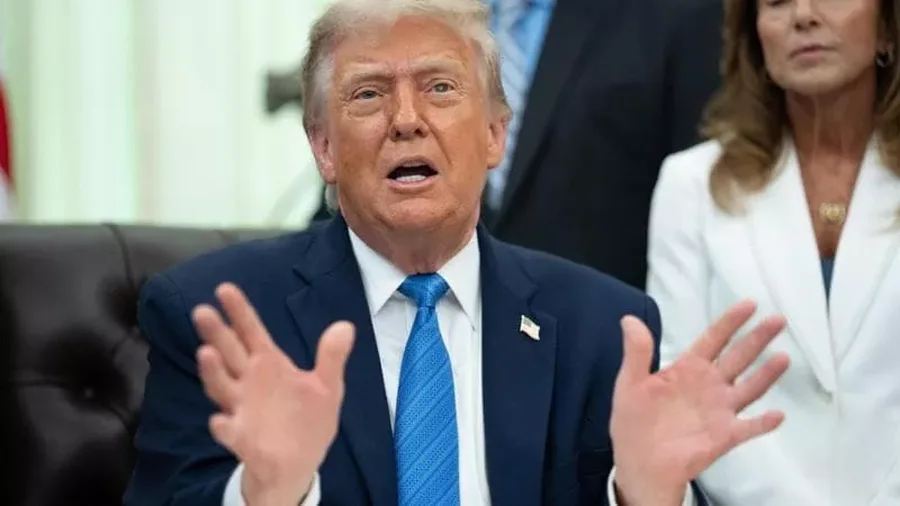
The US president warns of new attacks on Iran and threatens to expand the offensive, while diplomatic efforts for an agreement remain deadlocked and tensions in the Persian Gulf continue to rise.
"Yesterday we hit Iran hard and we will do it again today." With these words, US President Donald Trump warned from the Oval Office that the response to the downing of an American Apache helicopter over the waters of the Strait of Hormuz was not over.
A little earlier, through social networks, Trump had warned of expanding the American response to the civilian infrastructure of the Islamic Republic, accusing Tehran of dragging out negotiations and refusing to sign the agreement that, according to him, is already on the table to end the conflict.
The president then held a Situation Room meeting with military advisers to determine the next targets. At 5:15 p.m. local time, the Pentagon confirmed the launch of the second wave of strikes.
Explosions were reported in the Hormuz area, including Bandar Abbas, Sirik, Qeshm Island, Minab, Hengam and Hormozgan province. Anti-aircraft systems were also activated in Tehran.
It remains unclear whether these actions are intended to exert pressure through force for the purpose of negotiations or signal a new escalation of the conflict. The situation is developing at a time when inflation in the US has reached its highest level in the last three years, a factor that could affect the White House's political calculations ahead of the November midterm elections.
The Pentagon has not yet clarified whether the Iranian drone that shot down the Apache helicopter had it directly targeted or if it was an accidental incident. However, Washington described the response as proportionate to the alleged aggression.
According to US authorities, the attacks targeted air defense systems, control centers and radars, mainly in the southern regions of Iran and near the Strait of Hormuz.
Meanwhile, the US military hit the engines of a Palau-flagged tanker, the "Settebello", in an attempt to neutralize it and prevent it from violating the naval blockade. Three Indian sailors are missing, prompting reactions from New Delhi. Iran has also denounced attacks on two water tanks in Sirik.
In an interview with the Wall Street Journal, Trump downplayed the helicopter incident, noting that the two pilots were not injured. However, on social media he took a harsher tone.
"Iran is all talk and no action. The Middle East bully is dead. They wasted time negotiating a deal that would have been very favorable to them. Now they will have to pay the price," he wrote.
In another tweet, Trump declared that the US naval blockade is "a wall of steel" that is hindering the movement of goods and exerting severe pressure on the Iranian economy.
He also revealed that last month he had authorized a secret mission to support tankers and merchant ships as they pass through the Strait of Hormuz.
"Today I am pleased to announce that this effort has made it possible to transport more than 100 million barrels of oil. Over 200 commercial ships have safely passed through the strait," the US president declared.
However, a little later, in an interview with Fox News, Trump said he was considering expanding the military offensive to include Iran's energy and electrical infrastructure.
Iranian chief negotiator, Mohammad Bagher Ghalibaf, reacted by stating that "threats to civilian infrastructure are a sign of desperation."
From the Oval Office, Trump reiterated that the attacks launched on Tuesday will continue.
"The deal is ready. It's the Iranians who should sign it, but they're making fun of us," he said.
According to the US president, Tehran has also rejected a meeting with US mediators. Meanwhile, representatives from Qatar have returned to the Iranian capital in an attempt to unblock the diplomatic process.
Taken together, these developments suggest that the US administration is using military pressure as a tool to push Iran towards signing an agreement. However, in a climate of rising tensions, the risk of further escalation remains present, whether as a result of political decisions or due to incidents during operations on the ground./Adapted from "La Repubblica"


Lini një Përgjigje