


 Shkruar nga Sophia Yan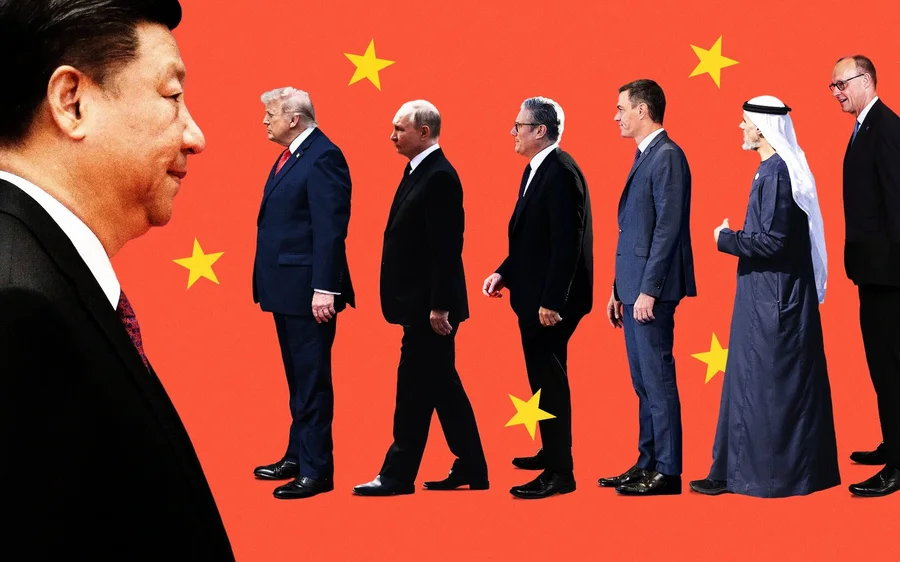
Xi Jinping is using Beijing's diplomatic clout as Donald Trump stumbles in Iran and Vladimir Putin remains stuck in Ukraine...
Xi Jinping is seizing the moment. With Russia engaged in Ukraine and the United States involved in Iran (as well as Venezuela, Cuba, and Greenland), the Chinese president has taken center stage on the international stage.
This year alone, Xi has hosted nearly 20 world leaders in Beijing, in an intensive series of meetings that Chinese state media calls "Xiplomacy."
In search of stability and closer relations, Keir Starmer, Friedrich Merz, Mark Carney, Shehbaz Sharif, Lee Jae-myung and others have traveled to the Chinese capital, each with their own specific demands and interests.
Xi seems to be the man everyone wants to talk to. Donald Trump and Vladimir Putin arrived in Beijing within a week of each other, presenting Xi as a modern emperor to whom leaders must bow. That is a significant advantage as he prepares for an unprecedented fourth term, which is expected to begin in the fall of next year.
Now Xi is preparing for his first foreign trip this year, a visit to neighboring North Korea to meet with Kim Jong-un. Historically, such a development would have caused concern in the West. Today, not so much.
This is a remarkable change.
Just a few years ago, China was largely isolated on the international stage. Many countries considered it the source of the coronavirus pandemic, criticized it for human rights abuses against Uyghurs, and opposed it for its harsh diplomatic clashes with the West, particularly over its so-called “hostage diplomacy” practices.
But Xi is patient and adaptable.
He still maintains his intentions towards Taiwan. He still continues his verbal clashes with the Japanese prime minister. In fact, he is playing a long-term game.
“This wave of high-level engagements has conveyed a clear message: in a turbulent and changing global landscape, China is widely seen as a source of stability, prompting countries to look East for cooperation and development opportunities,” a Chinese state media article wrote in February.
However, the question remains where Xi's true loyalties lie.
His motives are often difficult to understand, as he receives with the same ceremonial Western leaders from the "Five Eyes" alliance, but also autocrats from various countries around the world.
The human rights situation in Turkmenistan, Tajikistan, Vietnam and the United Arab Emirates still has much room for improvement, yet the leaders of these countries received the same red carpet welcome as Mark Carney or Pedro Sanchez.
Most importantly, China has provided Iran and Russia with vital economic support, helping them cope with the consequences of international sanctions. While both countries have been embroiled in wars, China has also provided them with material support.
In the case of Russia, China has trained some of Russia's officers and exported products ranging from drone components to industrial machinery, enabling Putin to continue producing weapons for use in Ukraine.
As for Iran, China has supplied chemical precursors for ballistic missiles and, according to claims, has also shared satellite imagery to help identify targets for US bases in the Middle East.
Instead of holding China accountable for these actions, the Trump administration has tried to bring Xi Jinping closer to exerting pressure on Iran in search of a resolution to the conflict.
The ball was in Xi's court, but he chose to let it stay there.
China will do little to help the US, which it considers a strategic rival. Xi will only get involved if Beijing sees a clear benefit.
It is for this reason that Xi and other Chinese officials have repeatedly called for a peaceful resolution of the conflict so that global trade can resume normally through the Strait of Hormuz.
This message was conveyed to Abbas Araghchi, Iran's foreign minister, during his visit to Beijing in early May, when talks between Tehran and Washington were still underway.
And that will likely be the limit of Beijing's engagement. The Chinese government is primarily aiming to mitigate the economic fallout that China, the world's largest exporter, would feel if Iran were to close the Strait of Hormuz. /Adapted from The Telegraph/


China has decades world leader. Every single product has a stamp ‘Made in China’. What do you want more to understand.