


 Shkruar nga Pamfleti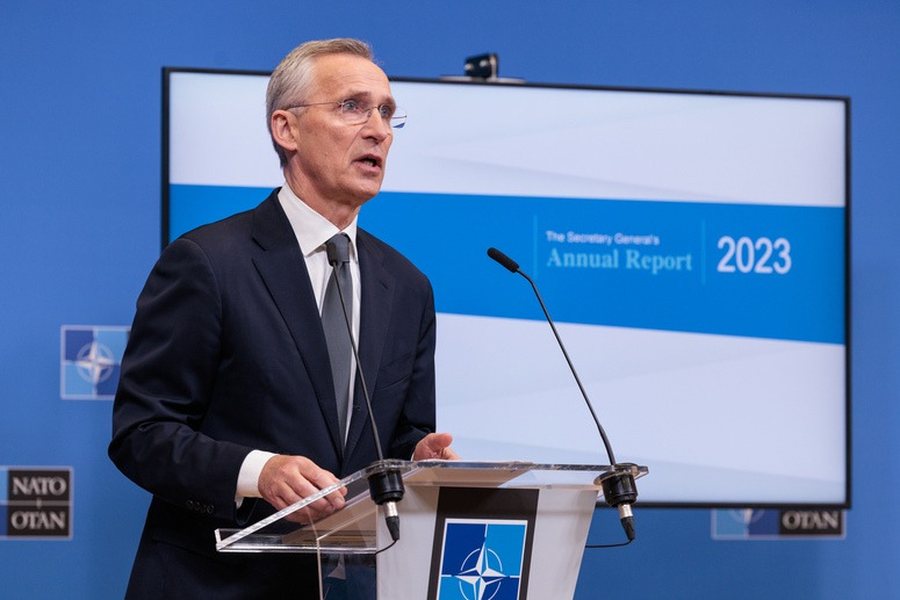
NATO has sounded the alarm regarding the danger posed to the world by Russia, but also what may happen in the Balkans as a result of the war in Ukraine. Today, Jens Stoltenberg submitted the 2023 annual report on NATO's commitment, a report in which the entire commitment of the alliance is shown.
"Pamphlet" has provided the full report, in which we have separated two elements. The part that talks about the risk of a nuclear war, as well as the increase in threats in the region. NATO makes it clear that Russia has increased its nuclear arsenal, while Kosovo clearly states that they will not allow Serbia to return to the former tensions.
PART OF THE NATO REPORT
Nuclear danger
For many decades, NATO has tried to create partnerships with Russia. Despite this, over the last decade Russia has repeatedly violated the norms and principles that contribute to a stable and predictable European security order. Russia's brutal and illegal military aggression against Ukraine, which began in February 2022, has destroyed the hard-won peace in Europe.
As NATO's Strategic Concept 2022 makes clear, Russia is the most significant and direct threat to the security of NATO member states and to the peace and stability of the Euro-Atlantic region. Russia seeks to create spheres of influence and direct control through coercion, subversion, aggression and annexation. It uses conventional, cyber and hybrid means against NATO and its partner countries. Its coercive military capabilities, rhetoric and proven willingness to use force to achieve its political goals undermine the rules-based international order. The Russian Federation is modernizing its nuclear forces and expanding its new and advanced dual-use delivery systems, while using the threat of nuclear weapons for coercive purposes. The goal is to destabilize countries to the east and south of us. In the High North, its ability to impede the strengthening of NATO countries and freedom of navigation across the North Atlantic is a strategic challenge for the Alliance. Moscow's military rise, including the Baltic, Black and Mediterranean regions, together with its military integration with Belarus, poses a challenge to the security and interests of the Alliance.
Chuang
NATO's presence in Kosovo remains crucial for the stability of the Western Balkan region. The mandate stems from UN Security Council Resolution 1244, adopted in 1999. Since then, NATO has continued to work to help maintain a safe environment for all communities in Kosovo and freedom of movement, in close cooperation with the European Union, the United Nations and other international actors.
The Secretary General reinforced NATO's strong commitment to the mission during his visit to Kosovo in November, as part of a tour of the Western Balkans. In 2023, the Kosovo Force played a critical role in ensuring stability in Kosovo amid rising tensions and increased instability in the north.
The Alliance has decades of achievements in building defense institutions and capacities with partners in the NATO neighborhood and beyond. NATO also has unique capabilities and expertise in crisis management, including coordinating, directing and supporting crisis response operations in Kosovo. After the violence in May and September, the Allies deployed about 1,000 reserve troops, providing the biggest reinforcement in a decade. This enabled the Kosovo Force to triple the number of patrols and quadruple their presence in the north.
NATO remains committed to supporting the EU-facilitated dialogue between Belgrade and Pristina. The dialogue is the main platform for finding a solution that respects the rights of all communities and building a lasting peace that benefits security and stability throughout Kosovo and the entire Western Balkans region.
NATO's engagement in the Western Balkans
NATO remains strongly engaged in the Western Balkans, a region whose stability is of strategic importance to the Alliance. In November, the Secretary General visited Bosnia and Herzegovina, Serbia and the Headquarters of the Kosovo Forces. The visit sent a strong signal that NATO will have a lasting commitment to peace and stability in the Western Balkans, against the background of a complex environment in terms of regional and global security. / Pamphlet





Lini një Përgjigje