


 Shkruar nga Pamfleti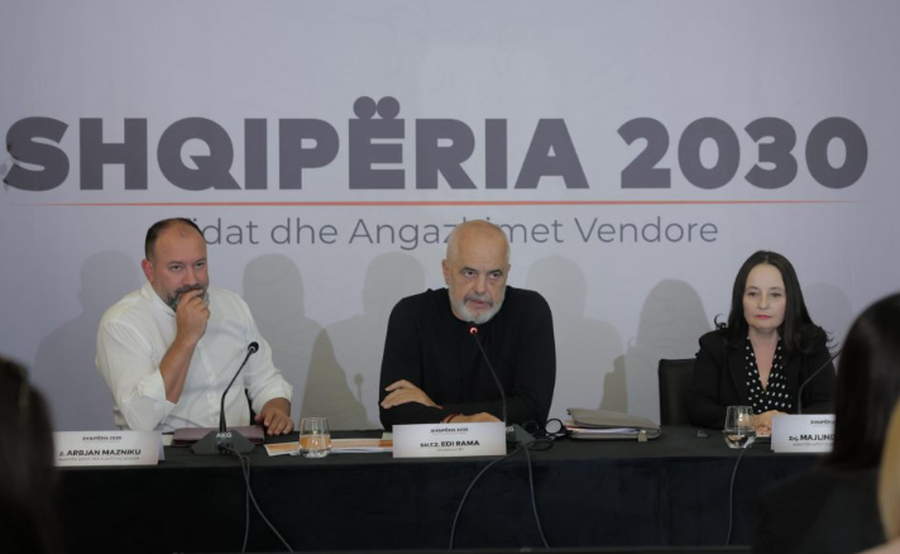
Edi Rama invents the "new school of local government", where instead of cleaning up the administration, he certifies and recycles the leaders of municipalities under investigation; an authoritarian farce that collapses local autonomy and legitimizes political patronage...
After the "Party School" for new SP MPs, Prime Minister Edi Rama has decided to create the "Local Government Academy", a training platform for municipal leaders and officials, which in fact represents another form of centralization and government intervention in local government.
This academy will function under the direction of a committee of “lecturers” selected by the municipalities and the Ministry of Local Government, while the executive management will be held by a civil society organization that, according to the government’s decision, will be appointed by the prime minister himself. Although it is presented as a mechanism for increasing the performance of local administration, with the aim of fulfilling obligations for European integration, in reality this is an instrument of political control by the central government.
The training of local officials is a legal process that belongs only to the Department of Public Administration and must be carried out prior to appointments, based on competitive procedures. However, in most cases, deputy mayors, unit heads and current directors have been appointed through political interference, clientelism and direct influence of the prime minister or deputies and exponents of the areas.
The majority of this local administration has been involved in a series of abuses, signing tenders, contracts and decisions that have led to the misuse of public funds, often to the detriment of the citizen interest. However, no legal measures have been taken against them. This shows that the government itself has maintained this patronage network to keep decision-making in the territory under control.
Instead of truly cleansing the municipal structures of individuals involved in affairs, the government is building an “academy” that aims to retrain and “certify” them to return them to the same positions. In this process, figures like Blendi Gonxhe, one of the most politically exposed names linked to the control of the administration and questionable appointment practices, has been placed at the head of this “reform”. Ironically, the leaders involved in abuses are becoming part of a training that on paper aims to fight corruption.
Many of the municipal leaders expected to be included in this process are currently under investigation by SPAK or mentioned in reports by the Supreme State Audit for serious financial irregularities, including cases in Durrës, Fier, Elbasan, Lushnje, Roskovec, Pogradec, Kamëz, Rrogozhinë, Saranda, Tepelena, etc.
In this context, the establishment of the “Academy of Municipalities” constitutes an act with direct constitutional and administrative consequences. It is an attempt to justify an open intervention by the central government in the powers of local self-government, through a structure that exceeds any legal limits of the separation of powers.
This is not reform. It is a strategy to reassert control over a territory that no longer guarantees political allegiance. It is an attempt to “rebrand” the loyalists, to bring them back onto the scene with a new logic, but with the same goals: total control over the country's public resources and administrative territory.
If this intervention were legitimate, it would include consultation with opposition municipalities and independent institutions. But the reality is the opposite: the very SP leaders who dared to oppose this line have been placed under strong political pressure.
This is another act of stripping local government of the autonomy guaranteed in the Constitution, and consequently, an alarm signal for all international partners seeking to strengthen decentralization in Albania./ Pamphlet



Lini një Përgjigje