


 Shkruar nga Maurizio Ambrosini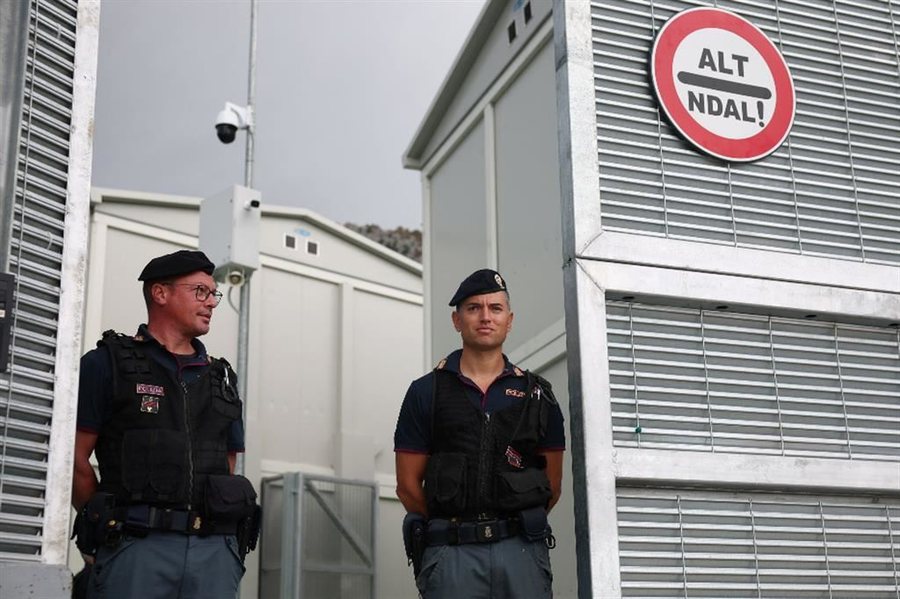
Millions of euros spent more. The expected management costs are huge: 800 million euros from now until 2028, all borne by Italy, but with employment and economic consequences outside our country.
The Meloni government has announced the opening of two centers for the treatment of asylum seekers in Albania. After a few procrastinations, maybe this time it will really work.
To achieve the objective, it turned to emergency procedures, which bypass the restrictions and guarantees of normal tenders.
There will be two centers: one in the port of Shengjin, intended for identification and entry procedures, with a capacity of 200 places.
The construction cost is 3 million euros, plus 200,000 for connections in 2024 alone, the other, in Gjadër, includes a detention facility for asylum seekers (880 places), a CPR (144 places) and a prison (20 places).
Millions of euros spent more. The expected management costs are huge: 800 million euros from now until 2028, all borne by Italy, but with employment and economic consequences outside our country.
To justify the controversial initiative, the government took two positions:
- in front of the guarantee institutions and in European and international forums, he spoke about a solution aimed at increasing the capacities for receiving and examining applications.
- in front of internal public opinion and his supporters, he did not hesitate to talk about a preventive measure against possible departures.
The fact that only adult men rescued from military ships and coming from countries classified as safe will be held in both centers confirms the punitive intent of the project and therefore the objective of spreading fear. It is no coincidence that the inspiration came from the British project to deport immigrants who landed by sea in Rwanda.
The questions concern both the practical-operational level and the level of principles.
First of all, the government's plan focuses on a fraction of asylum seekers: 39,000 cases a year, compared to 52,425 on October 11, although a decrease compared to last year.
But the calculation is based on the hypothesis of processing applications in four weeks, thanks to an accelerated procedure, while today it takes on average more than a year, often two.
Online connections with Rome and other procedural obligations are foreseen, which will not escape the examination of the judicial bodies. In order to speed up the process, applicants' rights have been compressed, leaving them very little time to prepare for the hearing, gather useful documentation to support their application and appeal to justice in case of rejection. As for the list of safe countries, it suffices to recall that the Italian list has recently expanded to 22 countries, including Egypt, Tunisia, Nigeria, compared to only nine in Germany.
Therefore, the very suspicious cases, "cleared" a priori to increase asylum refusals: not repatriations, which are much more complicated and expensive.
It is also unclear what will happen to applicants whose applications are rejected. Based on the limited capacity of the Italian authorities to carry out repatriations, it seems neither fair nor realistic to think about a release in Albania, which Prime Minister Edi Rama has opposed.
There may be a paradoxical result of transferring rejected applicants to Italy. Faced with a world in which humanitarian crises are multiplying, the answer is that of a limitation of humanity: the obstacle to the rescue of NGOs, the almost removal of special protection, funding and support for the authoritarian governments of the southern shore of the Mediterranean.
It may be that today's EU is more willing to tolerate these measures, but the mobilization of conscience, already so alive in many solidarity initiatives, is required to respond with welcome affirmation and support. / Taken from "Avvenire" , adapted by "Pamphlet"






Lini një Përgjigje