


 Shkruar nga Gjergj Zefi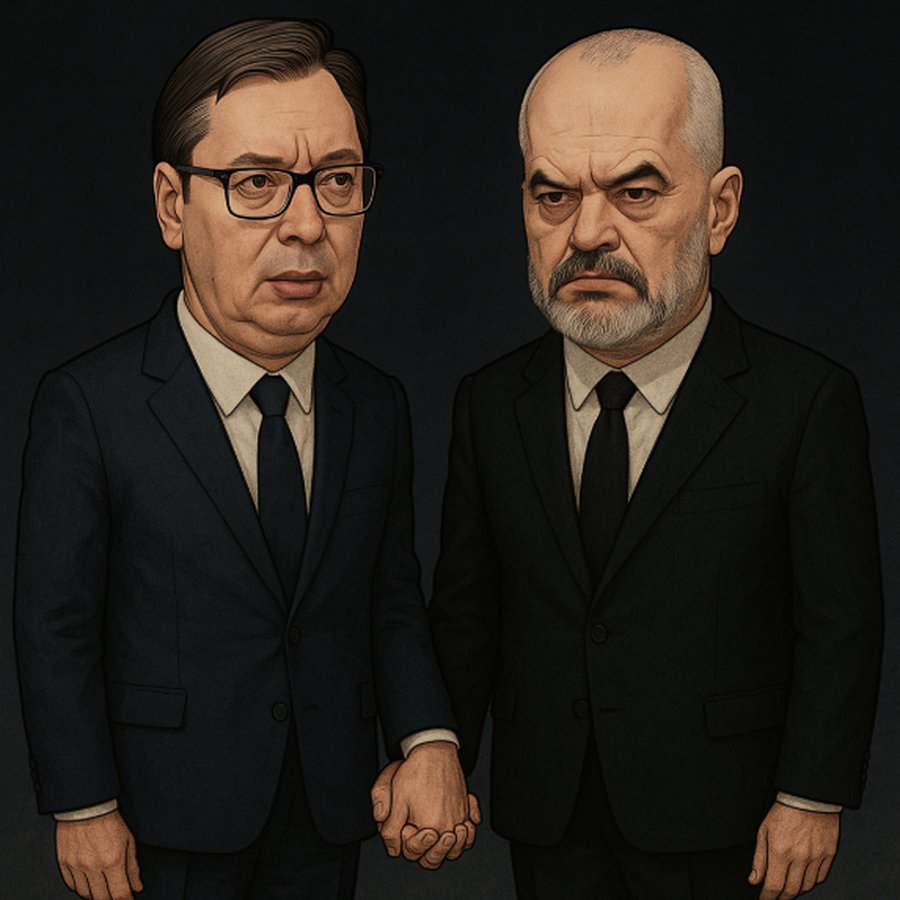
Supported by crime, closely linked to the financial oligarchy, legitimized by internationals; a power model that is destroying democracy in the region...
Aleksandar Vučić and Edi Rama, although coming from countries with different histories, share the same governance model: capturing the state from within, weakening institutions, and creating a clientelistic system, where the leader is the central institution. This model, known as "Balkan leaderocracy," is transforming governance into a vertical system.
Vučić has absolute control over the government, parliament, judiciary and public media. He has built a system where every important decision passes through his hands. Rama has followed a similar path, turning Parliament into an extension of the Prime Minister’s office, with laws passed without debate and without scrutiny, turning the government majority into an instrument for formalizing his personal will.
Both leaders have been accused of manipulating justice reforms. Rama, through his influence over the High Prosecutorial Council and vetting institutions, has influenced the selective cleansing of the system and the political control of SPAK. Furthermore, he has also usurped local government, where the Socialist Party controls all municipalities in the country. This reality has created a system without a balance of powers, where the citizen is simply a spectator in a "formal democracy".
Both Vučić and Rama have destroyed the normal functioning of the opposition. They portray the opposition as an enemy of the state and refuse to accept sincere dialogue. Rama has encouraged the division and dissolution of the opposition, leaving Albania without a real political alternative.
Both leaders are masters of political marketing. Vučić presents himself as a stabilizer in the Balkans, while Rama is a pro-European reformer. But in practice, both are undermining the foundations of democracy and the rule of law, hiding reality with empty slogans.
A critical element that unites them is their suspicious connection to mafia structures. Reports published by the Organized Crime and Corruption Reporting Project (OCCRP) and the Global Initiative Against Transnational Organized Crime (GI-TOC), in Vučić's case, speak of the government's connections to criminal networks in Serbia and the region.
In Albania, Freedom House's 2024 report highlighted that "political clientelism and the influence of criminal groups over the administration and public tenders is increasing."
Through a patronage system, both leaders have enabled public assets to be controlled by political clients and local oligarchs. Privatizations, concessions, closed tenders, and PPPs have served as mechanisms to transfer common wealth into the hands of power-linked minorities.
In both countries, Transparency International reports assess the level of corruption as "high and systemic."
The Vučić-Rama model is not just a domestic problem. It endangers the long-term stability of the region, producing disillusionment, mass emigration and extreme polarization. The lack of domestic democracy is also a threat to Euro-Atlantic security, as recent reports by the European Stability Initiative and the German Bundestag warn./ Pamphlet




Lini një Përgjigje