


 Shkruar nga Pamfleti
The budget is a social "contract", which determines what services and investments the government will provide, in exchange for the taxes it receives from its citizens.
The lower the budget of a country, the more efficiently it should be used. There are entire global manuals that talk about the good management of taxpayers' funds.
Especially in low-income and low-capacity countries, national budgets become difficult to manage efficiently, regardless of purpose.
Albania enters the countries with the lowest budget in Europe, with expenses that are as much as 30% of the Gross Domestic Product (GDP), from about 40% which is the European average, dictated by the low incomes, which do not have ever exceeded 28% of GDP.
As such, the focus of the budget should be fiscal control to support macroeconomic stability, reduce risks, increase spending efficiency, with the aim of improving welfare and reducing poverty.
But this social contract does not seem to have found justice. From 2017 to 2024, the budget has paid and is expected to pay (including next year) 86 billion ALL (about 800 million euros) for 12 concession contracts of the Public-Private Partnership (PPP) type.
For six of these contracts, the investigation by the Special Anticorruption Unit (SPAK) has been opened, with accusations of corruption, abuse of office, cleaning of the proceeds of the criminal offense, where it has been proven that the budget money was wasted.
The total value of these 6 concessions for the period 2017-2024 is almost ALL 40 billion, which is on average half of the capital investment budget in one year.
Of this amount, about 25 billion ALL are only health concessions, which would be enough to build 4-5 new hospitals.
Although SPAK is in operation, payments for PPPs are increasing by 9.3% in the 2024 budget. There is no "culprit" either for the wrong decisions, which have led to a bill of 195 million euros (this is only the amount of accepted by finance) for damages against the decisions of the Human Rights Court in Strasbourg (ECtHR) and the Court of Arbitration.
The country no longer has the luxury of bearing the cost of missing justice. In 2021-2022, the state budget was "inflated" by the effect of price increases, which made it possible to receive more taxes on consumer goods and high profits of energy companies, influenced by the increase in prices on the stock exchanges.
However, these two factors are not expected to operate in the following year. Tourism was another stimulus to the economy - which fortunately cushioned the decline in consumption from high emigration - but which operates seasonally, leaving it uncovered for the following months, until their massive return.
Business signals in the latest confidence survey, published by the Bank of Albania, were for a decline in sales and orders, even for construction, which has experienced a real boom in recent years.
Budget revenues in September were negative, indexed to inflation and economic growth. Even finance itself, in 2024, expects real income 0.4 percentage points lower in relation to GDP (27.7% of GDP).
On the other hand, the monetary policy will continue to remain tight. The Bank of Albania raised the key rate for the sixth time in two years, taking it to 3.25% recently, as a mechanism to combat inflation, which continues to remain high.
Unlike last year, when prices were "inflated" by imports, they are now being influenced by internal factors, such as the structural problems of the economy with truncated agriculture and low competitiveness, and the administrative increase in wages, not associated with productivity.
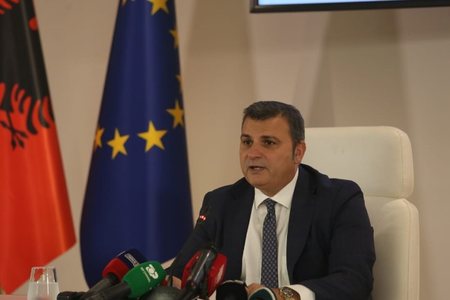
The governor's warning is that the tightening trend will continue and the IMF has advised that the rate reaches 4.5%, affecting the cost of money, which will inhibit investments and borrowing by businesses and individuals, but also increasing the costs of government debt.
So far, the social contract between the government and taxpayers has not been implemented. The money has been used in a significant part for corrupt projects and therefore, any attempt to increase taxes to increase the budget feels more like fiscal repression, because in the other direction, that of income, the social commitment is not being respected. As the belt is being "tightened", we have to wait and see if justice will be able to restore this balance./ Monitor


Lini një Përgjigje