


 Shkruar nga Pamfleti
The crisis in the Middle East could have far-reaching consequences beyond fluctuations in energy prices. According to American analyst Martin Armstrong, geopolitical tensions risk triggering a domino effect that would hit the international banking system and sovereign debt...
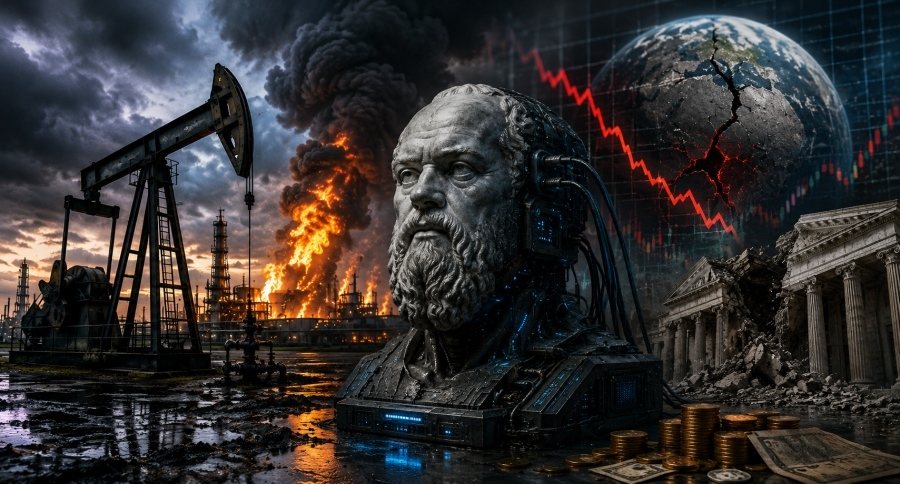
A new global financial shock appears to be taking shape, closely linked to developments in Iran and the risk in the oil market. According to the computer model “Socrates”, developed by renowned financial and geopolitical analyst Martin Armstrong, a domino effect has begun that will not be limited to the energy sector, but will also spread to the banking system and global debt markets.
According to Armstrong, the question is no longer whether there will be financial turbulence, but how severe it will be. He recalls that in May he warned that Iran could strike the United Arab Emirates with the aim of causing a financial collapse.
Then, the signing of a Memorandum of Understanding (MOU) between the US and Iran created the impression that tensions were easing. At that time, the price of oil fell below $70 per barrel and there was a belief that a 60-day ceasefire could pave the way for stabilization.
However, according to him, the situation has changed radically. The Iranian attacks, the US response and the escalation of the conflict show that the crisis is far from over. “Iran is not stupid. During the Covid-19 pandemic, the price of oil fell to $ 6.50 per barrel, below the cost of production. Governments were forced to borrow to survive and that debt still exists. In other words, a sovereign debt crisis could begin in the Middle East,” Armstrong says.
He adds that the perception that the Gulf countries are flush with cash no longer matches reality. “People believe that the Middle East has endless financial resources, but that’s not true. Even those countries are burdened with debt. Iran is hitting Gulf refineries and targeting the Strait of Hormuz. They know that the US is largely self-sufficient in energy, while the biggest impact will be felt in Europe and Asia.”
According to Armstrong, the main objective is the financial weakening of the Gulf countries.
“If they fail to export oil, they will not be able to repay the loans. Defaulting on loans could cause a banking crisis that would spread to London. The situation is much more complex than most people think. Donald Trump understands that the risk goes far beyond the Strait of Hormuz or the price of oil.”
Peace agreement remains distant
Armstrong also expresses skepticism about the possibility of a peace agreement with Iran.
"There will be no peace deal with Iran, as the interests of the parties are incompatible. Trump is trying to keep his distance because of the midterm elections, while Benjamin Netanyahu needs a political victory to secure the support of the electorate."
According to him, the opposition in Israel is increasing the pressure on Netanyahu, arguing that he has not achieved concrete benefits from the crisis. "If he accepts peace, he practically loses the election. Polls show that 61 percent of Israelis are against him," Armstrong says.
For this reason, he does not expect an agreement with Iran to be reached during the rest of the year, estimating that tensions could continue until 2027.
As for the markets, Armstrong predicts strong fluctuations for both oil and gold. “The Middle East is in chaos. Oil prices could rise again after a possible low in July, while gold could find the end of the correction this week and resume growth in August.”
Finally, he reiterates his belief that the Democratic Party in the US is facing a deep process of division, while for Europe he predicts a further escalation of tensions with Russia.
According to Armstrong, "there is a climate that favors war due to severe economic problems," while warning that tensions between Ukraine and Russia will intensify, claiming that President Volodymyr Zelensky has been given the "green light" for a further escalation of the conflict. / Pamphlet from "Bankingnews"





Lini një Përgjigje