


 Shkruar nga Pamfleti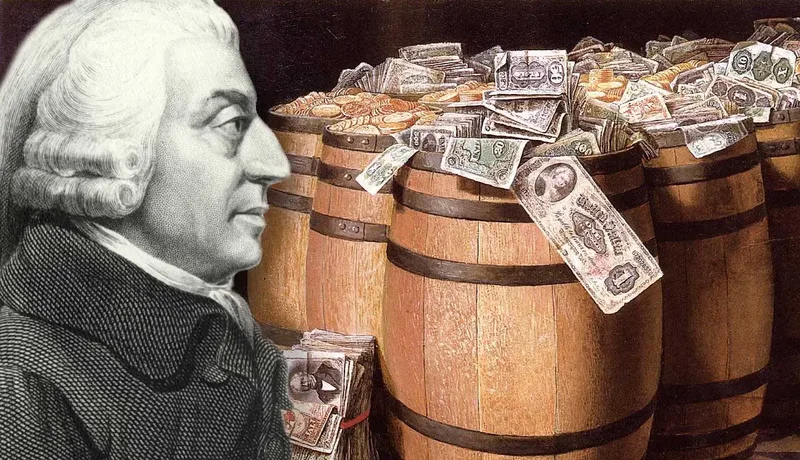
Adam Smith's will disappointed his nephew D ej vid D a gl l as. He received far less money than he had hoped for. The will even confirmed what Smith's friends had long suspected: the Scottish economist, who had always earned an above-average income , had given away almost all of his wealth to the poor, and had mostly in secret.
Smith, who was baptized on June 16, 1723 (exact date of birth unknown), is best known as a champion of capitalism. However, he was not immune to the intellectuals' grudges against the wealthy. In his two major works, The Theory of Moral Sentiments (1759) and An Inquiry into the Nature and Causes of the Wealth of Nations ( 1776), it is difficult to find a passage where he speaks positively of the rich and powerful.
Merchants and owners are described as people who only want to protect their selfish interests and create monopolies. You will find clearer praise of capitalists in Marx's " Communist Manifesto " than in Smith's works.
Many passages show sympathy for the condition of the "poor " , by which he meant not only those who lived in poverty , but also the " non-rich ", i.e. the majority of the population, who must exchange their work with wages to earn a living. "Sympathy" - today we would call it empathy - was the central pillar of Smith's moral philosophy.
And his sympathy was above all for the working poor. Here is a famous passage from the book " The Wealth of Nations " : " No society can flourish and be happier when the majority of its members are poor and miserable . "
Today these words are sometimes misinterpreted to claim that Smith advocated government-led redistribution of wealth. But that was not his intention , and he was certainly not calling for social revolution. Poverty, according to Smith, was not predetermined, and above all he distrusted the government.
He emphasizes that only economic growth can raise the standard of living. Continuous economic growth is the only way to increase wages, and a stagnant economy leads to a decline in wages . Elsewhere he writes that famines are the result of price controls by the government .
While Karl Marx claimed almost a century later that capitalism would lead to the increasing impoverishment of workers , Smith predicted that economic growth would lead to a rise in living standards. When " The Wealth of Nations " was published , capitalism was in its infancy .
At that time, 90 percent of the global population lived in extreme poverty . And poverty at that time meant something else: It is estimated that about 20 percent of the inhabitants of England and France were unable to work at all due to malnutrition .
Many of them had enough energy for a few hours of slow walking a day, which condemned most of them to a life of beggars . Smith was right about the effects of economic growth, and this has been confirmed in recent decades.
In recent years, the decline in poverty has accelerated at a rate unmatched by any previous period in human history. In 1981 the absolute poverty rate, which the World Bank currently defines as living on less than $1.90 a day, was 42.7 percent .
In 2000, it fell to 27.8 percent , and today it is less than 9 percent . Smith predicted that only an expansion of markets could lead to increased prosperity. And that is exactly what has happened since the collapse of planned socialist economies. In China, private property and market reform reduced the proportion of people living in extreme poverty from 88 percent in 1981 to less than 1 për qind sot.
Ekonomisti i tregut të lirë Zhang Ueijing i Universitetit të Pekinit thotë:”Zhvillimi i shpejtë ekonomik i Kinës gjatë 4 dekadave të fundit, është një fitore e konceptit të tregut të Adam Smith”. Në dallim nga interpretimet dominuese në Perëndim, Zhang thotë se rritja ekonomike dhe rënia e varfërisë në Kinë nuk ndodhën “për shkak të shtetit, por përkundër sjelljes sështetit”, pra për shkak të futjes së pronës private.
Plani i Smith për t’i nxjerrë njerëzit nga varfëria, nuk përfshinte zhdukjen e pronës private apo rishpërndarjen nga shteti. Ai nuk mbrojti ndonjë utopi libertariane. Ai besonte se qeveritë luanin një rol të rëndësishëm. Megjithatë, në vitin 1755, 2 dekada përpara se të shfaqej libri i tij i famshëm “Pasuria e Kombeve”, ai paralajmëroi në një leksion:”Në përgjithësi njeriukonsiderohet nga shtetarët dhe projektuesit si material i një lloj mekanike politike. Projektuesit e shqetësojnë natyrën gjatë operacioneve të saj në çështjet njerëzore; dhe ajo nuk kërkon asgjë më shumë se sa ta lini të qetë, dhe t’i jepni asaj një lojë të ndershme në ndjekjen e qëllimeve të saj, që ajo të përcaktojë vetë planet e saj. . . .
Të gjitha qeveritë që e pengojnë këtë rrjedhë natyrore, që i detyrojnë gjërat të futen në njëkanal tjetër, apo që përpiqen të ndalojnë përparimin e shoqërisë në një pikë të caktuar, janë të panatyrshme, dhe për të mbështetur veten janë të detyruar të jenë shtypës dhe tiranë”.
Very prophetic words . Smith showed the world how to overcome poverty. He did not leave much money to his grandson . But his great legacy is showing the world that only economic growth can lift people out of poverty , and that the most important condition for this is economic freedom.
Note : Rainer Zitelman, historian and sociologist . The most recent book is titled "In Defense of Capitalism". / "Wall Street Journal" - Bota.al








Lini një Përgjigje