


 Shkruar nga Federico Fubini
The euro is weighed down by political discord, the power of its enemies and the shadow of Putin. The dollar's decline poses a risk, but for Europe, it also presents an opportunity not to be missed. But the explosion in the price of gold and metals actually has an explanation.
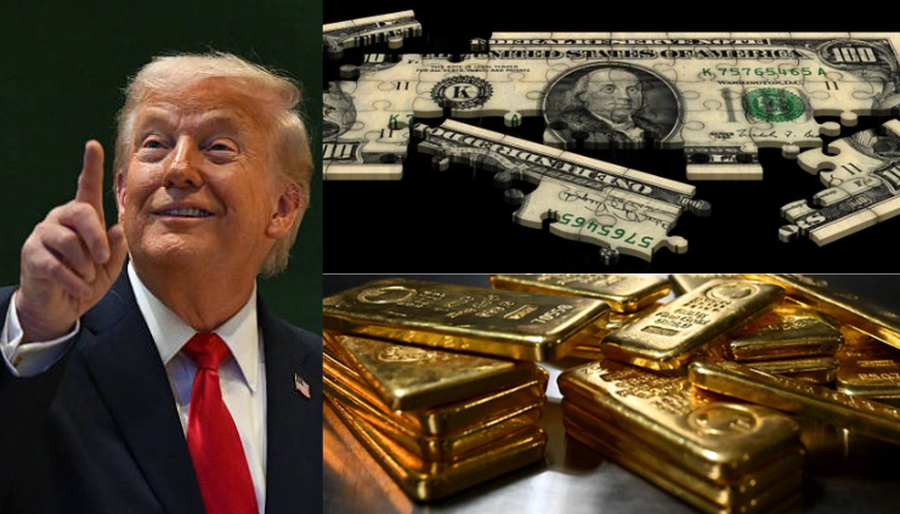
Why the dollar fell, what Trump's threats have to do with it (and why there is a risk and an opportunity for us)
Measured in dollars, the euro has increased in value by 15% in the year since Donald Trump returned to power, the pound slightly less, while the Japanese yen, after various fluctuations, has practically returned to the level where it was.
If you look at these currencies, as well as the twelve-month changes in Wall Street stock indexes or U.S. government bond yields, the first year of Trump's second White House has been ordinary. Predictable, a president like many others.
Meanwhile, measured in dollars, gold is up 91%. Platinum is up 170%; silver is up a staggering 266%, not to mention similar moves in lithium or copper. The dollar is about where it was against the euro ten years ago. Yet it has never lost so much value, or so quickly, against precious metals.
It seems as if someone has sought out hard assets, barbaric relics, as John Maynard Keynes said, considering them the only assets to protect themselves in this age of disunity. As the recent approach of the aircraft carrier USS Abraham Lincoln to Iran reminds us, the United States under Donald Trump is not withdrawing from the world. They are not giving up their supremacy. They simply want to get rid of the responsibilities, values, and costs of the old system of alliances, institutions, and rules that America itself had built over the past eighty years to exercise its leadership.
What is changing is not the superpower's ambition, but the way it expresses and cultivates it. Insults to Canada and Europe, claims to Greenland, and a fascination with Vladimir Putin are destroying the coalition that won the Cold War.
The tariffs, economist Gita Gopinath predicts, will ultimately erode growth and investment in America, just as Brexit did in the U.K. Then, of course, there’s the attack on the central bank, the strain on the entire fabric of American democratic institutions, and the nearly $2 trillion annual deficit.
Can we put a market price on such a transformation while it is happening?
The explosion in the price of gold and metals actually has, first and foremost, a practical explanation.
Today, liquid dollar assets, which are easily sold, are worth something over a hundred trillion, or roughly the same as the planet's gross domestic product: two-thirds are stocks, the rest US government debt, plus a portion of private debt.
When a large pension fund, sovereign wealth fund, or central bank wants to reduce its exposure to the dollar given the uncertainties mentioned above, they need to sell some of these assets and buy something else.
Yes, but what?
The euro is weighed down by political division, the strength of its enemies in France and Germany in the polls, weak growth and the shadow of Putin. The Japanese yen is weighed down by debt, demographics and a currently adventurous political leadership. China is a closed and unreadable world. Switzerland is too small. Thus, the gold rush is born, due to the lack of alternatives in turbulent times.
But gold assets on the market are currently worth $37 trillion, a third of them in foreign currencies, and even a modest outflow from the latter is enough to send the price of gold skyrocketing. Silver assets are worth one-twentieth of that in US dollars, so dollar inflows are driving up the price of the gray metal. One large, empty vessel causes two smaller, communicating vessels to fill with water. All of this suggests that, if this continues, the financial system will eventually lack a solid anchor.
For the first time since 2025, the dollar has fallen. The dollar's share of global central bank reserves, once at 60%, may now have fallen well below 50%.
For Europe, it is a risk if the dollar continues to lose value, making our exports more expensive for half the global economy. But it is an opportunity if it seizes the moment and launches a Eurobond worth (at least) a trillion for joint projects in defense, space, rare metals, chips, artificial intelligence: anything that offers autonomy and protects against superpower blackmail.
Those Eurobonds would immediately end up in the reserves of all central banks, instead of a few dollars. Because Europe today is divided between those who want to get by without the United States and those who understand that there is no other choice. / Adapted from Corriere della Sera







Lini një Përgjigje