


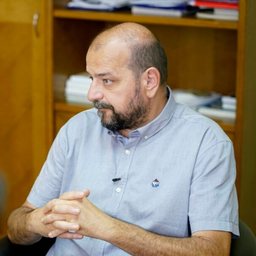
 Shkruar nga Dragan Sormaz
Aleksandar Vučić's power is no longer as strong as it was...
The relatively weak and unconvincing victory of the ruling coalition in areas that have traditionally been SNS-leaning indicates tectonic shifts within the electorate. However, these shifts have not yet received a clear political articulation. The system is clearly in motion, but without a force that would direct this movement.
The decline in trust in the government is visible and measurable. Compared to the 2022 elections, the results achieved by the list led by Vučić are significantly weaker, and this despite the fact that the president insisted on uniting all coalition partners under a single political “umbrella”. When we add to this the maximum use of all available mechanisms for voter mobilization and control, the picture becomes even clearer: we are talking about a serious erosion of trust in the government.
Even the intense engagement of the party apparatus and loyal phalanxes failed to hide this trend. On the contrary, attempts to attract attention by publicizing new scandals, such as the accusations against the marginal opposition party Narodna partija for electoral manipulation, look more like an attempt to divert attention and a sign of political nervousness than a serious strategy. Particularly worrying for the government are the minimal changes in percentages in areas that were previously considered safe. For if the change is small where the government is strongest, what can be expected in large urban centers where the opposition has significantly greater potential?
It is also noticeable that in the poorest areas the SNS has won more easily, such as in Majdanpek, while in Kula (Vojvodina) the difference is small, despite all the manipulations the regime has made, even with the use of violence and open intimidation. In some municipalities, the SNS with all coalition partners will now have an advantage of only one councilor.
However, the weakness of the government in itself does not mean its replacement. This is also clearly shown by the other side of the political equation, the opposition, namely the so-called "student" political list, which, despite the strong energy of the protests from the previous period, is not managing to benefit from the dissatisfaction of the citizens.
Unlike the model that the Democratic Opposition of Serbia implemented in 2000 in the fight against the regime of Slobodan Milošević, today's opposition scene seems fragmented, programmatically unclear and organizationally insufficient. In the era of social networks, where most citizens get their information outside of traditional media, it is theoretically easier to break the information blockade. However, without a clear political offer, even this communication channel is not enough.
The main problems of this political grouping are obvious. It lacks a clear stance on strategic issues such as European integration or the relationship with NATO. The organization is weak, without a recognized and credible leader. The program is reduced to generalizations about the fight against corruption, without detailed policies that would make this fight possible. Also, there is no clear stance or model of a new policy towards Kosovo, regional politics and the legacy of the wars of the 1990s.
Particularly significant is the lack of a clear position on the war in Ukraine and on the sanctions that the European Union has imposed on Russia. In a political space where geopolitical issues are key, ambiguity is not neutral - it is a political handicap.
Unlike such an opposition, the SNS nevertheless offers a certain framework, albeit problematic and quite outdated. Its policies are based on a combination of populism, quasi-patriotic rhetoric and an economic narrative that is reduced mainly to infrastructure projects and manipulation of statistical indicators. This model is increasingly costly for Serbia, but it continues to be politically functional because it offers a clear and distinct message.
The opposition’s problem is that it has neither a clear narrative, nor a coherent strategy, nor the political courage to make a fundamental departure from the political model that Vučić has “patented”. However, these elections showed something that should not be overlooked: the potential for change exists. The electorate is on the move, trust in power is declining, and the political space for a new alternative is opening up. What is missing is the political articulation of this space.
In this context, the experience of the Hungarian TISZA party and its leader Peter Magyar can be more than instructive. Their example shows that even in conditions of strong control of institutions and the media, a well-organized, clearly profiled and modernly conceived political alternative can achieve serious results. In other words, Serbia's problem today lies not only in the weakness of the government, but also in the weakness of the alternative. And without this alternative, any change remains only a possibility, but not a reality. / Adapted from "Pamphlet" by "TheGeopost"


Po ne c'pune kemi me Vucic, apo artikull per kosoven nga kosovaret