


 Shkruar nga Ylli Pata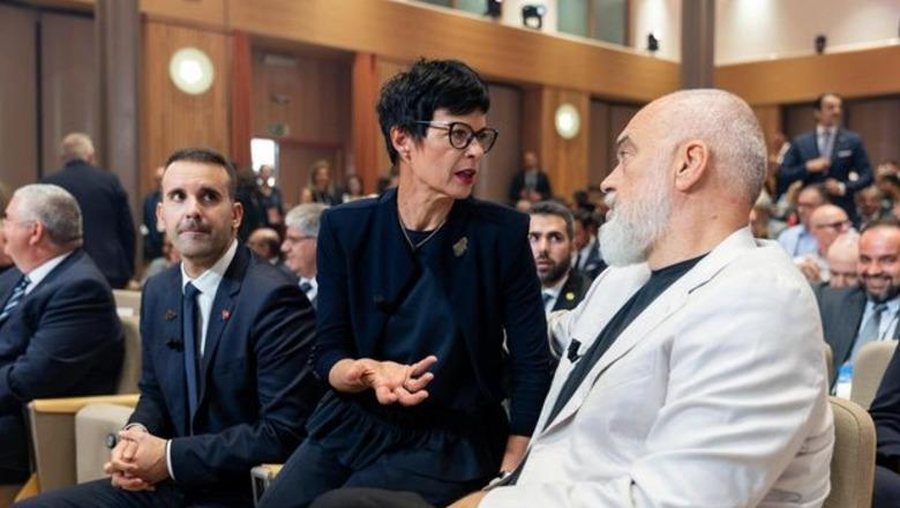
No one from political or media circles in the EU or the region has judged the statements about Albania as "false hope" or opposed them...
The European Commission delegation, in an official statement today, as a courtesy to the new government, has emphasized verbatim that "Albania can achieve the ambitious objective of closing EU membership negotiations by the end of 2027."
This is a political statement, but it is not political from a particular chancellorship of an EU member state, but from the central government of Europe. A stance that comes as a mature and determined will in the political center of the EU, such as Brussels, namely the Foreign Ministry of the European Union.
In fact, this stance is not a surprise, but seems like a political signal that important EU circles and figures have been saying openly for a long time.
So, clearly, there is a more open, positive and optimistic attitude of Europe towards Albania. An attitude that was not there before, an attitude that just a few years ago, you would have had to weary yourself through the phrases of declarations or progress reports, to find a "needle" in the endless "haystack" of armored phrases of Brussels' template diplomacy.
In this situation, when there is a political signal, when there is a positive nuance in Brussels and in the member states not to stop or block Albania's progress for any "formal" reason as often happens, there is a completely controversial atmosphere in political and media Tirana.
Meanwhile, while the entire political and media environment could debate what the best, safest, and shortest paths would be to achieve the objective of joining the EU, today we have diametrically opposed positions.
Edi Rama's majority is the only one that has set as a political objective, with which it also campaigned on May 11, entry into the European Union, but also a daily and longer-term tactical agenda to superimpose or adapt other developments within the framework of this strategic objective.
The opposition, namely Sali Berisha's DP, has not only abandoned the political battle for EU entry, but also aims, through its propaganda fable, to call Rama's objective not only unattainable, but more than once blames EU officials for doing this driven by corruption. So the political concept of the opposition is that the EU establishment and the member states that support Edi Rama are corrupt.
Which means that even if they, the EU leaders, grant Edi Rama entry into the EU, it is not valid, as it is a complicated process.
Another slightly more convincing narrative, coming from opposition-leaning media circles, is that we should be careful because Edi Rama is rushing too far. This could lead to the rise of right-wing sovereigntist forces in France and Germany and the downfall of both EU enlargement and the EU itself.
Another position that comes from media circles very close to the opposition, so close that they are even considering it as a version to run for mayor of Tirana, considers the EU a great, warmongering and corrupt evil that does not support the people but the financial and media elites.
More or less, this is the panorama of political positions towards the government's agenda, along with its optimism for EU membership by 2030.
But is this a sharp division in Albanian public opinion, so do we have a division in opinion for and against the EU?
Every survey or even perception measurement conducted by reliable institutions in this field reveals that there is no real Euroscepticism in Albania, as the overwhelming majority of the public supports EU accession.
But then the question arises, why does a part of politics, or rather half of it, take on the task of politically "riding" Euroscepticism? The first answer may logically come to ignore the majority's objective, considering it as propaganda, as a false and exaggerated flag.
Well, that could be it. But does the opposition have a counter-strategy or alternative counter-idea for EU entry? Not yet! Then why is it playing the Eurosceptic card?
From what we have seen so far, Sali Berisha's DP has played the anti-EU card, just as it has played the anti-US card, as they have opposed the cause of the fight against impunity and political corruption, which the European Union has supported and continues to support.
Secondly, it is playing to create a perception that there is a political segment in this country that is dissatisfied with the European behavior towards Edi Rama. In order to make it possible to create a space for dialogue or discussion with European political actors. Who in reality have completely ignored and do not even think about this "offer".
But on the other hand, there is another network, however small, which comes as a political or geopolitical current of other gravitational centers that are rivals to the EU, the US and the West. This includes the obvious circles of Russia, China, but also others that operate in the East-West, East and Asian seas, where the Iranians and of course the Arabs enter.
Who, through their spheres of influence, want to signal their position in the countries where they have had and have relations and sympathy. Albania, which is today a NATO member country, an ally of the West, has had in its history long-standing ties with other spheres of foreign powers in history. Since the Ottoman Empire, the Russian sphere during the time of its closeness with the Soviet Union, as well as the close friendship with China.
Segments of these spheres are quite identifiable today in their stances, since they are not afraid to give the Eurosceptic mark. A mark that has been clearly given by a well-known character, an Albanian diplomat since the time of communism and later, who until a few years ago was the Chief Negotiator of Albania with the European Union.
This character, in a recent comment on the China summit, where the alignment of the Xi-Putin-Kim trio was clearly shown, tried to explain that this tandem was a successful path for the world and was not afraid to mock Western democracy as a political system.
A few days ago, the former chief negotiator, while analyzing the path of EU integration, harshly attacked the European Commissioner for Enlargement, Marta Kos, because according to him, she was creating a false narrative, giving Albania false hope for EU entry.
The Slovenian politician, who is a member of Ursula Von Der Leyen's cabinet, has made some optimistic statements towards Albania. While she has not made any such statements about Bosnia, Serbia or other countries in the region.
No one from the political or media circles in the EU or the region has judged the statements about Albania as "false hope" or opposed them. If there were discussions, they simply assessed them as political signals. And it cannot be otherwise, since Marta Kos or the EU diplomats have no reason to please anyone for nothing, since they do not gain anything from it, but they also have no reason to do it if they do not have authorization.
So how can this fog of Euroscepticism in Albania be defined? So far, it can only be said that it is neither bio nor public perception, simply created by political and geopolitical gravitational centers and circles. Which want to create an agenda, or hold a position to show or demonstrate this position.


Lini një Përgjigje