


 Shkruar nga Ben Andoni
The luxury of not a small part of our politics and the way they lower the weapons of strife, when it comes to salaries, are indicators of our argument.
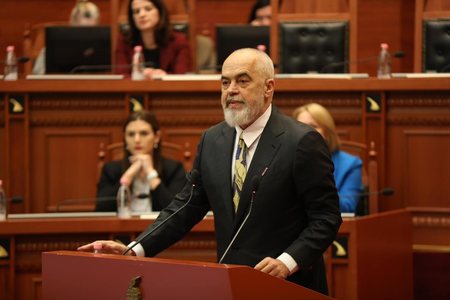
When listening to the last lecture of Mr. Berisha, for the revision of the Justice Reform, pension and salary increases, realizes that he and his political force no longer recognize Albania. When you listen to Rama's podcasts with really interesting characters, which quite often turn into monologues, from what is said about Albania, you realize that although the right things are articulated, they are far from the real Albania. There are entire urban spaces in Albania, which, although they are fewer today demographically, neither know nor care anymore who represents them in the parliament! The system actually "makes it easier" for politicians, because they are no longer elected products of the areas, but nominated by party leaders. Therefore, the generalist directives from the leaders of the parties are mostly not even forwarded to them. The ordinary Albanian no longer "needs" his deputy, just as the latter does not need the ordinary Albanian at all.
Of course, except for the last few months, when they have to insistently seek the vote. Like Albania, this is what a large part of the countries are suffering today, whose people no longer trust their politicians. Even more so, the US and the UK, our two great Western allies, are alike in this unimaginable circle of democracy today. To the public, political leaders in the US and the UK are people with millions in the bank (former British Prime Minister Rishi Sunak and incoming President Trump are obvious examples), varied work histories, backed up by degrees of course university in almost everything. Unfortunately, none of those who lead in politics today show any kind of empathy, sensitivity or real dealing with honesty. In the UK, the media has often slammed their leaders for this kind of life. Most of the politicians, not only in Albania but everywhere, cannot understand the ordinary people, because they have not had or need to face the difficulties that we, the "normal" people, face.
And again, just like in Albania, while most people remain facing difficult daily problems; the most frequent in social networks dealing with each other; the ruling class, which keeps politicians in power to maintain and expand policies that interest them, walks away with wealth and resources. The luxury of not a small part of our politics and the way they lower the weapons of strife, when it comes to salaries, are indicators of our argument.
The most essential evidence is elsewhere: The Socialist Party used to accuse their democratic opponents that in their government 5% of the population had a hand in the country's biggest assets; paradoxically, today, that number has shrunk further, making socialists far from proclaiming their left. But, not only in the economy, the disparity with politicians is great.
Now, democracy and freedom are under global threat with data in the Indexes of Freedom and Prosperity showing a steady decline in political freedom that has not stopped since 2012. In the theoretical sense, or in the ongoing demonstrations of politics, they (politicians) should be and pretend they are with the people, but in fact "being a good politician means making good decisions on behalf of others. So, the ability to understand how they experience the world and what matters is how citizens feel. But, given that politicians are by definition powerful and are more likely to come from higher statuses, they may need to put much more effort into this understanding", says Emma Oterski in the article "Why politicians may find it hard to understand ordinary voters" (Why politicians may find it hard to understand the ordinary voter). And, while political leaders do not seem to understand what is happening to ordinary citizens, for the latter, things are clearer, because often the consequences of politics fall directly on their shoulders. Research on social cognition, related to how we understand other people, has shown that an individual's possession of power and status affects the ability to interpret others and understand their lives. At this time, the public is suffering what in the most difficult times (Dictatorship and Cold War) became the basis of survival: Empathy and friendship, smile and above all kindness.
"In the most dangerous times, those who escape and survive generally know people they can trust. Having old friends is the policy of last resort in conditions of great danger. And making new friends is the first step towards change", - writes Timothy Snyder in his book "on Tyranny (the twelfth bud), which we are referring to in this article. An interesting observation, involving the United Kingdom, was that politicians tend to come from a narrow subsection of society and this makes them have a higher status than those they represent. This status can be an obstacle to sensitivity, it was referred to in one of their media.
We see this chaos of operation today in the informality and the way governing campaigns are conducted, the first to determine priorities, which are more related to political interests than the interests of the country, and the second in the uncertainty of where they should really be directed to given development to the country. Therefore, it is not surprising that Albania is still supported by remittances. In the latest statement from the Bank of Albania: While if we refer to the official figures, for the period January-September of this year, income from immigrants reached the level of 772 million Euros, compared to 677 million Euros resulting in the 9th month of 2023. Are these read in Albania?
At election time, the challenge is elsewhere: where will the voters be found?! As for the government, how will it show that its mandate was reached and it deserves a new vote of confidence. Yes, but if she represents the Albanians. "The strongest government is precisely that, of which every person feels himself to be a part", said one of the ideologues of American democracy, Thomas Jefferson. And, in this postulate, you understand how little politics is known... today's Albanians./(Homo Albanicus)


Lini një Përgjigje