


 Shkruar nga Skënder Minxhozi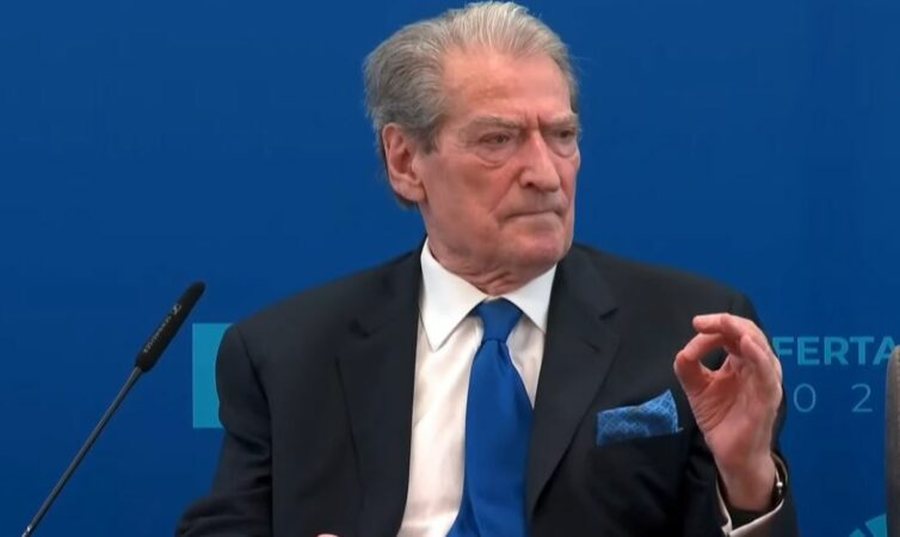
America is not lifting its non grata status, Great Britain is not either, while the Europeans maintain close communication and full partnership with Edi Rama.
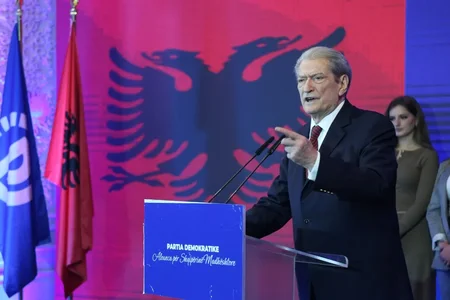
This electoral campaign has produced a toxic extension of the attitudes that followed the last American elections last November. The main opposition led by Berisha has chewed badly and with opposition Brussels' positive statements regarding Albania's accession negotiations to the European Union. A day earlier, the opposition leader declared that the European Union silently approved the creation of a narco-dictatorship in Albania. This is the first time that Berisha has spoken out so openly and harshly against the EU and this comes just a few hours after Enlargement Commissioner Marta Kos stated that the EU negotiations with Tirana will be closed by 2027. An unexpected deadline for us and a real surprise in the Union's plans for enlargement.
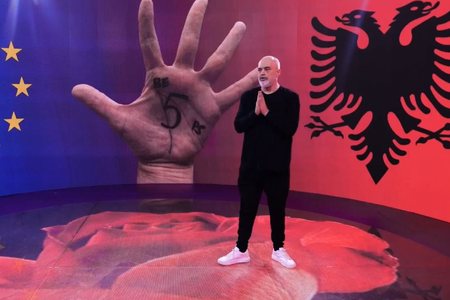
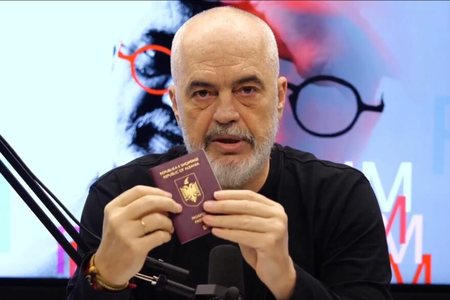
On the other hand, Prime Minister Edi Rama has made the European passport the main focus of his electoral campaign. Rama seems to have chosen integration as the battle horse for the May 11 elections, in an environment that has consumed a lot of European rhetoric for decades, but which has in reality been blocked in a millimetric process of advancement towards Brussels.
Albania is currently on a more advanced path than the Western Balkan countries, which was considered simply utopian just a year or two ago! The changing geopolitical situation in Europe and some positive developments in Albania, such as the start of investigations against senior officials or even the country's openness and its stabilizing role in the Balkans, have led member states to promise the red carpet towards the door of membership for Albanians in the not-so-distant future. Which, according to Rama, now has a date: within 2030!
Thus, our country may find itself in the surreal position of membership in the Union for mainly geopolitical reasons related to the war in Ukraine and regional stability where Tirana has been a key actor.
We entered NATO in 2009 without an army, we can enter the European Union even without having an economy and rule of law comparable to the 27 member states. This is the strange alchemy that we are currently facing in relation to the Europeans and which Edi Rama seems to be trying to catch in the air to move towards a fourth consecutive victory in the parliamentary elections.
The opposition, for its part, experiences this process in the middle of the campaign, just as every Albanian opposition has experienced it under identical conditions: as a threat to its chances of winning the elections. Berisha feels himself unwillingly drawn into a subject that is being imposed with insistence by Rama, bypassing the debate on corruption and misgovernment. And in conditions where the media traditionally lacks direct confrontation and debate between the parties, this ping-pong game at a distance is determined by the power of each party to lead the electoral agenda in the press and social networks.
Rama has accurately captured in this campaign what is the most important news for Albanians. And that consists in the return of the European integration process for decades from half-empty rhetoric and propaganda, to a concrete and tangible advancement that finally offers an identifiable time perspective of entry into the European Union. Any politician and statesman who would enter an electoral campaign under these conditions would act in the same way as the Albanian prime minister, especially since this constitutes the carrot in a situation where the stick is represented by the numerous investigations into the political leaders close to him.
Beyond the election campaign, the topic of integration is starting to show another side of it: that of obligations and standards. If 14 years ago, when visas were liberalized, we conceived of Europe more as a space where you could go without having to wait in line at embassies, today we are gradually facing the obligations that stem from approaching the European market and institutions. Farmers must offer higher-quality fruits and vegetables, tailors and other producers of food industries or even services must raise the standard of work and final products. The state must review the laws and other acts on which it operates, infrastructures, small and large businesses, education and other areas of human activity that are already beginning to face the Europe of tables and regulations.
If we consider it in this prism, the electoral debate regarding a passport, currently graphically constructed on a computer, should begin to expand and occupy the entire political space in the country. Integration is gradually approaching as the most difficult challenge of state-building in our old and new history, while the politicians of Tirana see only until May 11 and quarrel over a cardboard with the stars of Europe on it.
Berisha's complex regarding Rama's campaign with the European passport is not only related to the May race. It is related to the fact that the former prime minister continues to see himself outside any format of cooperation and communication with the West. America is not removing his non grata status, Great Britain is also not doing so, while the Europeans maintain close communication and full partnership with Edi Rama. This is Berisha's real problem regarding the EU, which neither Doris Spak nor some peripheral ambassadors in Tirana who invite him and please him can fill. This problem cannot be compensated for by the sheriffs of Washington who are not showing up or the lightning bolts on Rama from Donald Trump who are not appearing anywhere on the horizon.
Elections will come and go. What will remain is the process of rapprochement with the EU, the most serious and long-term for us as a state, despite the deeply transformative effects that it is expected to bring. The small game of elections will once again seem petty and transitory, because since the beginning of time, in the distant year 1991, the destination has been Europe, not the horses of this or that electoral race. At this point, Berisha has lost the fight with the Europeans, just as he had and still has lost with the Americans and the British.



Lini një Përgjigje