


 Shkruar nga Pamfleti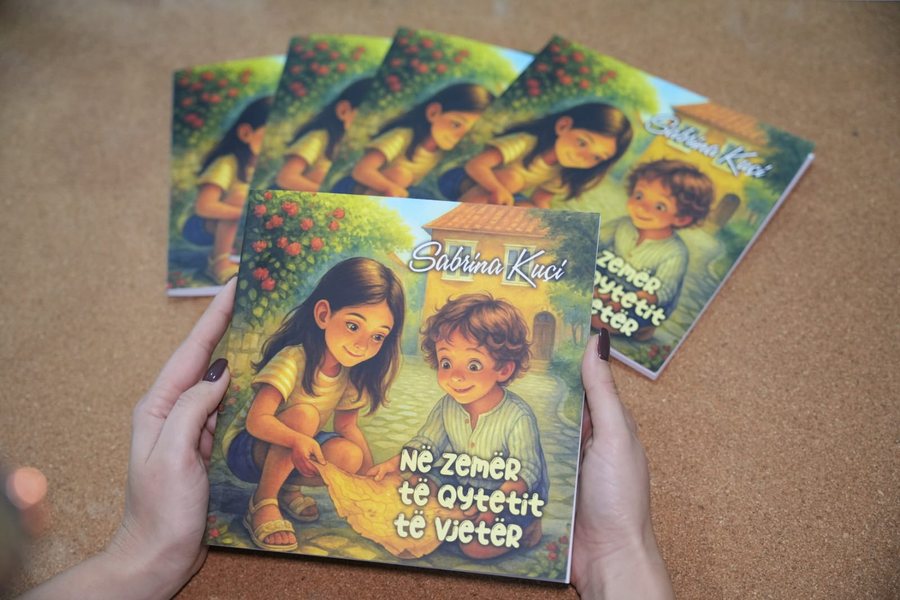
Sabrina Kuçi invites children to walk through the heart of the old city and discover the spirit preserved by the legends, houses, bridges and monuments...
“In the Heart of the Old City” is a book that approaches you slowly, as if it were touching your arm and inviting you to walk through a city that does not age, because it is preserved in people's memories. Sabrina Kuçi treats Shkodra not as a space, but as a living being that breathes in the stones, in the old windows, in the bridge that connects the banks and in the voice that rises from the minaret. Riani and Serena converse with this city, like children who do not know how to lie to their feelings and who seek the essence of everything they see. On their journey, memory appears as a subtle light that illuminates the traces of history and teaches them that the city lives only when someone listens to it. The book turns Shkodra into a meeting place between the past and growing children, as if it were a silent instruction that love for one's homeland begins with the art of knowing and the dedication to keeping alive what time risks hiding.
Notes for the book "In the Heart of the Old City, by the writer Xhahid Bushati"
Author: Sabrina Kuçi, editor: Msc. Senada Demushi (Delaj), graphics: Abel Spahija; Shkodër, Sh. B. "Fiorentia", 2025
What is the story of author Sabrina Kuçi in her book "In the Heart of the Old City"? The book, as if, takes you by the hand and says that "The Memory of a City" is not an abstract concept, but with great finesse she uses it as a spiritual map, where events, traditions and legends are remembered, historical figures are preserved, heritage objects speak (Shkodra Castle, Mesit Bridge, "Migjeni" Theater, "Pashko Vasa" House, Lead Mosque, Big Church, Oso Kuka's House, - and where civic identity is transmitted. But "Memory" becomes more visible and illuminating through the stories that Riani and Serena discover during their journey, seeing Shkodra, their birthplace, as a city that has a soul, that lives through stories.
Thus, Riani and Serena are the children who represent curiosity, purity and the ability to see the essence of things; and, consequently, they (brother and sister) browse the "Map of Memory" to understand the roots of the city, try to discover the connections between old objects and the stories they carry; they learn that everything around them, such as: the castle, the bridge, the houses, the museums... etc., are not just stones, but are Teachers. And, the lesson that Sabrina brings through them, through their eyes tells us: - A city lives, only, when we know its stories. Without memory, the city dies. Riani and Serena embody the new generation that must keep this heritage alive.
THE SECRET OF THE SHKODRA CASTLE.
The author brings the beauty of the legend, the sacrifice of Rozafa, the strength of love for family and construction. The secret of the castle is not the wall itself, but the stone that speaks, the sacrifice that preserves the foundations, the history that does not disappear, the strength of the city that is born from resistance. For children, this legend does not appear scary, it appears as a lesson about love, about loyalty and the role of women in Albanian history. LIGHT UNDER THE BRIDGE. How does the "Bridge of the Middle Ages" appear as an element of memory in the eyes of children? The author sees the "Bridge of the Middle Ages" as a miracle of stone, as a symbol of the connection between people, as a bridge that unites shores, time and history. Riani and Serena learn that the bridge is not an old object, but it preserves the stories of merchants, of former travelers, of legends who have passed over it. In their eyes, the BRIDGE becomes an open question: "How much history does a stone hold?" CURTAIN THAT TALK...
The "Migjeni" Theater is another element of memory. It represents: - the artistic spirit of Shkodra; - the civic school of culture; - the passion for the performing arts. The author herself, as a writer who has the Theater as a neighbor, presents it as: - a door that opens the imagination; as a place where dreams are born; as a temple of art that nourishes the soul. And we have a message in this part: - The Theater is a living Memory, because art makes a person better and more open to the world. DOORS THAT SPEAK, WALLS THAT REMEMBER...
The house of Pashko Vasa is a dimension of importance in Sabrina's precious book. Because, we find the role of the patriot, the Renaissance man and the poet Pashko Vasa. Also, we find the value of educated culture and civic thought, the contribution of Pashko Vasa to the nation. This house has historical value, because: - it reconfirms Shkodra as the center of the National Renaissance, - it preserves the memory of a man who cried out in time: "Oh my Shqypni, poor Shqypni!", - it speaks of the bright past and the duty to inherit it. So, DOORS THAT SPEAK = TRADITION. - SO, WALLS THAT REMEMBER = HISTORY THAT DOES NOT FADE OUT THE VOICE OF THE MINARET.
The Lead Mosque is one of the oldest monuments of Shkodra, which for the author represents: - the religious harmony of the city; the resistance of material culture, the Ottoman architectural beauty. While, the voice of the Minaret is: - The Call of Memory, is the voice of tradition that although struck by time, floods, wars, continues to stand; and at the same time shows: - that religious beliefs and cultures intertwine without colliding. STARS ON THE CEILING OF IDROMENOS. This part has a different perspective from the author's side, it adheres to a dialogue with the art of Kolë Idromenos. When talking about art, Master Idromenos is an architect, painter and photographer. The author, as a specialist in the field, describes the architecture of the Master, as an art that speaks to you; as a light that enters like "stars" from the crafted ceilings, as a memory that is preserved in every frame, sculpture and corner of the house. For children, Idromeno is not just a painter: - he becomes a magician of light, - a creator of dreams, - a voice of Shkodra art that speaks beautifully and with beauty!
THE SECRET OF OSO KUKA'S HOUSE. Oso Kuka is a figure of Shkodra heroism. His house, in the book, appears as a haven of courage, - the history of resistance, - his act inspires bravery. But the 'Secret of the house' is Oso Kuka's faith and sacrifice for the defense of the homeland. This is a lesson that Sabrina gives to children in a clear, understandable and beautiful way. * * * The book "In the heart of the old city" is an ode (lyric poem) for Shkodra, for its history and spirit; a way for children to know the roots of their city, to learn the value of culture, to understand the greatness of the heritage, to build a dense and healthy civic identity. Through Rian and Serena, the author invites children to: - Love their city by getting to know it.




Lini një Përgjigje