


 Shkruar nga Pamfleti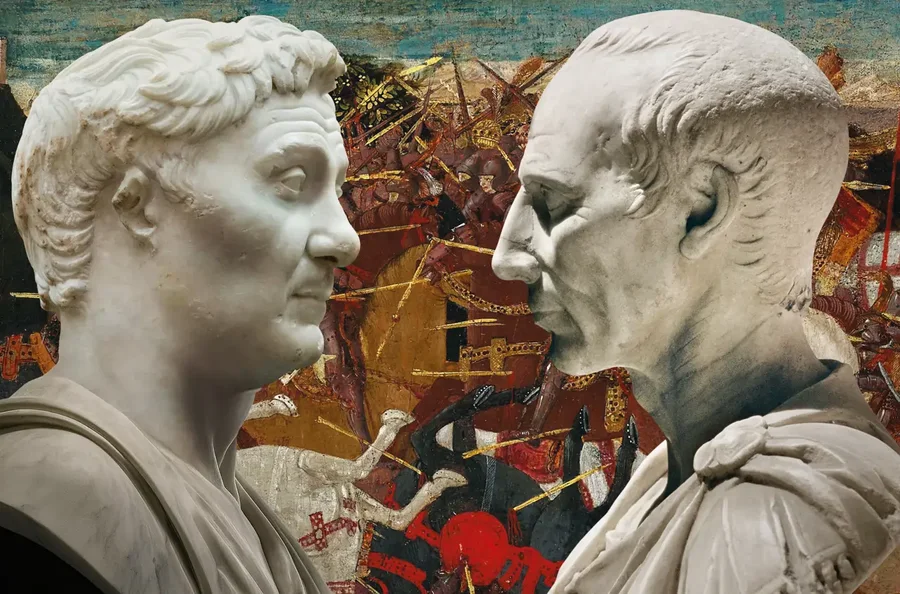
An epic of disaster: how Lucan turned the Roman civil war into an anti-Aeneid
Can an epic poem celebrate a historical, moral, and even cosmic catastrophe? That is precisely what Lucan's "Bellum civile" does, the only surviving work by the Nero-era poet, grandson of Seneca, who was also forced to commit suicide in 65 AD, at the age of 26, after being implicated in the Piso conspiracy.
"Bellum civile" narrates the war between Caesar and Pompey, two central figures of Roman politics, who were both father-in-law and son-in-law. It is more than a civil war, a conflict within the same family, like those that, according to Aristotle, constitute the subject of tragedy.
For the ancients, epic, especially war epic, had the task of singing the glories of heroes. But in a civil war every act of heroism becomes a crime, every victory loses the brilliance of triumph. Traditional values are overturned, and with them the classical form of epic itself enters into crisis.
For Lucan, the clash between fellow citizens that culminates in Caesar's victory at Pharsalus in 48 BC is nothing to celebrate. It represents the "burial of the world," the catastrophe that the loss of republican freedom brought to Rome. In the poem's introduction, the end of the republic is presented as the end of the world itself and a return to Chaos.
Lucan's narrative is fiery and one-sided. Events of a century ago are told as if they were happening in the present and as if history could still be changed. In the first book, an astrologer predicts disaster: weapons will prevail over law, force will replace justice, and injustice will take the name of virtue. But worse than war, he warns, will be the peace that an absolute ruler will bring.
This prophecy ends with a paradox: an appeal to Rome, free only during civil war, to prolong it as long as possible. This is a typical example of Lucan's style, built on passion and paradox.
More than the voices of the characters, the poem is permeated by the voice of the militant narrator, who comments, judges, and condemns the events. Lucan believes that future generations will read this war with the same emotions as its contemporaries, still taking sides in the conflict between Caesar and Pompey.
One of the most striking features of the work is that it is an epic without traditional gods. From antiquity to Tasso, many critics have argued that "Bellum civile" is more history than poetry. It has also been called "a poem without a hero".
However, this label conceals a classical bias against Lucan. For a long time he was judged only in comparison with Virgil and the Aeneid. Only in recent decades have scholars begun to appreciate the originality and experimentation of post-Virgilian epic.
Lucan's poem lacks the divine plan that in the Aeneid is guaranteed by Jupiter. There is no pious Aeneas who embodies the fate of Rome. On the contrary, the gods seem hostile to the city.
A famous line sums up this vision: "The winning cause pleased the gods, but the losing one pleased Cato." Here another central figure of the poem appears, Cato, the symbol of republican freedom and the Stoic ideal.
In "Bellum civile," the victorious Caesar is a dark hero: treacherous, revolutionary, and tyrant. Pompey, on the other hand, is presented as a shadow of a past greatness, before regaining his dignity through his death.
Yet, despite Cato being the moral hero of the poem, the narrative energy emanates from Caesar himself. Swift, furious, and determined to his fate, he drives events towards disaster. It is this titanic character that exerts a dangerous pull on the reader and creates what critics call "negative empathy."
For Lucan, the presentation of the grandeur of evil creates an ethical and aesthetic problem. Does the poet become complicit with what he describes? His response is to constantly maintain a moral distance from the events he narrates.
This is clearly seen at the climax of the poem, during the battle of Pharsalus. The narrator turns to himself and wishes not to tell this part of the story, to leave it in the dark. It is another typical Lucanian paradox: he promises silence precisely by narrating.
"Bellum civile" has often been called an anti-Aeneid. Unlike Virgil, who presents the civil war as a painful but necessary episode on the road to Augustan peace, Lucan completely rejects the myth of Augustus and the idea of history as a march towards a predetermined goal.
With polemical allusions to the "Aeneid", with his style filled with pathos and paradoxes, Lucan describes the self-destruction of a people that raises its victorious hand against itself.
For him, civil war is not the foundation of a new order. It is a catastrophe without cure. And it is precisely this catastrophe that his epic against empire celebrates. / Adapted from "Corriere Della Sera"


Lini një Përgjigje