


 Shkruar nga Rikard Jozwiak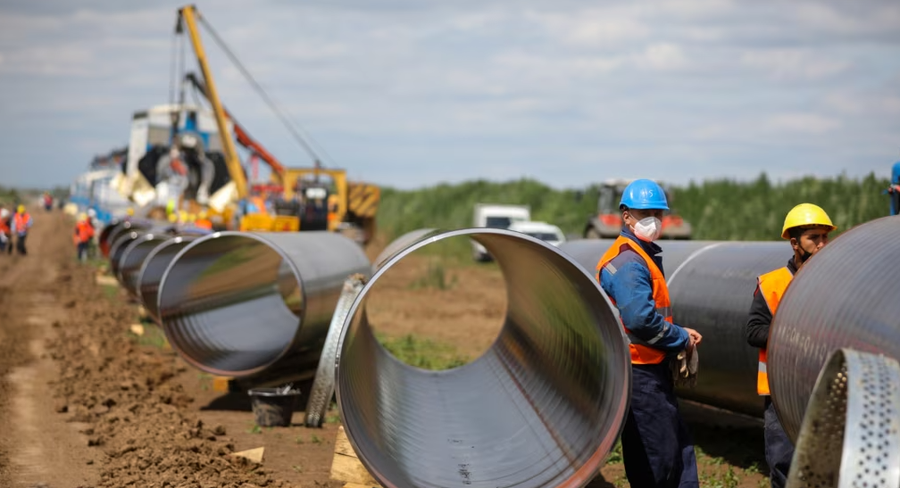
The US is bypassing European Union rules to sign multi-billion dollar deals that cut off the Balkans from Russian gas. But this direct offensive by the Trump administration has created an open clash with Brussels, pitting strategic projects against European bureaucracy...
Since US President Donald Trump took office last year, Washington and Brussels have clashed over trade, support for Ukraine and military spending. Now a new front has opened: the Western Balkans.
Uniquely positioned at the intersection of EU and US interests, but also of Russian and Chinese influence, the countries of the region have attracted the attention of major world powers, fueling a race to take advantage of their developing status, structural weaknesses, and fragile economies.
This is evident more clearly than anywhere in recent deals by American investors in energy projects in Albania, Croatia, and Bosnia and Herzegovina - countries that aim to end their dependence on Russian supplies.
"President Trump is opening a new era of cooperation with Southern, Central and Eastern Europe," US Energy Secretary Chris Wright told reporters at the Three Seas Initiative business forum in Dubrovnik, Croatia.
The clash of agendas became apparent last week, when the United States launched its largest public investment in years in the Western Balkans, signing several multibillion-dollar deals for gas exports and artificial intelligence development in Albania, Bosnia, and Croatia.
The flagship project is the $1.5 billion “Southern Interconnection” gas pipeline between Bosnia and Croatia, which connects the former to both the Croatian liquefied natural gas terminal on the island of Krk and the wider pan-European gas networks.
"There is an awareness that this region is still of high strategic importance, and the more sensational announcements you make, the more you provoke reactions from Moscow, from Beijing, and even from some circles in Europe," a US congressional adviser familiar with the discussions told RFE/RL.
Another official added: "The strategy is to move capital and projects faster than politics can react. If you present everything as a geopolitical competition, you slow it down; but if you call it investment and infrastructure, you progress."
Bosnia, one of Europe's poorest countries, is in need of rapid development. It is currently completely dependent on Russian fossil fuels, imported through the TurkStream gas pipeline.
Meanwhile, the Krk terminal is a key conduit for the entry of American liquefied natural gas (LNG) into the European continent, and the agreement co-signed by the US is expected to secure even greater supplies for the region.
Balkan countries appear to be turning to the US after years of failing to secure the necessary financing from Europe. “Low investment has been a long-standing plague on the Balkans,” says David J. Kostelancik, a researcher at the Center for European Policy Analysis (CEPA).
He emphasizes that "energy security in Southeast Europe is no longer a peripheral economic issue, but a core U.S. national security concern."
"By focusing diplomatic engagement and facilitating financing, the United States can increase investment in an energy sector that strengthens competitiveness and ensures security, including cybersecurity and investment screening mechanisms that detect efforts by malicious actors to gain influence," he underlines.
Both Brussels and Washington support the Balkans' disconnection from the Russian energy “umbilical cord.” But energy policy is now also intertwined with the race for influence, pitting the two capitals against each other.
To pave the way for the pipeline deal, Bosnia changed legislation by appointing a private American company, ASFS Infrastructure and Energy, as the lead investor and developer.
According to company records, its director is Jesse Binnall, a former member of Donald Trump's legal team, while vice president Joseph Flynn is the brother of former national security adviser Michael Flynn.
The new law ruled out the open tendering process, infuriating Brussels and prompting Transparency International to warn of a "dangerous precedent".
In a letter dated April 13, the EU ambassador to Sarajevo, Luigi Soreca, warned that special legislation for the project could jeopardize Bosnia's access to the European energy market, as well as around 1 billion euros in funding from the EU's Growth Plan for the Western Balkans.
Bosnia is part of the EU's Energy Community, which extends its laws in this area to aspiring countries. Although it has been a candidate country since 2022, there is no sign that membership is imminent, while Brussels often criticizes the lack of internal reforms.
Bosnian officials argue that the agreement with American investors also aims to meet the EU's goal of ceasing Russian energy imports by January 1, 2028.
This is a major challenge for Bosnia, which does not produce gas and is completely dependent on Russia, which supplies it with about 225 million cubic meters of gas per year. With the prospect of EU membership looking distant, Bosnia appears to have chosen to ignore Europe’s warnings to “carefully consider obligations,” by moving forward with American investments.
It even joined a US initiative to strengthen regional energy supplies, with Foreign Minister Elmedin Konakovic stressing the economic importance of the move. "This part of Europe is coming to its senses. The path to development requires more energy, not less," Wright said.
American economic interest in the region has been further boosted by the approval in Congress in February of the Western Balkans Democracy and Prosperity Act, which aims, among other things, to deepen economic cooperation.
Last week, Pristina hosted a conference of American investors aimed at attracting businesses to projects such as a new bus station, a hospital, the construction of a ring road and sports facilities. The American group Pantheon Atlas has signed a preliminary agreement to build a large artificial intelligence and data center in Croatia.
Meanwhile, in Tirana, Albania signed a 20-year agreement for the supply of American LNG, worth $6 billion, linking the local company Albgaz with the American firm Venture Global and the Greek company Aktor.
Anonymous officials said that further developments are expected in the future. They added that, while the current focus is on Albania, Bosnia and Croatia, this policy clearly has regional ambitions.
Serbia, North Macedonia and Montenegro are seen as the next steps, while Washington aims to build a more integrated energy and digital corridor throughout the Western Balkans. / Pamphlet from "Radio Free Europe"


Lini një Përgjigje