


 Shkruar nga Pamfleti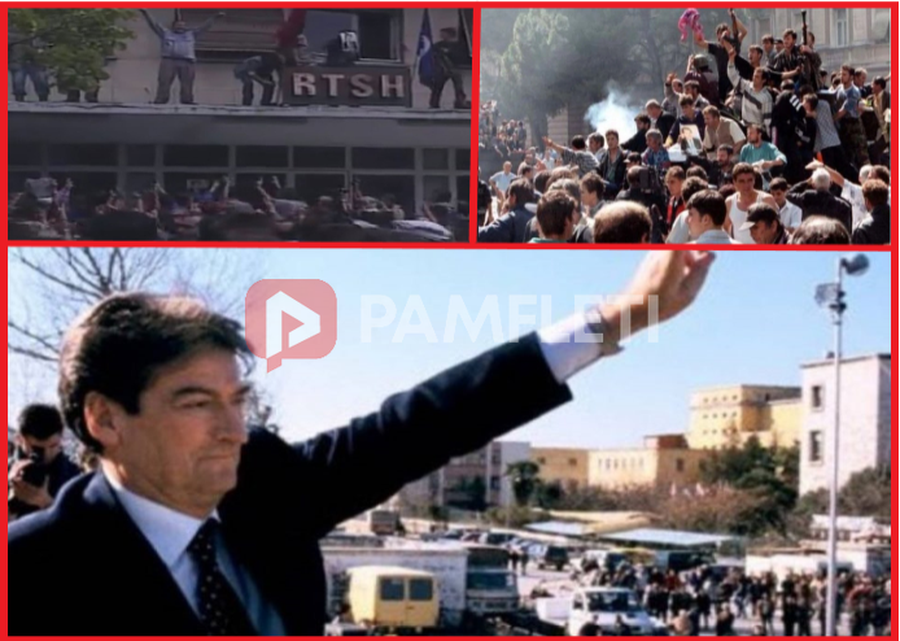
26 years from September 14, 1998, this is how the Americans reported the attack on the Prime Minister...
Today marks 26 years since September 14, 1998, the day Sali Berisha tried to take over the government by force.
On September 12, Azem Hajdari was shot dead and this was used by the democratic leader of that time, Sali Berisha, for a "coup d'état" two days later. Berisha and his loyalists attacked the Prime Minister's Office with weapons and took over Public Radio and Television on September 14. Prime Minister Fatos Nano himself left the sight of the feet. But what still raises a lot of mystery is how it is possible that Berisha was never punished for this action.
In the meantime, this event has caused a stir among the international community. " Pamphlet " is bringing to the public today details from the reports of the US Department of State for Human Rights from 1998-1999, where they talked about the murder of Hajdar and the coup d'état initiated by Berisha.
" On September 12, 1998, DP deputy and chairman of the Parliamentary Defense Committee, Azem Hajdari, was killed in an assassination attempt near the DP headquarters, which led to violent protests. During his funeral on 14 September 1998, armed DP supporters briefly raided government offices, such as the Parliament, State Television and Radio. It seemed as if ex-president Berisha was going to stage a coup, but after 72 hours order was restored and the protesters handed over the tanks they had taken. Parliament then lifted Berisha's immunity for his role in the uprising, but eventually no charges were brought against him. 12 people were arrested for the violence. The PD refused to participate in all state functions at the national level after the assassination of Hajdar, boycotting the Parliament as well ," the report states.
It also shows what has not yet been clarified. Berisha was the first to point the finger at the perpetrators after the murder, but when it came to testifying in court, he refused. He informed the Americans and sold Izet Haxha to them, but he himself never came before justice, even as a witness.
" DP officials, including Berisha, refused to testify in the investigations into the murder of Hajdar, arguing that the investigations were politically motivated. Prime Minister Nano resigned in September 1998, citing a lack of support within the Socialist Party. Pandeli Majko, the former secretary of the Socialist Party, became prime minister, while the PD led by Berisha returned to Parliament in July 1999, after the government's pledge to fully and fairly investigate Hajdar's murder. Meanwhile, the trial of the head of the Legality Party, Ekrem Spahia, and 12 of his supporters continued for the events of September 1998 that followed Hajdar's murder. On February 5, 1999, Leka Zogu was arrested in Johannesburg, where he had lived since 1979, for possessing an illegal arsenal of weapons and ammunition. He was released on bail 10 days later. In October 1999, Majko lost the leadership of the party to Fatos Nano and was forced to resign as Prime Minister a few weeks later. Ilir Meta succeeded him in the post ", the report states.
According to Albanian law at the time, armed insurrection was punishable by life imprisonment. Berisha's immunity was removed, but then the prosecution withdrew and did not file any charges. He gave her peace. / Pamphlet






Lini një Përgjigje