


 Shkruar nga Gjergj Zefi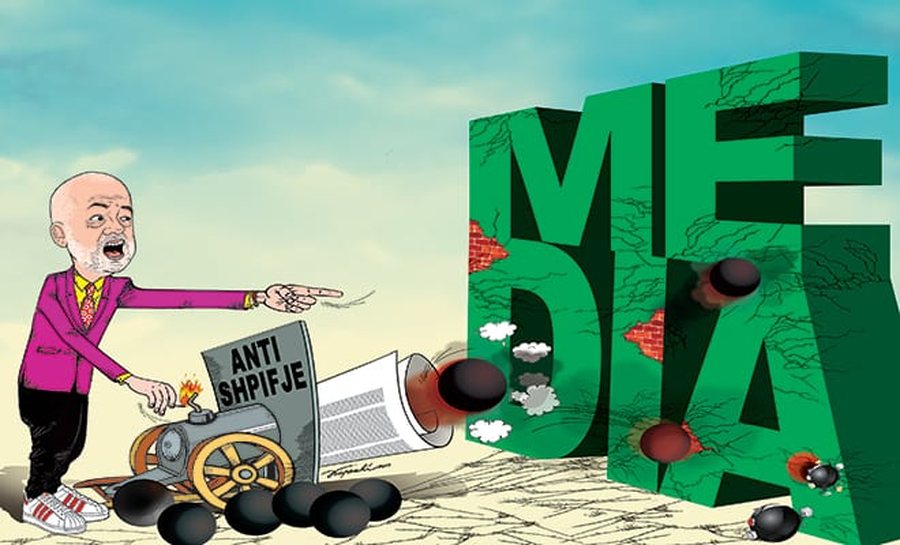
Albania is sliding towards a model where the media either become part of propaganda or victims of a legal environment built for the purpose of control...
In Albania, free speech has never been a concept sincerely embraced by governments. Every regime, left or right, has wanted to have a control button over the media – a link caught in the propaganda chain. This approach has produced a tense environment, where any attempt to pass media laws is accompanied by deep suspicions of censorship and attacks on editorial independence.
Currently, Albania is one of the only countries in the Western Balkans to apply a 20% Value Added Tax (VAT) on audiovisual media services – a policy that severely penalizes independent media and places an unfair financial burden on entities trying to survive outside of political or oligarchic control.
More scandalous is the fact that online media, which are among the most dynamic sources of information and analysis, do not benefit from any exemption or support: they do not buy anything with VAT, but are forced to blindly pay the value added tax.
In contrast; in Kosovo, North Macedonia, Serbia and Montenegro, legislators have reformed fiscal policies to support the media as a link to democratic order and public interest.
In Kosovo, for example, VAT for media is zero – a clear policy to protect free speech and empower the media as a social actor in a difficult market burdened with political pressures. The same approach exists in North Macedonia, Serbia and Montenegro, where the media is considered not only a means of information, but also a shield against authoritarianism.
In North Macedonia, the government has created funds dedicated to supporting quality journalism, in cooperation with international agencies.
This standard is not only an indicator of will, but also a condition for European integration. All countries in the region that aim for a new chapter in relations with the EU are realizing that without a free media there is no real progress. Albania, in this comparison, emerges as a country that punishes critical voices financially and remains institutionally silent about the systematic exclusion of the media from any economic support package.
Meanwhile, in Albania, not only is there no strategy to help free media, but none of the political parties has included this issue in its program, before the May 11 elections. This silence is significant – a kind of tacit consensus to keep the media under economic and legal pressure. Instead, the idea of creating a “media law” has been constantly promoted, which essentially does not aim at standards, but sanctions.
All the drafts that have circulated in recent years, proposed by the government or its affiliated institutions, have attempted to impose fines, restrictions, mandatory registrations, and even content control, on online media – a flagrant violation of Council of Europe standards and EU directives on freedom of information.
In this climate, Albania is sliding towards a model where the media either become part of propaganda or victims of a legal environment built for the purpose of control. Even worse, the country remains without an organized institutional voice to articulate the interests and needs of the media community. Instead of functioning as defenders of the profession and lobbyists for better legal and fiscal standards, most journalist associations in Albania are politically oriented, silent in the face of legal abuses and incapable of influencing the improvement of media legislation. None of them has taken a serious stance to address the tax handicap or the discriminatory treatment given to online and independent media towards a model where they either become part of propaganda or victims of a legal environment built for the purpose of control. And what is most worrying is that this is happening without any honest public debate, without the involvement of civil society, and with total indifference from political actors who hope to benefit tomorrow from the same control formula.
In the Western Balkans, countries that truly aspire to European integration are realizing that media freedom is a key indicator. Albania, on the contrary, is turning the media into an enemy of the government and information into a taxed commodity.
If this trend is not stopped, if parties do not give space to the media in their programs as a guarantor of pluralism, then Albania risks being the only country in the region where free speech is a luxury and journalism, a profession with unaffordable costs./ Pamphlet



Lini një Përgjigje