


 Shkruar nga Daniel Innerarity dhe Fabrizio Tassinari
“Project Syndicate”: The sun is the facade, 'Rilindja' gives the tenders again
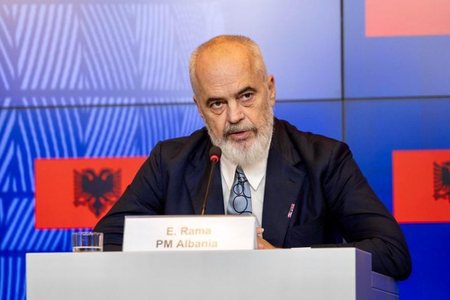
When Albanian Prime Minister Edi Rama recently announced his new cabinet, it wasn’t the choice of finance or foreign minister that attracted the most attention. The most sensational news was Rama’s appointment of an artificial intelligence-powered robot as the new minister for public procurement.
“Diella” will oversee and award all public tenders that the government entrusts to private firms. “[She] is the first member of the government who is not physically present, but virtually created by artificial intelligence,” Rama declared. She will help Albania become “a country where public procurement is 100% corruption-free.”
This move, both evocative and provocative, reminds us that those who place the greatest hope in technology are often those who have the least faith in human nature. But more importantly, Diella’s appointment is proof that while there is a cure for every evil in democracy, it is increasingly taking the form of digital authoritarianism. Such interventions may please Silicon Valley oligarchs, but democrats everywhere should be on alert.
The conceptual basis for an AI minister lies in how technophiles imagine humanity’s relationship to the future. “Techno-solutionists” treat political problems that usually require discussion and deliberation as engineering challenges that can be solved simply by technical methods. As we saw in the United States during Elon Musk’s brief stint as head of the “DOGE (Department of Government Efficiency),” technology is offered as a substitute for politics and political decision-making.
The implication of AI-administered governance is that democracy becomes redundant. The digital technocracy consists of technology developers who claim the authority to set the rules we must abide by, and thus the conditions under which we will live. The checks and balances that Locke, Montesquieu, and America’s founding fathers championed become obstacles to effective decision-making. Why bother with such institutions when we can harness the power of digital tools and algorithms? Under the digital technocracy, debate is a waste of time, regulation a brake on progress, and popular sovereignty a mere sanctification of incompetence.
Of course, no sane person can deny that technological innovation has solved many problems. But the promise that those who own technology today are throwing forward is not just that they will solve problems, but that they will make them disappear. They deny the very idea of a problematic, uncertain, unpredictable future.
It is no coincidence that Chinese President Xi Jinping and Russian President Vladimir Putin were recently caught on the open mic discussing immortality. Ending aging means saving ourselves from the future; it means not just avoiding what has yet to come, but escaping the burden of choice.
By eliminating the ambiguity that defines us, we would become beings from whom nothing could truly happen. We would inhabit an eternal present, with no source of meaning beyond optimizing living conditions, untouched by the uncertainty, contestation, or risks associated with decision-making. We would achieve a humanity without humanity.
Nor is it a coincidence that Albania's experimentation has been directed towards public works and corruption. These are the areas that attract attention from the European Union, towards which Albanians usually want to be. Since the end of communism, 35 years ago, Albania's desire to join Europe, at least on paper, has led it to accept the technocratic premises articulated by the German sociologist Max Weber: only an autonomous bureaucracy can be free from political distortions.
EU membership follows strict parameters, neutral conditions, and rigorous criteria against which progress is measured. However, Albania, like all other Balkan countries waiting in the lobby of Europe, has learned that technocracy is often little more than a bitter veneer covering the political resistance of the EU itself. Even if Albania were to meet every last demand dictated by the European Commission’s technocrats, new conditions could be reintroduced, justifications offered, objectives changed.
By appointing a minister for public procurement who is an AI, Rama is giving Europe a bit of its own medicine. He is also setting the stage for a surreal and frustrating situation: senior European officials holding summits with a chatbot to discuss Albania’s application for membership. The sun will be held up as a mirror, merciless and inevitable, of the shrinking of democracy we are inflicting on ourselves. /Adapted from “Pamphlet” by “ Project Syndicate ”




Lini një Përgjigje