


 Shkruar nga Pamfleti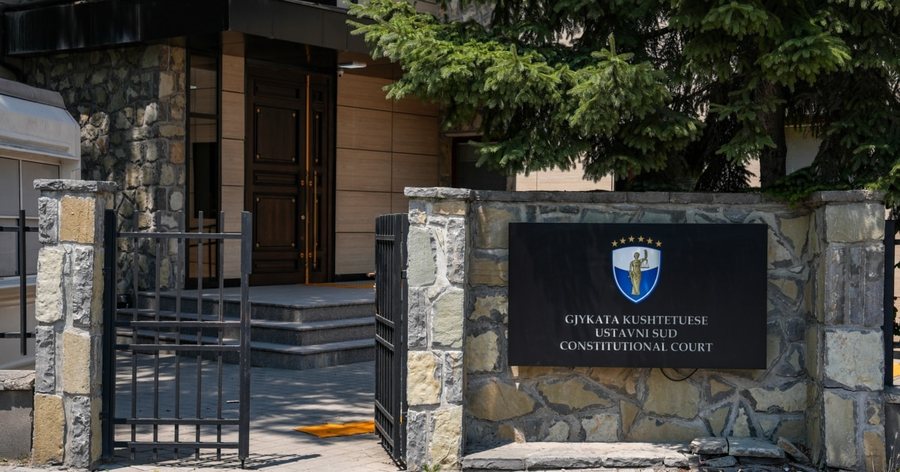
The Constitutional Court of Kosovo published on Wednesday the full verdict regarding the appeal submitted by the Serbian List, the largest Serb party in Kosovo, regarding the constitution of the Assembly.
The court announced in a decision published days ago that the Assembly has not been constituted and gave the deputies 12 days to finalize the process, from the day of the full publication of the decision on its website. The full decision was published on October 8.
The Kosovo Assembly told Radio Free Europe that the verdict obliges the parties to schedule a hearing within 48 hours.
"The Court recalls that from the constitutional provisions, the Rules of Procedure of the Assembly and the judicial practice of the Court, there is no obligation for the deputies to vote in groups for the deputy speakers of the Assembly, whether those proposed by the 3 (three) largest parliamentary groups or communities that are not in the majority. In this context, since voting in groups is not expressly defined in the Constitution, the same can be realized if there is an agreement between the parliamentary groups or deputies ," it is stated in the full decision.
The Court stated, among other things, that "based on the parliamentary practice for the election of deputy speakers from among the members of the communities that are not in the majority since 2011, the deputy speakers from among the members of the communities that are not in the majority have been voted and elected in packages. Therefore, the Court assesses that such a voting procedure remains at the discretion of the members of the parliament and parliamentary groups, provided that the election of the members of the Presidency of the Assembly is carried out."
The Serbian List had complained precisely about this point of the procedure, assessing that the failure to vote in a package for two vice-presidents from minorities constituted a violation.
Emilija Rexhepi has been elected Deputy Speaker of the Assembly from the non-Serb minority, while no Serb MP has secured the necessary votes for the position reserved for this minority, despite several rounds of voting and changes in the names of the candidates.
After receiving the complaint, the Constitutional Court imposed a temporary measure, which prohibited the deputies from taking action towards the formation of the new Government, as there were suspicions of a constitutional violation.
She has made it clear that the Assembly is not considered constituted without the Serbian Deputy Speaker being elected.
"If the Assembly fails to elect the Deputy Speaker from among the deputies of the Serbian community, its Presidency would be incomplete and unconstitutional. In this context, the election of the Deputy Speaker of the Assembly from the Serbian community as a necessary member of the Presidency of the Assembly is a prerequisite for the constitution of the Assembly," the Constitutional Court's decision states, among other things.
In the full judgment, the Court stated that based on the Constitution and the Rules of Procedure of the Assembly, the Deputy Speaker of the Assembly from the Serbian community is elected by a majority of votes of all deputies of the Assembly, namely 61 votes in favor, and the proposal is made in writing by the majority of deputies from the Serbian community.
"From the above, the Court underlines that the proposal for the Deputy Speaker of the Assembly from among the deputies of communities that are not in the majority, in this specific case, the Serbian community, must be made by the majority or the largest number of deputies from among the deputies of the Serbian community ," the decision further states.
In the composition of the Assembly, the Serbian List has nine seats that are reserved for the Serbian community and another was won by Nenad Rašić from the Serbian party For Freedom, Justice and Survival, who is also a serving minister in Albin Kurti's Government.
"The representation of communities that are not in the majority in the structure of the Presidency of the Assembly is a constitutional guarantee, so that communities that are not in the majority, respectively, the Serbian community and other communities that are not in the majority, are included in the full functioning of the Presidency of the Assembly, enabling them to participate in the decision-making of the Presidency of the Assembly, in the manner specified in the Rules of Procedure of the Assembly ," the Court said, among other things, in the reasoning of the decision taken.
Despite months having passed since the parliamentary elections, Kosovo still lacks new institutions. The largest Albanian parties have not reached an agreement to move the process forward, and as a result, the Constitutional Court has been forced to issue several rulings.
In the parliamentary elections, the Vetëvendosje Movement came first and won 48 seats in the Assembly. The Democratic Party of Kosovo came second with 24 seats, the Democratic League of Kosovo third with 20, followed by the Serbian List with nine and the coalition between the Alliance for the Future of Kosovo and the Social Democratic Initiative, with eight.
The other seats are reserved for minorities. The international community has repeatedly called for Kosovo to form new institutions as soon as possible./ REL







Lini një Përgjigje