


 Shkruar nga Pamfleti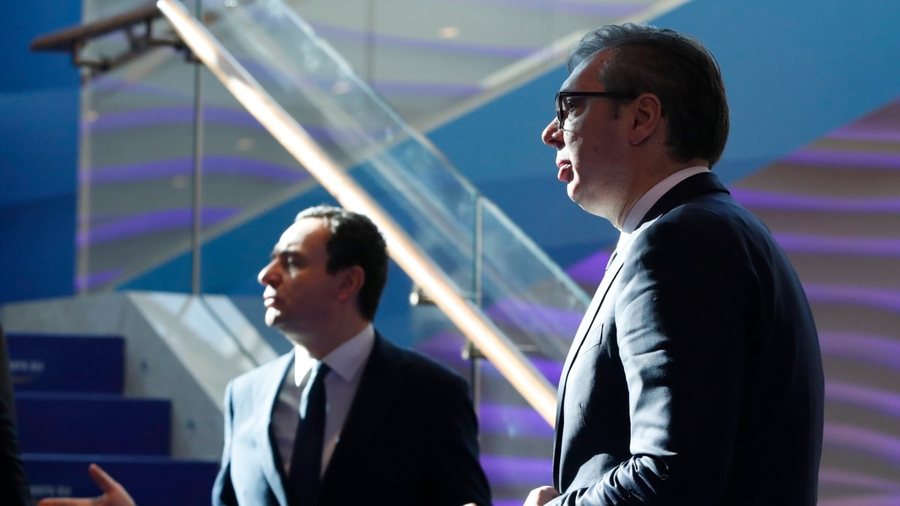
It was April 2013 when the European Union announced that Kosovo and Serbia had reached a "historic agreement" for the normalization of relations.
The agreement - the first of its kind between them since the end of the war in 1999 - was signed by the then prime ministers of the two countries, Hashim Thaçi and Ivica Dacık.
"This is a step away from the past for both of them and a step closer to Europe," said then-EU foreign policy chief Catherine Ashton, who mediated the talks between them.
From that time, Serbia only opened a few chapters of negotiations for admission to the EU, while Kosovo only applied for membership in this bloc.
Many points of the agreement were not implemented and tensions continued. In some cases, they culminated in protests and barricades in the north of Kosovo, where the majority population is Serbian and, influenced by Serbia, opposes the authority of Kosovo.
Ten years after the first agreement, in 2023, the two countries agreed on another one - also for the normalization of relations. Even then it was considered an important achievement by the European Union.
Referring to the prime minister of Kosovo, Albin Kurti, and the president of Serbia, Aleksandar Vucia, the head of the EU's foreign policy, Josep Borrell, said that they have agreed to implement all the articles of the agreement and the relevant obligations.
More than a year later, almost all of these articles remain only on paper. Tensions again culminated in violent protests in the north, and even armed incidents.
For Kurti, Vuçiqi is to blame, for Vuçiçi it is Kurti. For Kurt, Serbia is a danger for Kosovo. For Vucic, Kurt's Government is a danger for Kosovo Serbs.
At a summit last week, in honor of the 25th anniversary of the liberation of Kosovo, Kurti said that his government has no problem with the country's Serbs.
"We have a problem with Belgrade, which did not distance itself from either the Milosevic of the past or the Putin of the present," Kurti said, referring to the former Yugoslav president and the current Russian president.
Just three days before the event where Kurti spoke, the Government of Serbia and that of Republika Srpska in Bosnia and Herzegovina approved a joint statement , which, among other things, treats Kosovo as "an inalienable part of Serbia". Serbia continues to have such wording in the Constitution, despite the fact that Kosovo has been an independent state since 2008.
Radio Free Europe addressed both the Government of Kosovo and the Office for Kosovo in the Government of Serbia to ask them what or who the stable peace between the two countries depends on, but none of the institutions responded.
Aidan Hehir, from the University of Westminster in London, says the problem lies with Serbia. Speaking on Radio Free Europe's Expose program, he says that this country has been led for years by hard-line nationalists who were part of Slobodan Milosevic's regime in the 90s and do not want peace - they support, according to him , the idea of creating a 'Greater Serbia'.
"It is impossible for Kosovo to make an agreement with a country that does not accept its right to exist, that continues to interfere in its internal affairs and that incites violent unrest within its territory. So, the fault lies with Serbia, not with Kosovo. Kosovo is an independent state. It does not threaten anyone, it will not invade anyone and it will not take anyone's land", says Hehir.
Dimitar Bechev, from the University of Oxford, agrees that Vučić is not willing to take things forward, but says that Kurti also shares part of the responsibility.
His Government's decisions to install Albanian mayors in municipalities with a Serbian majority in the north, or to stop the use of the Serbian dinar in Kosovo, do not contribute to solving the problem, says Bechev.
"And, I don't think there is time pressure for a solution. Because, as long as there are tensions, Vucic has good stories to tell his constituents... that he is standing up for the Serbs, that he is protecting the interests of Serbia, etc. Similarly, Albin Kurti also plays with his constituents, which include many nationalists", says Bechev for Expose.
This status quo, according to him, can continue for an indefinite period of time, and he puts part of the responsibility on the EU for, as he says, "abstract offers" for the integration of the two countries into its ranks.
He adds that the EU should use the "carrot and stick" strategy with them - offer them one thing, in exchange for one thing.
The EU has made it clear to both Kosovo and Serbia that their integration into the European family will depend on the normalization of relations with each other. It constantly sends messages to the parties to implement the agreements reached.
But, Bechev expects that the EU's attention now, when it is in the process of electing its new leaders, will not be on either Kosovo or Serbia. Moreover, he says that the dynamics could change completely if Donald Trump is elected in the presidential elections in the USA, who in his first term has leaned towards the fastest and sharpest solutions.
"If Trump wins the election, politics can shift to finding a solution with the separation [of Kosovo]. Even these developments would then prolong the problem", says Bechev.
The division or correction of the borders was mentioned as an option in 2018 even by the then leaders of Kosovo and Serbia, Hashim Thaçi and Aleksandar Vučič, but the idea has been silenced, after the opposition it encountered in both countries.
Hehir, from the University of Westminster, says that if there is ever to be lasting peace in the Balkans, it must come from governments that accept that the current borders cannot be changed.
Hehir says that the West should treat Kosovo and Serbia as equal states and if it wants a solution between them, it should focus the pressure on Serbia, which, with the support of Russia, has more leverage in its hands to manipulate.
"Serbia is surrounded by the European Union and NATO, so it is very sensitive to Western sanctions. The West can take a tougher stance towards Serbia and ask it not necessarily to recognize Kosovo, but at least stop interfering in its internal affairs and allow its membership in international organizations. So the West can do this," says Hehir.
Citizens who, according to Bechev, "are always hostage to such pending situations, or become a soccer ball between two governments", are reserved optimists for lasting peace with the other's country.
"I, personally, believe that yes [there can be peace] but it will take a longer time. As a young generation, even though I did not experience the war, I grew up with the spirit of hatred towards Serbia, and I believe that it takes time", says Gentiana Fejza, in her early 20s.
Her fellow citizen from Prishtina, Orhan Avdiu, says that "with this regime in Serbia, peace cannot be achieved".
"It is a political class from the time of Milosevic. His people are in power and there can be no agreement between Kosovo and Serbia", he says for Radio Free Europe.
"Time must pass. Serbia has a very deconstructive approach and it will take a very long time", says Majlinda Ferati.
In Belgrade, a citizen who wanted to be identified only by her name Jellena, says that she does not believe in lasting peace between Kosovo and Serbia.
"The conflict has a long history. There are also many people who are nationalists. Nationalism here is more powerful than anything", according to her.
"It is a difficult question. Many people have been killed and now the families find it difficult to reach out. You have to look at the positive things, but politics poisons everything, on all sides", says Ivo Beserovac.
Stefan Vukashinovic thinks that "it depends on the generations".
"The younger they are, the more present they are on the Internet, they see that peace can be achieved," he says.
It is not known when the leaders of Kosovo and Serbia will be able to see each other again at the negotiating table - at least to try to achieve peace.
Chances are slim during the summer months, until successors to the current mediators are chosen.
The US and Germany reiterate that the two countries must move towards mutual recognition.
In the words of the American ambassador in Pristina, Jeffrey Hovenier - "nothing less fulfills the vision of a complete, free, prosperous and peaceful Europe"./ REL



Lini një Përgjigje