


 Shkruar nga Pamfleti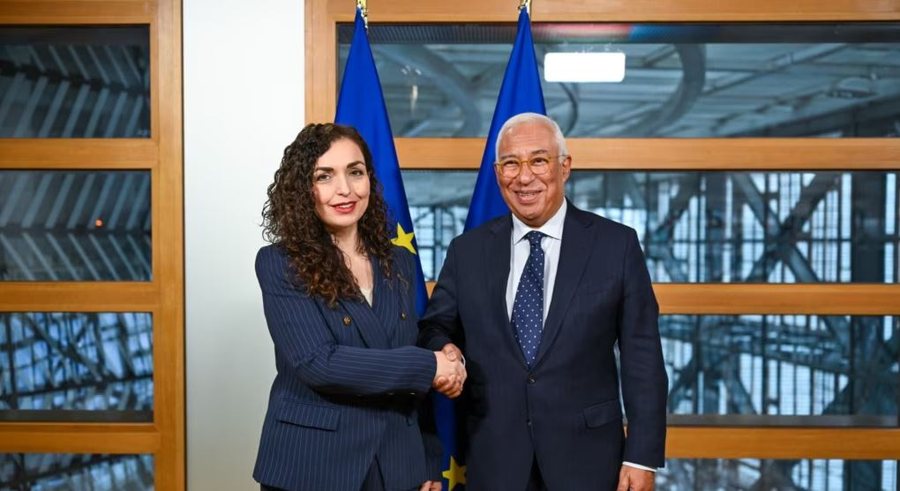
The President of Kosovo, Vjosa Osmani, said that she hopes that the punitive measures that the European Union imposed on Kosovo in 2023 will soon be completely lifted.
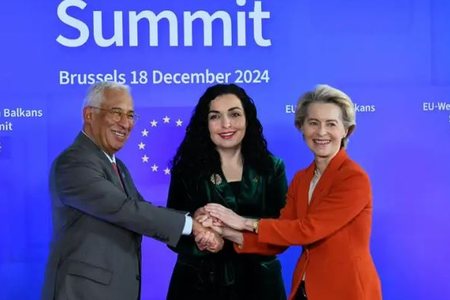
She made these statements during a meeting with the President of the EU Council, Antonio Costa, in Brussels, on the eve of the EU-Western Balkans summit.
A day ago, Kosovo's Deputy Prime Minister, Besnik Bislimi, said that he had been notified by the European Commission that this institution "has decided to lift most of the measures against Kosovo."
According to Bislim, these are projects related to IPA programs, worth 34.6 million euros.
"We welcome the EU's decision to partially lift the measures, while we hope and work to have them lifted in full as soon as possible. The Republic of Kosovo has demonstrated constructiveness, cooperation and full compliance with the European Union's foreign and security policy," Osmani wrote on Facebook.
According to the President of Kosovo, the country has met all the conditions set by the European bloc, therefore "there is no reason to hinder or delay the lifting of the remaining measures."
The EU imposed punitive measures against Kosovo in the summer of 2023, as a result of tensions in the Serb-majority north.
The European bloc has begun phasing them out, but officials in Kosovo insist that their continuation is an unfair decision and the conditions have been met, and Osmani has repeatedly called for their removal.
The situation in the north has been de-escalated, the police presence near municipal buildings in the north has been reduced, and the peaceful transfer of power in Serb-majority municipalities has been achieved.
Rikard Jozwiak, Europe editor of Radio Free Europe (RFE/RL), in Prague, has learned from his sources that the issue of not lifting all measures against Kosovo was discussed in Brussels last week and that France and Italy are supportive of the idea of lifting only 50 percent of them.
Osmani is staying in Brussels where he is participating in the summit between EU leaders and the six Western Balkan countries.
The draft summit declaration, seen by Radio Free Europe, which will then be approved by EU leaders, asserts that “the future of the Western Balkans lies in our bloc. Enlargement is a real opportunity that must be seized.”
Of the Western Balkan countries, Albania and Montenegro have made the most progress on their European path, while Kosovo remains the only country that does not yet have candidate country status.
Kosovo submitted its application for EU membership in December 2022. However, this application has not yet even passed the first formal phase, that of review by the EU Council and then sending it for opinion to the European Commission.
The draft summit declaration also mentions the dialogue between Kosovo and Serbia.
It states that "the lack of normalization of relations between Pristina and Belgrade is keeping both countries blocked on the European path."
"All agreements reached in the EU-facilitated dialogue must be implemented, in particular the Agreement on the Pathway to Normalization and its Annex. Support under the Western Balkans Reform and Growth is conditional on the constructive engagement of the partners and measurable progress and concrete results in the normalization of their relations," the document states.
Since September 2023, a few days before the armed attack in Banjska, no high-level round has been held in Brussels. The agreement mentioned in the draft declaration was reached in 2023, although the parties have not signed it. The EU considers the agreement to be binding on Belgrade and Pristina and has consistently demanded its implementation and the annex.
This agreement, with 11 articles, among other things, provides for a level of self-management for the Serbian community in Kosovo, mutual recognition of state symbols, so that Serbia does not block Kosovo's membership in international organizations, and requires Pristina and Belgrade to also implement all previous agreements reached during the dialogue. /REL



Lini një Përgjigje